

In this guide 19 sections
- How to use this equipment list
- 1. Housing and structures
- 2. Cages and housing systems
- 3. Feeding equipment
- 4. Drinking equipment
- 5. Brooding and heating equipment
- 6. Ventilation and cooling equipment
- 7. Lighting equipment
- 8. Egg collection and handling equipment
- 9. Manure handling equipment
- 10. Hygiene and biosecurity equipment
- 11. Farm tools and monitoring equipment
- 12. Transport equipment
- Equipment checklists by farm type
- Manual, semi-automatic and fully automatic: which level fits you
- How to judge a poultry equipment manufacturer
- Equipment maintenance calendar
- Common poultry equipment buying mistakes
- Next steps
Poultry farming equipment covers twelve groups: the house, cages, feeders, drinkers, brooders, fans and cooling, lighting, egg collection, manure handling, hygiene tools, farm tools and transport crates. What you buy depends on the bird (broiler, layer or breeder), the house (open or environment-controlled) and how much you want to automate.
This guide lists every item a commercial farm in India needs, what to check before you pay for it, and how many you need per 1,000 birds where a breed guide, university or Vijay Raj figure gives a number. Use the four checklists in the middle of the guide as your shopping list, and the maintenance calendar at the end to keep it all working.
How to Use This Equipment List
Start with three decisions, because they decide almost everything else on the list. First, which bird: broilers for meat, commercial layers for table eggs, or breeders for hatching eggs. Second, which house: an open-sided house with curtains, or an environment-controlled (EC) house with tunnel fans and cooling pads. Third, how much automation you can afford and maintain.
Once those are fixed, work through the equipment groups below in order. Each group explains what the equipment does, the main types, what to check when buying, and which birds and houses it suits. Quantities are given only where a published source or Vijay Raj’s own brochure gives a figure. Where no reliable figure exists, you get a method to work it out for your own flock.
Tip: Size your house and equipment together, not one after the other. The Vijay Raj poultry house calculator takes your bird type, flock size and cage system and gives house dimensions and a first bill of quantities for cages, feeding, drinking, egg collection and fans.
1. Housing and Structures
The house is the largest single item in most project budgets and the one you cannot easily change later. Every other piece of equipment is sized to fit inside it, so its width, height and ventilation plan need to be settled before you order cages or feed lines.
What It Does
The poultry house protects birds from sun, rain, wind and predators, and gives you a controlled space for feeding, drinking and collecting eggs. In an open house the building also does much of the ventilation work through its orientation, side curtains and roof. In an EC house the building is sealed and fans do the work.
Types
- Open-sided house: side walls kept low with curtains or mesh above, roof overhangs to keep rain out. The common choice for broilers on deep litter and for California and Comfort layer cages in tropical India.
- Environment-controlled (EC) house: closed side walls, insulated roof, tunnel fans at one end and cooling pads at the other. Needed for multi-tier battery cages and for high-density broiler houses.
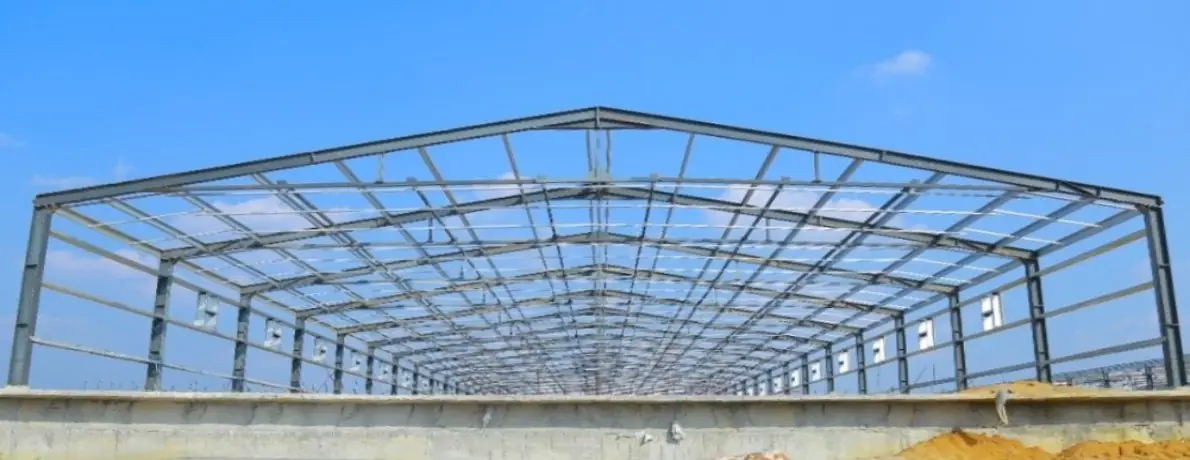
- Pre-engineered building (PEB): a steel frame designed and fabricated in a factory and bolted together on site. It can be built as either an open house with curtains or an EC house.
- Support buildings: feed store, egg room, workers’ rooms, generator and pump room. Many farms put these in a separate warehouse or a lean-to on the main shed.
What to Check When Buying
For an open house, width is the first thing to check. The TNAU Agritech poultry house construction guide recommends that open houses in tropical countries be no wider than 22 to 25 ft, with ridge ventilation along the roof if you go wider. It gives an eaves height of 6 to 7 ft, a centre height of 10 to 12 ft, a roof overhang of at least 3.5 ft and a foot bath at the entry. EC houses can be 40 ft wide or more because fans move the air.
For cage houses, the roof height is set by the cage. A Vijay Raj Automax layer cage stands about 279 cm tall at 4 tiers and about 507 cm at 8 tiers on a single deck, according to the Vijay Raj catalogue drawing, and you need working clearance above that. Check the clear height of the shed against the overall height of the cage you want before the steel is fabricated.
For a steel shed, ask for the design loads (wind, earthquake, rain), the steel grade, the coating system and the delivery time in writing. Vijay Raj states that its PEB poultry houses are designed for wind, seismic, rain and collateral loads, are about 30 percent lighter than conventional sheds, and have an average order-to-delivery time of 6 to 8 weeks. Its brochure lists clear-span frames up to 30 m wide and multi-span frames for wider buildings. Our guide to PEB poultry shed frame types and spans explains the options.
Which Birds and Houses It Suits
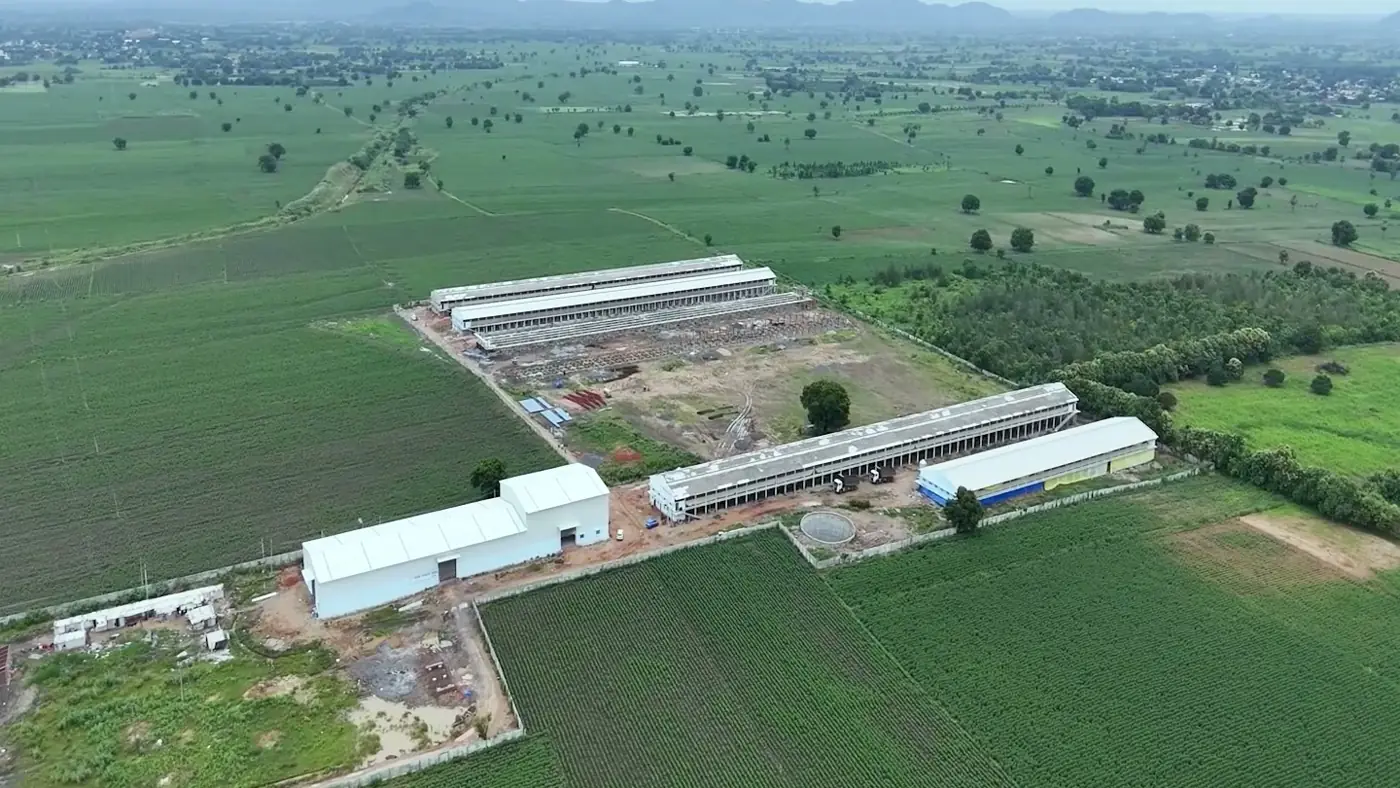
Open houses suit broilers and layers in most of India when the site has good natural airflow. Vijay Raj brochure planning limits are about 33,000 layers or 25,000 broilers in one open house; above that, an EC house is the safer choice. Breeder farms can use either, but multi-tier breeder cages need an EC house.
Floor area follows the bird and the system. TNAU gives 1 sq ft per broiler and 2 sq ft per layer on deep litter, so a 1,000-bird broiler house needs about 1,000 sq ft (93 sq m) of floor before walkways and stores. Cage houses need far less floor per bird because the birds are stacked, which is why the cage choice comes before the house drawing.
2. Cages and Housing Systems
Cages decide how many birds fit in the house, how feed and water reach them and how eggs and manure leave. For layers and breeders they are the core of the project. For broilers they are an alternative to deep litter.
What They Do
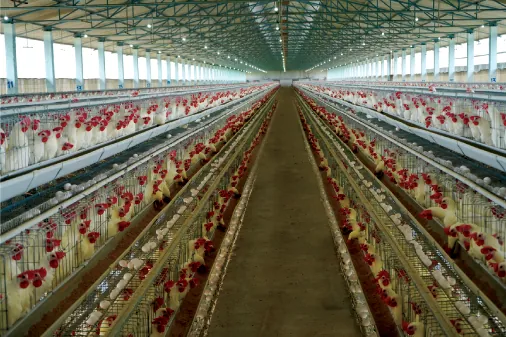
A cage system holds birds in wire boxes arranged in rows and tiers, with a feed trough along the front, nipple drinkers inside, a sloped floor that rolls eggs forward, and either open space or a belt below for manure. Birds stay off their droppings, eggs stay clean and one worker can look after many more birds.
Types
- California (A-type, stepped) cages: 2 or 3 tiers set in steps so droppings fall to the floor and air moves freely. Vijay Raj describes the California system as its most economical option for open houses, needing no automatic manure remover.
- Comfort cages: Vijay Raj’s Comfort+ system, introduced as the Comfort cage in 2001, is a stepped cage on a tubular galvanised steel frame, built for hot and humid open houses, in 2 or 3 tiers.
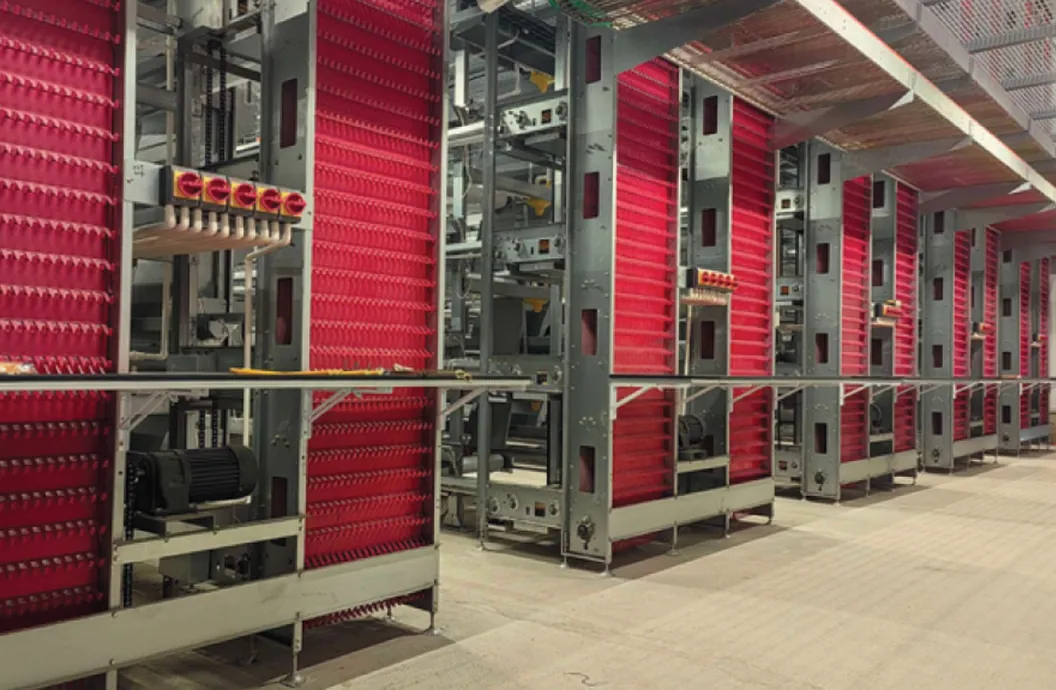
- H-type battery cages: tiers stacked vertically in an H-frame with manure belts under each tier, for EC houses. Vijay Raj’s Automax layer cage goes from 4 to 12 tiers.
- Rearing and chick cum grower cages: for pullets from day old to transfer. Vijay Raj rearing cages cover day one to week 14 for layers, and the Automax breeder pullet system covers broiler breeder chicks to week 16 to 18.
- Breeder cages: separate male and female boxes with stepping rails for artificial insemination (AI). See breeder cages and nesting.
- Broiler cages: the Automax broiler cage comes as BS60 and BS72 (60 cm and 72 cm between tiers) in 3 to 6 tiers, with pans, nipple lines and automated harvesting.
What to Check When Buying
Legal space per bird. The Prevention of Cruelty to Animals (Egg Laying Hens) Rules, 2023 set a minimum floor space of 550 sq cm per laying hen in colony enclosures (the rules’ term for battery cages), preferably with 6 to 8 birds per enclosure, and apply to layer pullets too. Existing farms must comply by 1 January 2029. Work out the area of any box you are offered: front width multiplied by depth, divided by the number of birds. 550 sq cm is about 85 sq in. A box 50 cm wide and 45 cm deep (2,250 sq cm) holds 4 hens at that minimum, not 5.
Wire and coating. Wire rusts first where droppings and water touch it, so ask for the zinc coating weight. Vijay Raj specifies 275 GSM galvanised or Bezinal wire on its California, Comfort+ and Automax cages. GSM means grams of zinc per square metre of surface: a higher figure means a thicker coat and a longer life in a humid house. Ask for the coating figure in the quotation, not just “galvanised”.
Frame. Check the frame material and how parts join. Vijay Raj California and Comfort+ cages use tubular galvanised steel (GI) frames; Automax cages use a profile in graded, corrosion-resistant alloy steel, assembled by insertion.
Egg roll and trough. The floor slope must roll eggs to the front gently. Ask how the manufacturer sets the angle and what breakage you should expect. Check that the trough doubles as a step so workers can reach the top tier, a feature on Vijay Raj stepped and Automax cages.
Height and tier count. Compare the cage’s overall height with your roof. For broiler cages, the Vijay Raj drawings give about 205 cm for a 3-tier BS60 and 241 cm for a 3-tier BS72, rising by 60 cm or 72 cm for each extra tier.
Which Birds and Houses They Suit
California and Comfort cages suit layers, pullets and breeders in open houses. H-type battery cages suit large layer, pullet, breeder and broiler flocks in EC houses where land is costly or scarce. Our guide to poultry cage systems and how to choose compares them in detail.
3. Feeding Equipment
Feed is the biggest running cost on any poultry farm, so feeding equipment is judged on two things: does every bird get its share, and how much feed ends up on the floor.
What It Does
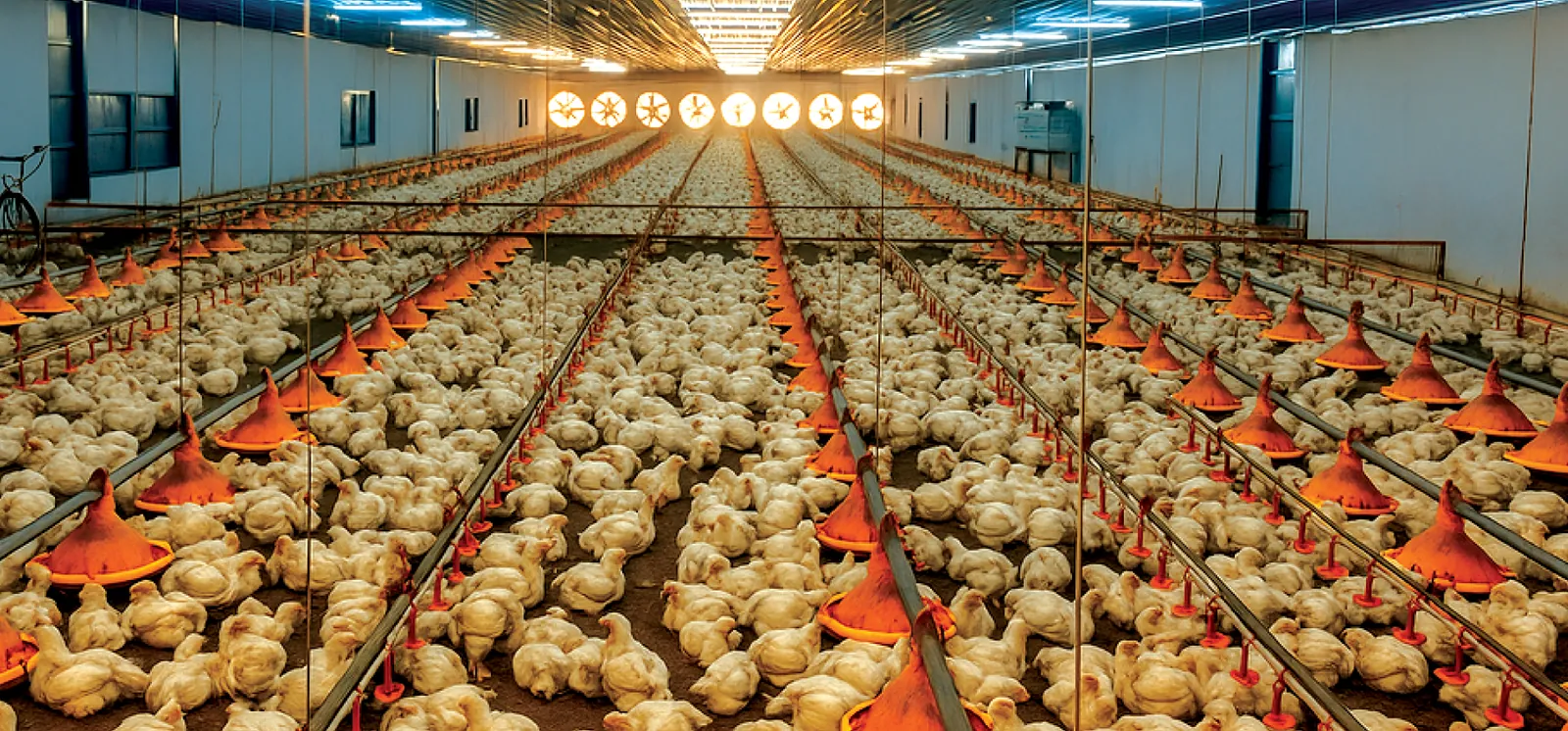
Feeders hold feed within reach of the birds and, in automatic systems, move it from a bin or hopper along the house. Good feeders let the whole flock eat at once without crowding, keep feed clean and dry, and can be raised as birds grow.
Types
- Chick feeders and plate feeders: shallow trays for the first days of brooding.
- Hanging (tube or circular) feeders: a cone that feeds a pan by gravity. TNAU notes they hold 5 to 7 kg of feed and fit about 30 percent more birds than a linear feeder.
- Linear (trough) feeders: galvanised troughs birds use from both sides, for floor houses, and the standard front trough on cages.
- Automatic pan feeding lines: an auger carries feed through a pipe and drops it into pans hung along the house. See Vijay Raj automatic pan feeding.
- Chain feeders: a chain drags feed along a trough on the floor.
- Feed trolleys: for cage houses, a trolley runs along the cage row and fills every trough evenly. Vijay Raj’s feed trolley comes in manual and automatic versions with an output funnel for each trough.
- Bulk feed bins or silos and hoppers: store feed outside the house and feed the lines.
How Many You Need
For pan lines, the Cobb Broiler Management Guide (2018) recommends 50 to 70 birds per 33 cm pan, which works out to about 15 to 20 pans per 1,000 broilers. Vijay Raj’s standard pan serves 40 birds (25 pans per 1,000), and it also makes 45, 60 and 100-bird pans. For chain feeders, Cobb gives 2.5 to 4 cm of feed space per bird, so 25 to 40 m of track per 1,000 broilers.
For layers in cages, the Hy-Line Brown management guide gives 7 to 12 cm of feeder space per bird in lay, which means 70 to 120 m of trough per 1,000 hens. For hanging feeders on litter, TNAU gives a formula: number of feeders = 1.3 x (circumference of the feeder pan in cm divided by feeder space per bird in cm). Use the feeder space your breed guide gives for the age of the birds.
What to Check When Buying
- Pan capacity (birds per pan) and whether the pan design lets day-old chicks reach feed. The Vijay Raj pan lets 18 to 20 growing birds, or 12 to 14 grown broilers, feed at the same time.
- How the line is raised: a winch that lifts the whole line saves labour and avoids handling birds.
- Whether you can shut off feed to a single pan, and how leftover feed is cleared at the end of a flock.
- Auger and motor quality, the availability of spare augers, and who services the drive.
- For trolleys: even discharge to every trough, and whether the trolley is sized for your row length and tier count.
- Galvanising on troughs and hoppers. Vijay Raj’s California breeder feed hoppers are highly galvanised.
Which Birds and Houses It Suits
Manual hanging feeders suit small and medium deep litter broiler and breeder farms. Vijay Raj recommends its automatic pan feeding for broiler farms of 3,000 birds and more, in open or EC houses. Feed trolleys suit cage layer and breeder houses. Our full guide to automatic poultry feeding systems covers augers, pans, chains and trolleys in depth.
4. Drinking Equipment
Birds drink more water than they eat feed, and a drop in water intake is often the first sign of trouble. Drinkers need to deliver enough clean water at the right height without wetting litter or cages.
Types
- Manual (fountain or jar) drinkers: for chicks in the first week, and easy to use for vitamins and vaccines in water.
- Bell drinkers: hang from a water line and keep a set water level automatically. Vijay Raj makes Universal and Deluxe versions.
- Nipple drinkers: a closed pipe with a valve pin the bird pushes. Used in cages and, with drip cups, on litter. See Vijay Raj nipple drinkers.
- Channel drinkers: an older open trough along cage fronts, now largely replaced by nipples.
- Water system parts: header tank, filter, medicator or doser, pressure regulator for each line, and flush valves.
How Many You Need
For broilers on nipples, Cobb recommends 12 birds per nipple on high-flow nipples (80 to 90 ml per minute) and 10 birds per nipple on low-flow nipples (50 to 60 ml per minute). That is 84 to 100 nipples per 1,000 broilers. Cobb also says birds should not have to walk more than 3 m to water, with nipples at no more than 35 cm centres.
During brooding, Cobb recommends 14 to 16 drinkers per 1,000 chicks in the brooding area, of which 8 to 10 can be bell drinkers, plus 6 to 8 supplementary mini drinkers per 1,000 chicks. For bell drinkers in grow-out, Cobb gives at least 0.6 cm of drinking space per bird, so 600 cm of drinker rim per 1,000 birds. Divide 600 by the rim circumference of the bell you are buying to get the number of bells.
For layers in cages, Hy-Line recommends one nipple per 12 birds, or access to two drinkers, and nipples that deliver at least 60 ml per minute. That is at least 84 nipples per 1,000 hens. For breeders, the Ross Parent Stock pocket guide (2024) gives 6 to 10 birds per nipple from 20 weeks, or 100 to 167 nipples per 1,000 birds.
What to Check When Buying
- Pin and body material. Vijay Raj nipples use specially alloyed stainless steel pins in graded plastic bodies.
- The right nipple for the bird. Vijay Raj makes chick (low pressure), layer, breeder (jumbo) and all-direction broiler models, each in single lock or twin lock, with 180 or 360 degree pins.
- Leak prevention. A leaking nipple wets litter or manure, which feeds bacteria, fungus and ammonia.
- Flow rate at your line pressure, and a regulator for every line so the far end gets the same flow as the near end.
- Rearing and laying nipples of the same type. Hy-Line advises using the same nipple type in the rearing and laying house so pullets drink straight away after transfer.
- A filter at the house entry and a medicator so you can dose vaccines and vitamins through the line.
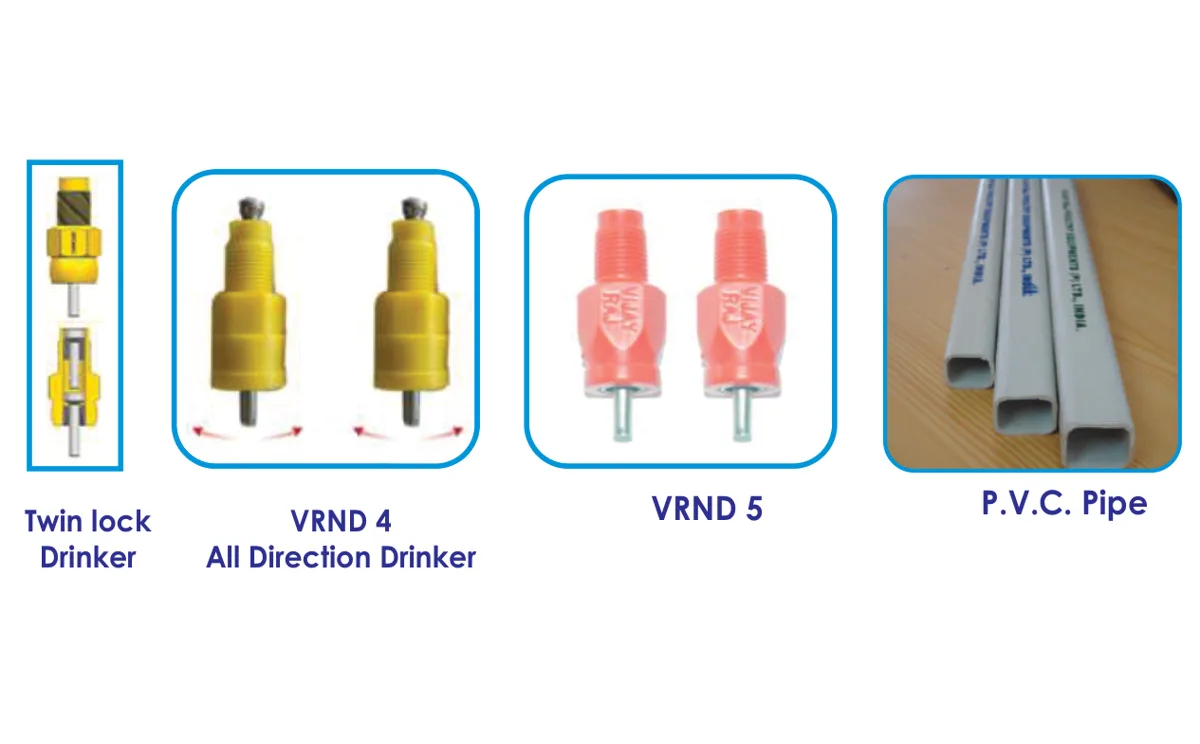
Our guide to choosing poultry nipple drinkers covers flow rates, pressure and line layout in more detail.
5. Brooding and Heating Equipment
Day-old chicks cannot hold their own body temperature, so the first two to three weeks decide uniformity, early mortality and how well the flock performs later. Brooding equipment gives chicks a warm zone they can move into and out of.
Types
- Gas brooders: infrared canopy heaters run on LPG. TNAU notes they are hung 3 to 5 ft above the chicks. Vijay Raj’s gas brooder uses a heat-resistant stainless steel perforated bulb and an integrated stainless steel filter.
- Electric brooders: thermostatically controlled hovers. Vijay Raj’s Electric Brooder 1000 warms 1,000 day-old chicks over about 200 sq ft, draws 2 kW and has an automatic cut-off.
- Infrared bulbs: TNAU gives 150 W and 250 W bulbs for about 150 and 250 chicks respectively. Useful for small batches or as backup.
- Space heaters: heat the whole house rather than a spot. Vijay Raj’s LPG Space Heater 5000 is direct-fired, hangs from the roof and runs on LPG or natural gas.
- Brooder guards (chick guards): a ring that keeps chicks near the heat. TNAU describes a ring about 5 ft across and 1 to 1.5 ft high, made of GI sheet, hardboard, wire mesh or mat depending on season.
- Charcoal or kerosene stoves: still used where power is unreliable, but harder to control.
How Many You Need
With the Vijay Raj Electric Brooder 1000, plan one brooder per 1,000 chicks; the Vijay Raj house calculator uses the same rule. Other electric brooders are smaller: TNAU cites 300 to 400 chicks for a typical unit, so always size by the rated chick capacity of the model you buy, not by the number of brooders. TNAU notes that brooding lasts about 5 to 6 days in summer and 2 to 3 weeks in winter.
What to Check When Buying
- Rated chick capacity and the floor area covered, from the manufacturer in writing.
- Thermostat or automatic cut-off, and how the height is adjusted.
- Gas safety: regulator, hose quality, filter and a flame failure device where available.
- Running cost in your area: compare LPG price per cylinder against your power tariff and hours of supply.
- A thermometer at chick height in every brooding ring. The heater’s own setting is not the temperature the chick feels.
Which Birds and Houses It Suits
Every floor-brooded flock needs brooders: broilers on litter, breeder chicks on litter and pullets reared on the floor. Chicks placed in rearing cages or in Automax broiler cages are brooded in the cage, usually with house heating. Hilly and cold regions add space heaters for the whole house.
6. Ventilation and Cooling Equipment
Heat stress is the biggest climate risk for Indian poultry farms. Ventilation removes heat, moisture, ammonia and dust; cooling lowers the air temperature when ventilation alone is not enough.
Types
- Side curtains: the main ventilation control in an open house, raised and lowered with weather and bird age.
- Exhaust box fans: Vijay Raj box fans come in 24, 36, 48 and 50 inch sizes moving about 10,000 to 28,000 CFM.
- Exhaust cone fans: the cone improves efficiency for tunnel ventilation. Vijay Raj cone fans run from 36 to 57 inch, with the 57 inch fan rated at about 55,000 CFM. See exhaust box and cone fans.
- Evaporative cooling pads: wet cellulose pads at the air inlet end. Vijay Raj cooling pads use a cross-fluted structure in 60/45 and 30/15 degree versions.
- High-pressure fogging: Vijay Raj’s fogging system produces 10 to 12 micron droplets that evaporate before reaching birds, lowering house temperature by 3 to 8 degrees C depending on humidity.
- Sprinklers: Vijay Raj’s sprinkler cooling produces 50 to 100 micron mist for 5 to 10 degrees C of cooling. TNAU notes that in hot and humid conditions sprinklers are best used to cool the roof in the afternoon.
- Controller: a panel that runs fans, inlets, pads, heaters and lights from temperature and humidity sensors. Vijay Raj EC houses use a touch-screen control panel.
How Many Fans and How Much Pad
Fans for a tunnel-ventilated house are sized by air speed through the house, not by guesswork. Cobb’s method: multiply the house cross-section (width x average height) by the target air speed, then divide by the working capacity of one fan. Cobb’s worked example uses 3.0 m per second (600 ft per minute) for broilers, and says to use each fan’s capacity at a static pressure of at least 25 Pa, not the free-air figure.
A worked example: a house 12.2 m wide with a 3 m average inside height has a cross-section of about 36.6 sq m. At 3 m per second that needs about 110 cubic metres per second, or about 2,33,000 CFM. Using the 55,000 CFM rating of a Vijay Raj 57 inch cone fan, that is 4.2 fans, so 5 fans, and more if the rating at working pressure is lower. Ask your supplier for the fan curve.
Cooling pad area follows from the fans. Cobb gives an air speed through 15 cm (6 inch) pads of 1.78 m per second (350 ft per minute). Divide total fan capacity by 350: five fans of 55,000 CFM (2,75,000 CFM) need about 786 sq ft (73 sq m) of 15 cm pad. The Vijay Raj calculator uses the same pad air speed.
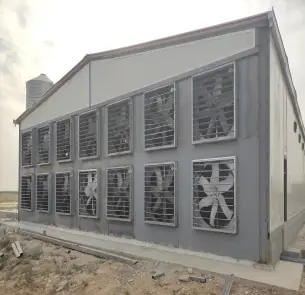
What to Check When Buying
- Fan airflow at working static pressure, not only at zero pressure, and power drawn at that point.
- Housing and blade material. Vijay Raj fans use galvanised housings and stainless steel blades, in direct or belt drive.
- Belt tensioners, shutters that close tightly when the fan is off, and guards on both sides.
- Pad thickness, flute angle, edge coating against algae and scale, and a water system with a filter and bleed-off.
- For foggers: pump pressure, nozzle droplet size and anti-drip valves so nozzles do not wet litter when the system stops.
- A controller with alarms and a standby generator. In a closed EC house, a summer power cut can cause heavy losses before anyone reaches the farm.
Read our guide to cooling a poultry house with fogging, sprinklers and cooling pads to choose between the three methods for your climate.
7. Lighting Equipment
Light controls how much broilers eat and when layers and breeders start and keep laying. It is cheap equipment with a large effect, and it is often installed badly.
What It Does and What the Guides Ask for
Cobb asks for at least 25 lux at chick height in the darkest part of the house during brooding, with no more than 20 percent difference between the brightest and darkest spots, then a gradual reduction to 5 to 10 lux after 7 days. Hy-Line recommends 30 to 50 lux for layer chicks in the first week. The Ross parent stock guide asks for an even 30 to 60 lux in the breeder house in lay.
Types and Placement
- LED bulbs and tubes: low power and long life; dimmable versions let you follow the lighting programme exactly.
- Tube lights and incandescent bulbs: still common in older houses. TNAU suggests hanging lights 7 to 8 ft above the ground, about 10 ft apart for bulbs and 15 ft apart for tube lights.
- Timers and dimmers: needed for any written lighting programme.
- Light traps: for EC houses where you need true darkness, fitted on fans and inlets.
What to Check When Buying
- A lux meter. Measure at bird height, not at the lamp.
- Waterproof fittings (IP rated) that survive pressure washing.
- In cage houses, light at every tier, including the bottom one, and between cage rows.
8. Egg Collection and Handling Equipment
Eggs lose value every time they are cracked, dirty or left too long in the house. Egg handling equipment moves eggs from the bird to the egg room with as few touches as possible.
Types
- Manual collection from cage fronts: eggs roll to the front lip and workers pick them into trays.
- Egg belts and collection units on stepped cages: Vijay Raj’s egg collection system for California houses gathers eggs along the full length of the farm with a short rolling distance, built in GI and plastic.
- Lifter or Niagara collection on battery cages: used on Vijay Raj Automax layer and breeder cages to bring eggs from every tier down to one level and on to the egg room.
- Nests for breeders: Vijay Raj’s breeder nesting system comes in automatic versions linked to collection belts and manual versions for smaller farms.
- Egg trays and fillers: Vijay Raj plastic egg trays are moulded from 100 percent virgin plastic. Hatcheries also use setter trays; TNAU notes these typically hold 90 or 180 eggs.
- Egg room equipment: grading table, candler, cool storage for hatching eggs, and a tray washer.
How Many You Need
For egg belts, the Vijay Raj calculator counts one belt per female tier on each side of every cage row, and one collection unit per row. For breeder nests, the Ross parent stock guide allows 3.5 to 4 hens per manual nest hole, which is 250 to 286 nest holes per 1,000 females, or 40 hens per linear metre of mechanical (communal) nest, which is 25 m per 1,000 females. For egg trays, divide your peak daily egg count by the tray capacity and add enough for eggs waiting in the store and in transit.
What to Check When Buying
- Egg roll angle and the distance an egg travels before it stops. Short, gentle rolls mean fewer cracks.
- Belt material, belt width and how the belt is cleaned.
- Speed control and soft transfers where eggs move from belt to lifter to cross conveyor.
- For nests: soft, cleanable floor pads, easy access and a way to close nests at night.
- Whether the collection system matches the cage tier count and row length you have ordered.
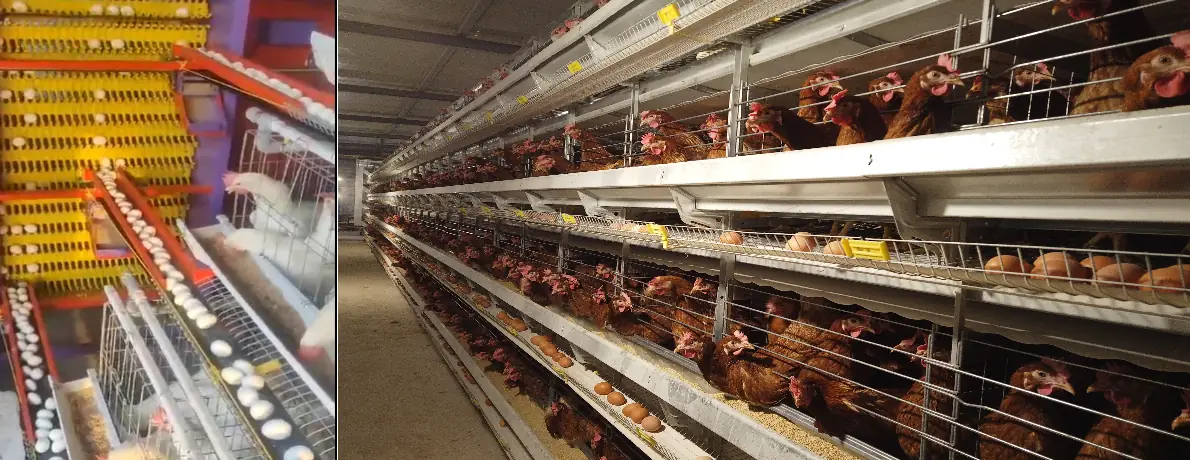
9. Manure Handling Equipment
Manure is the source of ammonia, flies and most neighbour complaints, and the rules around it are getting stricter. How you remove, dry and store it depends on the housing system.
Types
- Deep litter: droppings mix with rice husk, sawdust or wood shavings on the floor and are removed at the end of the flock. Tools: rakes, forks, shovels, wheelbarrows and, on large farms, a small loader.
- Droppings under stepped cages: manure falls to the floor or a raised platform below the cage and is cleared periodically.
- Manure belts: on H-type battery cages, a belt under each tier carries droppings to the end of the row and a cross conveyor takes them out of the house. Vijay Raj Automax cages use belt cleaning with an optional manure drying system.
- Scrapers: pull manure along a pit under cages to one end.
- Composting or biogas units: to process manure on or near the farm.
Rules to Design for
The CPCB Environmental Guidelines for Poultry Farms (2022) apply to farms above 5,000 birds from 1 January 2023, following National Green Tribunal orders. They ask for manure and litter stores at least 2 m above the water table with a stone, concrete or compacted clay base, covered against rain and dust. They also require litter in deep litter houses to be turned at least once in two days, and proper facilities (burial pit, composting or incineration) for dead birds. Composting is listed for small farms, and composting or biogas for medium and large farms.
What to Check When Buying
- Belt material and joint type, drive motor rating and how belt tracking is adjusted.
- Drying: air blown over belts dries manure, reduces ammonia and makes it easier to sell.
- Where the cross conveyor discharges, and whether a truck or trolley can reach that point.
- For deep litter: litter supply for every flock and storage for used litter away from the sheds.
10. Hygiene and Biosecurity Equipment
Disease costs more than any piece of equipment on this list. Biosecurity equipment keeps disease out, and cleaning equipment gets the house back to a clean state between flocks.
What You Need
- Fencing and a single gate, with a vehicle wheel dip or spray at the entry.
- Foot baths at every shed door. TNAU includes a disinfectant foot bath at the entry of every house.
- Change room and boots kept for each shed.
- Knapsack or power sprayer for disinfectants. TNAU recommends a hand-operated sprayer carried on the back for most farms.
- Pressure washer for cages, feeders and floors between flocks.
- Flame gun: Vijay Raj’s flame gun, in 2 and 4 burner models, sanitises metal frames and floors with heat and no chemicals. TNAU notes flame guns are used to rid buildings of external parasites and their eggs.
- Vaccinator: Vijay Raj’s vaccinator gives accurate doses with less operator fatigue. TNAU also lists droppers for eye and nose drops and a lancet for fowl pox.
- De-beaker (beak trimmer): Vijay Raj’s de-beaker trims beaks precisely to reduce feed wastage and pecking injuries.
- Water treatment: filter, dosing pump and a water test kit.
- Dead bird disposal: a covered burial pit, compost bin or incinerator, as the CPCB guidelines require.
Tip: Buy one set of hygiene tools per shed, or at least per age group. Shared buckets, sprayers and boots are one of the easiest ways to carry disease from an older flock to a new one.
11. Farm Tools and Monitoring Equipment
Small tools cost little but decide whether you can see problems early. A farm that measures temperature, weight and water every day finds problems days before a farm that relies on looking at birds.
- Weighing scale: for weekly sample weights of birds and for checking feed deliveries.
- Thermometers and hygrometers: at bird height in several places, plus a maximum-minimum thermometer.
- Water meter: one per house. Hy-Line asks farms to record daily water use, because a drop is often the first sign of a serious problem.
- Lux meter: for checking the lighting programme.
- Litter rake: for turning litter. TNAU describes an iron-tined rake with a wooden handle.
- Raking machine: Vijay Raj’s raking machine stacks, loads and moves egg trays or chick boxes with less labour and breakage.
- Standby generator and pump: sized for every fan, pump and control panel that must run during a power cut.
- Records: a daily sheet or app for mortality, feed, water, eggs and temperature.
12. Transport Equipment
Birds and eggs are damaged most often when they are moved. Transport equipment is cheap compared to the losses it prevents.
- Chick transport boxes: ventilated, stackable boxes for day-old chicks. See chick transport boxes.
- Bird transport crates: Vijay Raj bird transport boxes are reinforced plastic crates in two sizes with interlocking stacking and side handles, for moving pullets, spent hens and broilers.
- Egg trays and cartons for road transport, stacked and strapped on a flat, shaded vehicle.
- Feed trolleys and handcarts for moving feed bags within the farm where there is no feed line.
Check that crates are easy to wash and disinfect, that they stack without crushing the crate below, and that the number of birds per crate follows your catching team’s practice and local transport rules.
Equipment Checklists by Farm Type
These four tables are your shopping lists. Quantities per 1,000 birds come only from the sources named in each row. Where a cell says “method”, work it out for your own house with the rule given, because no published figure fits every farm. Print the table for your farm type and tick items off as you get quotations.
Broiler Farm, Open House (Deep Litter)
| Item | Per 1,000 birds | Source | Vijay Raj page |
|---|---|---|---|
| Floor area | About 1,000 sq ft (93 sq m) | TNAU, 1 sq ft per broiler on litter | PEB poultry houses |
| Brooder (electric) | 1 Electric Brooder 1000 | Vijay Raj brochure | Electric brooders |
| Brooder (gas), alternative | By rated chick capacity of the model | Method | Gas brooders |
| Brooder guard | 1 ring about 5 ft across, 1 to 1.5 ft high, per brooder | TNAU | – |
| Brooding drinkers | 14 to 16, plus 6 to 8 mini drinkers | Cobb 2018 | Manual feeders and drinkers |
| Chick feeders or plate feeders | Method: enough trays for the whole brooding ring to eat at once | Method | Manual feeders and drinkers |
| Grower hanging feeders | Method: 1.3 x rim circumference / feeder space per bird | TNAU formula | Turbo and grower feeders |
| Bell drinkers (grow-out) | 600 cm of drinker rim in total | Cobb 2018, 0.6 cm per bird | Bell drinkers |
| Nipple lines, alternative to bells | 84 to 100 nipples with drip cups | Cobb 2018, 10 to 12 birds per nipple | Nipple drinking |
| Side curtains | Both long sides of the house | Method | – |
| Cooling | Foggers or sprinklers as your climate needs | Method | Fogging, Sprinklers |
| Lights | Enough for 25 lux at chick height in brooding | Cobb 2018 | – |
| Hygiene set | Sprayer, foot bath, flame gun per farm | TNAU | Flame gun |
| Tools | Scale, thermometers, litter rake, water meter | TNAU, Hy-Line | – |
| Transport | Chick boxes and bird crates | Method | Bird crates |
Broiler Farm, Environment-Controlled House
| Item | Per 1,000 birds | Source | Vijay Raj page |
|---|---|---|---|
| Floor area | About 750 sq ft (70 sq m) as a planning figure | Vijay Raj calculator planning guideline (0.75 sq ft per bird) | Pan feeding EC house |
| Feeder pans | 25 standard 40-bird pans, or 17 of the 60-bird, or 10 of the 100-bird | Vijay Raj brochure; Cobb gives 50 to 70 birds per 33 cm pan | Automatic pan feeding |
| Feed lines, hopper and winch | Method: lines = house width / line spacing; one hopper and winch per line | Vijay Raj calculator rule | Automatic pan feeding |
| Nipples | 84 to 100 | Cobb 2018 | Nipple drinking |
| Regulator and filter | 1 regulator per line, 1 filter set per house | Vijay Raj calculator rule | Nipple drinking |
| Tunnel fans | Method: cross-section x 3 m per second / fan capacity | Cobb 2018 | Box and cone fans |
| Cooling pads | Method: total fan CFM / 350 ft per minute for 15 cm pads | Cobb 2018 | Cooling pads |
| Heating | Gas brooders or space heaters by rated capacity | Method | LPG space heaters |
| Controller | 1 per house, with alarms | Method | EC house package |
| Lights | Dimmable, 25 lux in brooding then 5 to 10 lux | Cobb 2018 | – |
| Standby generator | Sized for all fans, pumps and controls | Method | – |
| Hygiene, tools, transport | As for the open house | TNAU | Flame gun |
Layer Farm, Cage House
| Item | Per 1,000 hens | Source | Vijay Raj page |
|---|---|---|---|
| Cage floor area | At least 55 sq m (550 sq cm per hen) of cage floor | Egg Laying Hens Rules 2023 | Layer cages |
| Cage boxes | Method: 1,000 / birds per box, with each box giving at least 550 sq cm per bird | Egg Laying Hens Rules 2023 | California, Comfort+, Automax |
| Feed trough | 70 to 120 m | Hy-Line, 7 to 12 cm per hen | Supplied with the cage |
| Feed trolley | 1 per cage row | Vijay Raj calculator rule | Feed trolley |
| Nipples | At least 84 (1 per 12 hens), and access to 2 per box | Hy-Line | Nipple drinking |
| Egg collection | 1 belt per tier per side of each row, 1 unit per row | Vijay Raj calculator rule | Egg collection |
| Egg trays | Method: peak daily eggs / tray capacity, plus stock in store and transit | Method | Plastic egg trays |
| Manure | Stepped cages: floor or platform clearing; battery cages: 1 belt per tier per row | Vijay Raj calculator rule | Automax |
| Rearing cages (if you rear your own pullets) | Separate rearing house to week 14 to 16 | Vijay Raj; Hy-Line transfer by 16 weeks | Pullet rearing |
| Fans and cooling | Open house: fogging or sprinklers; EC house: tunnel fans and pads by the method above | Cobb 2018 method | Fans |
| Lights | At every tier; 30 to 50 lux for chicks in week one | Hy-Line | – |
| Hygiene and tools | Sprayer, flame gun, de-beaker, vaccinator, scale | TNAU | De-beaker |
Breeder Farm
| Item | Per 1,000 females | Source | Vijay Raj page |
|---|---|---|---|
| Floor area (litter or slat house) | 182 to 286 sq m (about 1,960 to 3,080 sq ft) | Ross PS 2024, 3.5 to 5.5 birds per sq m | Breeder deep litter |
| Males | 95 to 100 at mating-up (22 to 24 weeks) | Ross PS 2024 | – |
| Manual nests | 250 to 286 nest holes | Ross PS 2024, 3.5 to 4 hens per hole | Nesting system |
| Mechanical nests | 25 m of nest | Ross PS 2024, 40 hens per metre | Nesting system |
| Nipples | 100 to 167 | Ross PS 2024, 6 to 10 birds per nipple | Jumbo breeder nipples |
| Feeders | Separate male and female feeding, feeder space by sex and feeder type | Ross PS 2024 | Feeders |
| Breeder cages, alternative to litter | Male boxes in the top tier (stepped) or reserved boxes (battery) | Vijay Raj brochure and calculator rule | California, Automax breeder |
| Brooding and rearing | Brooders by chick capacity, or rearing cages to week 16 to 18 | Vijay Raj | Breeder pullet system |
| Lights | Even 30 to 60 lux in lay | Ross PS 2024 | – |
| Egg room | Trays, cool store, candler, fumigation or sanitising | TNAU | Egg trays |
| Hygiene and tools | As for layers, plus AI kit where birds are caged | Method | Vaccinator |
For a complete farm, the Vijay Raj turnkey projects pages show what one supplier can plan and supply for broiler, layer and breeder farms, and our guide to what a turnkey poultry farm project includes explains the scope.
Manual, Semi-Automatic and Fully Automatic: Which Level Fits You
Most equipment on this list comes in three levels. The right level is the one your team can run and your power supply can support, not the most automated one you can find.
| Point | Manual | Semi-automatic | Fully automatic |
|---|---|---|---|
| Typical kit | Hand-filled feeders, fountain and bell drinkers, hand egg collection | Nipple lines, manual feed trolley or pan lines filled from a hopper, hand egg collection or belts | Auger-fed pans or automatic trolleys, nipple lines, egg belts and lifters, manure belts, controller |
| Usual house | Open, deep litter | Open house, stepped cages or litter | EC house, battery cages or pan lines |
| Flock size it suits | Small farms and first-time farmers | Medium farms | Large farms; Vijay Raj pan feeding from 3,000 broilers upwards |
| Labour | Highest | Moderate | Lowest per bird, but needs a trained technician |
| Power dependence | Low | Moderate | High; a standby generator is essential |
| Feed wastage risk | Higher if feeders are overfilled or set at the wrong height | Lower | Lowest when calibrated |
| Upfront cost | Lowest | Middle | Highest |
| Spares and service | Simple, local | Motors and trolleys need service | Motors, sensors, controllers and belts need a manufacturer service network |
For a cost anchor, the NABARD Jharkhand Regional Office unit cost booklet for 2023-24 uses Rs 45 per bird for broiler equipment in a deep litter model (about Rs 45,000 per 1,000 broilers) and Rs 170 per bird for cage and layer equipment in a 5,000-bird cage model (about Rs 1.7 lakh per 1,000 hens). These are indicative bank figures for simple systems in one state, not quotations. Automatic systems cost more, and prices change every year, so get a current written quotation for your own design. Our guide to poultry farm subsidy and loans in India explains how banks use these unit costs.
Tip: You do not have to automate everything at once. Many farms start with nipple lines and a manual trolley, and add automatic trolleys or egg belts later. Ask the manufacturer whether the cage and line you buy today can take the automatic parts later without rebuilding.
How to Judge a Poultry Equipment Manufacturer
Searches for “poultry equipment manufacturers” lead mostly to directories and home pages. A listing tells you who sells, not who will still answer the phone when a motor fails in the middle of summer. Use these checks before you sign.
1. Do They Make It, or Trade It?
Ask which parts are made in their own plant and which are bought in. A manufacturer controls wire galvanising, welding and frame quality; a trader depends on someone else. Visit the factory if you can, and look at the wire coating, weld quality and the finish on cut edges.
2. Specifications in Writing
Get the key numbers in the quotation: wire coating in GSM, frame material, box size and birds per box, tier count and overall height, fan airflow at working pressure, nipple flow rate, pan capacity, motor ratings. If a supplier will not write a figure down, treat it as unknown.
3. Installation and Commissioning
Ask who installs, how long it takes, what the farm must provide (labour, cranes, power, water) and what “commissioning” includes. Settle who sets up the trolley, egg collection and controller, and who trains your staff to run them.
4. Spares and After-Sales Service
- Which spares they keep in stock and how fast they ship them to your district.
- Whether a technician can reach your farm, and at what cost after the warranty.
- Warranty terms for structure, wire, motors and electronics, separately.
- A list of wearing parts (nipples, belts, augers, bearings, pad media) with their expected life and price.
5. References You Can Visit
Ask for three farms of your type and size that have run the equipment for at least a few years, and visit one without the salesperson. Ask the owner what broke, how fast it was fixed and what they would change. Vijay Raj lists completed farms on its projects page, and its company history goes back to 1972 in Hyderabad.
6. Design Support
A good manufacturer asks about your birds, climate, land and budget before quoting, and gives you a layout drawing, not just a price list. If a supplier quotes cages without asking about your house, you will be the one fixing the mismatch.
Equipment Maintenance Calendar
Equipment that is not maintained loses its value fast: a blocked nipple, a slipping fan belt or a dry cooling pad costs birds before anyone notices. Use this calendar as a starting point and add the manufacturer’s own schedule for each item.
| When | Equipment | What to do |
|---|---|---|
| Daily | Drinkers and water line | Check nipples at the far end of every line are flowing; look for leaks and wet patches; read the water meter and record it (Hy-Line) |
| Daily | Feeders and trolley | Check every pan or trough has feed; clear jams; check the trolley runs the full row |
| Daily | Brooders and heaters | Check temperature at chick height; check gas hoses and flames |
| Daily | Fans, pads, controller | Check all fans run; check pads are evenly wet; check alarms and the generator fuel level |
| Daily | Egg collection | Run belts at set times; remove broken eggs and clean spills at once |
| Every 2 days | Deep litter | Turn the litter at least once in two days (CPCB guidelines) |
| Weekly | Water lines | Flush every line (Hy-Line); clean the filter; check regulator pressure |
| Weekly | Drinker and feeder height | Raise lines to the bird’s back or head height as recommended for the age |
| Weekly | Fans | Check belt tension; clean shutters and guards |
| Weekly | Manure belts | Check belt tracking and scrapers; run belts on schedule |
| Weekly | Standby generator | Test run under load |
| Monthly | Lights | Measure lux at bird height; replace failed lamps; clean fittings |
| Monthly | Cooling pads and foggers | Clean pad sump and filter; check nozzles for blockage and dripping |
| Monthly | Motors and gearboxes | Check bearings, lubrication and electrical connections |
| Between flocks | Whole house | Remove litter or manure; dry clean, wash, disinfect; flame-gun metal frames; repair wire and curtains |
| Between flocks | Water system | Clean and sanitise lines and header tank, then flush before chicks arrive |
| Between flocks | Feeding system | Empty and clean hoppers and pans; check augers and pan grills |
| Yearly, before summer | Ventilation and cooling | Service every fan; replace worn belts and damaged pad media; test the controller and alarms |
| Yearly | Structure and cages | Check steel for rust, bolts for tightness, roof sheets and gutters; touch up coatings |
Common Poultry Equipment Buying Mistakes
- Buying cages before the house is designed. Cage height, row width and walkways decide the house size. Order them the other way round and you may find the top tier hits the roof or the walkways are too narrow for a trolley.
- Ignoring the Egg Laying Hens Rules. A cage that gives less than 550 sq cm per hen may have to be restocked at fewer birds per box by 2029, which cuts your flock. Check area per bird on every quotation.
- Comparing price without comparing wire coating. Two cages that look the same can have very different zinc coatings. The cheaper one may rust through years earlier in a humid house.
- Using fan ratings at zero pressure. Fans deliver less air once pads, inlets and shutters add resistance. Size on the working pressure rating or you will be short of air on the hottest day.
- No standby power. An EC house, an automatic feed line or a nipple system with a pump all stop when the power does. Budget for a generator from the start.
- Mixing drinker types between rearing and laying. Pullets that learned on one nipple type may drink less for days after transfer to another.
- Too few drinkers and feeders in brooding. The first week decides uniformity. Follow the breed guide numbers, not the number that happens to be in the store.
- No plan for manure and dead birds. Farms above 5,000 birds fall under the CPCB guidelines. Include a covered manure store and a disposal pit or compost unit in the first drawing.
- Buying from a supplier with no service near you. A cheaper machine is expensive if a technician takes a week to reach you. Check spares and service before price.
- Automating beyond your team. Automatic systems need someone who can calibrate, clean and repair them. Train staff before the birds arrive, or start one step simpler.
Next Steps
Pick your farm type, print the matching checklist and fill in the quantities for your flock size using the figures and methods above. Then run your numbers through the poultry house calculator to get a house size and a first equipment count. If you are starting from scratch, read how to start a broiler poultry farm in India or how to start a layer poultry farm in India for the full project sequence.
When you have a draft list, talk to a Vijay Raj engineer to check it against your site, climate and budget, or browse the full Vijay Raj product range.
Frequently Asked Questions
What equipment is needed for a poultry farm?
A commercial poultry farm needs a house, feeders, drinkers, brooders for chicks, fans or curtains for ventilation, cooling for summer, lighting, hygiene tools such as sprayers and foot baths, a weighing scale and thermometers, and crates for moving birds. Layer and breeder farms add cages or nests, egg collection and egg trays. EC houses add tunnel fans, cooling pads, a controller and a standby generator.
How many nipple drinkers do I need for 1,000 broilers?
The Cobb Broiler Management Guide recommends about 12 birds per nipple on high-flow nipples and 10 birds per nipple on low-flow nipples, so plan 84 to 100 nipples for 1,000 broilers. Birds should not walk more than 3 m to water. In the brooding area, add 6 to 8 supplementary mini drinkers per 1,000 chicks for the first days.
How many feeder pans are needed for 1,000 broilers?
Cobb recommends 50 to 70 birds per 33 cm pan, which is about 15 to 20 pans per 1,000 broilers. Vijay Raj's standard pan serves 40 birds, so 25 pans per 1,000, and it also makes 45, 60 and 100-bird pans. Pan size, bird weight at sale and your house layout decide the final number.
How many chicks can one brooder handle?
It depends on the model. The Vijay Raj Electric Brooder 1000 is rated for 1,000 day-old chicks over about 200 sq ft. TNAU notes that a typical smaller electric brooder serves 300 to 400 chicks, and a 250 W infrared bulb about 250 chicks. Always size by the rated chick capacity of the brooder you buy.
What is the cost of poultry farm equipment per bird in India?
The NABARD Jharkhand unit cost booklet for 2023-24 uses Rs 45 per bird for broiler equipment in a deep litter model and Rs 170 per bird for cage and layer equipment in a 5,000-bird cage model. These are indicative bank figures for simple systems. Automatic systems cost more, and prices change, so get a current written quotation.
What is the difference between manual and automatic poultry equipment?
Manual equipment such as hand-filled feeders and fountain drinkers costs least and needs little power, but uses more labour. Automatic systems such as auger-fed pan lines, feed trolleys, egg belts and manure belts cut labour per bird and feed wastage, but cost more, depend on steady power and need trained staff and a reliable service network.
What should I check when buying poultry cages?
Check the area per bird against the 550 sq cm minimum in the Egg Laying Hens Rules 2023, the zinc coating on the wire (Vijay Raj uses 275 GSM galvanised or Bezinal wire), the frame material, the egg roll angle, the overall height against your roof, and whether feeding, egg collection and manure handling can be automated later.
How do I choose a poultry equipment manufacturer?
Check whether they make the equipment or only trade it, get key specifications in writing, confirm who installs and commissions, ask which spares they stock and how quickly a technician can reach you, and visit reference farms of your type and size that have run the equipment for a few years. Prefer suppliers who design around your house, not just quote a price list.
Sources
- Cobb-Vantress: Broiler Management Guide L-1020-06 (2018)
- Hy-Line International: Brown Commercial Layers Management Guide (2018)
- Aviagen: Ross Parent Stock Pocket Guide, Production 20 weeks to depletion (2024)
- TNAU Agritech Portal: Poultry farm equipments
- TNAU Agritech Portal: Poultry house construction
- Ministry of Fisheries, Animal Husbandry and Dairying: Prevention of Cruelty to Animals (Egg Laying Hens) Rules (2023)
- NABARD Jharkhand Regional Office: Unit Cost 2023-24 (2023)
- Central Pollution Control Board: Environmental Guidelines for Poultry Farms (2022)