

In this guide 14 sections
- What a poultry cage system actually is
- The two frame families: A-type and H-type
- Cage types by bird and stage
- The 2023 Egg Laying Hens Rules and space per bird
- Comparison table: A-type vs H-type, California vs Comfort+ vs Automax
- Open house or EC house: match the cage to the air
- Tiers and stocking density: how many birds fit
- Materials and corrosion: frames, wire and coatings
- Feeding, drinking, egg collection and manure handling by type
- What drives cage price, and how to compare quotes per bird
- Cage vs cage-free: the debate, fairly
- Decision matrix: farm size, house type and land cost
- Common mistakes when choosing a cage system
- Next steps
A poultry cage system houses birds in wire boxes on a steel frame, with feeding, drinking, egg and manure handling built in. A-type (stepped) cages such as California and Comfort+ suit open houses. H-type (vertical) cages such as Automax suit environment-controlled houses. Choose by house type, flock size, land cost and India’s 550 sq cm per hen minimum.
Choose the wrong cage and you live with it for the life of the house: the wrong density, the wrong ventilation, a quote that looked cheap per box and turned out expensive per bird. This guide covers every cage type used in India, the 2023 space rules, materials, running systems and cost, and ends with a decision matrix and a worksheet for comparing quotations.
What a Poultry Cage System Actually Is
A cage system is more than the wire boxes. It is a complete housing machine: a frame that carries the cages, the boxes where birds live, and the equipment that feeds and waters them, collects their eggs and takes away their manure. When you compare suppliers, compare the whole machine, not just the cage.
Every cage system has the same six parts, whichever brand or frame you pick:
- Frame: the steel structure that holds the tiers. Stepped A-frames spread the tiers out sideways. H-frames stack them straight up.
- Cage boxes: welded wire mesh boxes. Box size and birds per box decide the space each bird gets, and the space now has a legal minimum for laying hens.
- Feeding: a trough along the front of each tier, filled by hand, by a manual trolley or by an automatic trolley that runs along the row.
- Drinking: nipple drinker lines, usually one line per tier per side, with pressure regulators and a filter.
- Egg handling: a sloped cage floor that rolls eggs forward, then manual picking or egg belts to a collection point.
- Manure handling: droppings fall to the floor or a pit (common in stepped cages), or land on belts under each tier that carry them out (standard in tall H-frame systems).
Cages are used most in egg production. They are also used for rearing pullets, for breeders producing hatching eggs, and increasingly for broilers in environment-controlled (EC) houses. The TNAU Agritech portal lists cages and deep litter as the two systems commonly followed in India.
The Two Frame Families: A-Type and H-Type
Almost every cage on the Indian market belongs to one of two frame families. The frame decides how air moves around the birds, how tall the system can go and how much automation it needs, so settle this before anything else.
A-Type (Stepped) Cages: California and Comfort+
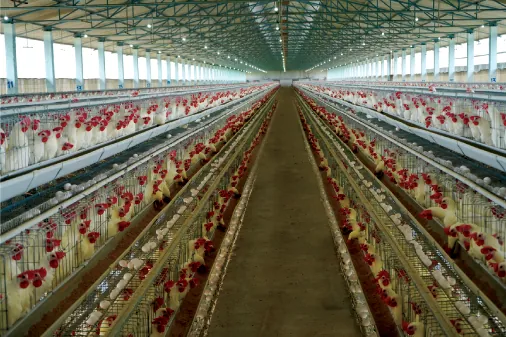
In an A-type cage the tiers are stepped, like a staircase seen from the end of the row. The lower tier sits further out than the tier above, so from the end the row looks like the letter A. Droppings from the upper tier fall past the lower tier rather than onto it, and each tier gets open space above it for air.
That open, airy layout is why A-type cages suit open-sided houses in hot climates. Natural airflow and curtains do the ventilation work, and a stepped row does not block the breeze the way a solid tall stack does. The trade-off is height: stepped systems usually run 2 or 3 tiers, so you house fewer birds per square metre of shed than a tall vertical system.
Vijay Raj makes two stepped families:
- California cages (VJR California System): the proven open-house cage for tropical and subtropical farms, in 2 or 3 tiers. Vijay Raj describes it as its most economical system, and it runs without an automatic manure remover. Box sizes are customised to each project. Feeding can be manual or by automatic trolley, and egg collection manual or automatic on request.
- Comfort+ cages (VJR Comfort+ System): built for hot and humid climates, in 2 or 3 stepped tiers. Vijay Raj introduced the Comfort cage in 2001. Box sizes are customised to each project. The egg roll angle is engineered for zero breakage and the system can be fully automated on request.
H-Type (Vertical Battery) Cages: Automax
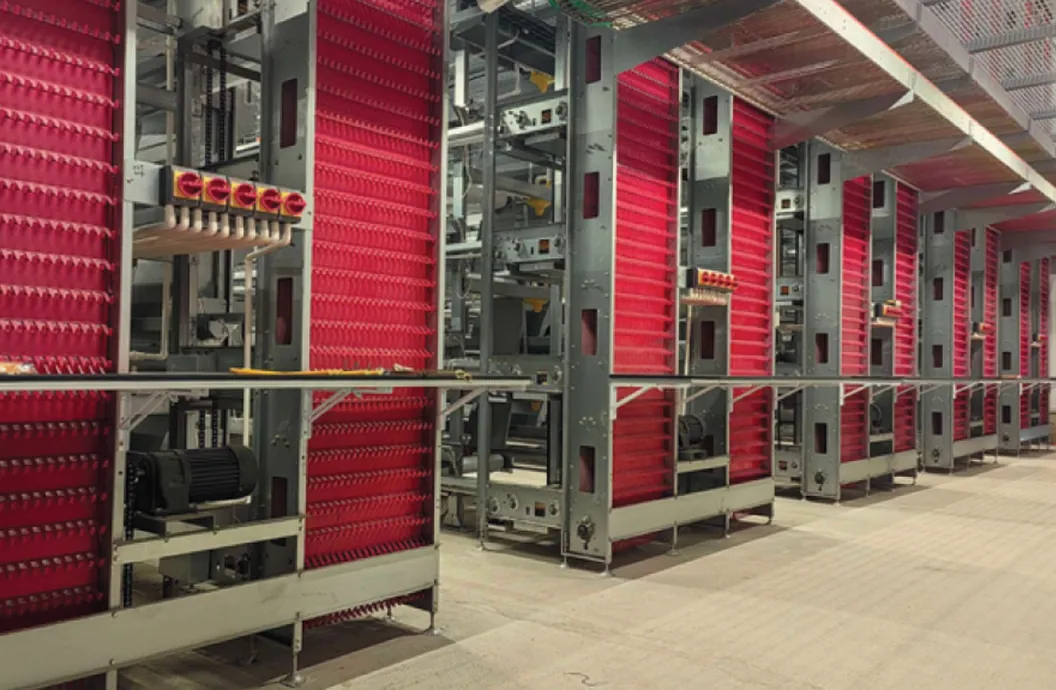
In an H-type cage the tiers sit directly on top of each other, so from the end the row looks like a stack of the letter H. Because tiers overlap, droppings must be caught on a manure belt under each tier and carried out. Because the stack is tall and dense, the house needs mechanical ventilation to get fresh air to every tier.
This is the system to choose when land is scarce or expensive, or when you want the most birds under one roof. Vijay Raj Automax layer cages run from 4 to 12 tiers. Up to 8 tiers are built as a single deck. The 10 and 12 tier versions are two stacked decks (5 + 5 and 6 + 6), and an 8 tier house can also be built as two decks of 4. The frame is a profile in specially graded, corrosion-resistant alloy steel, assembled by insertion.
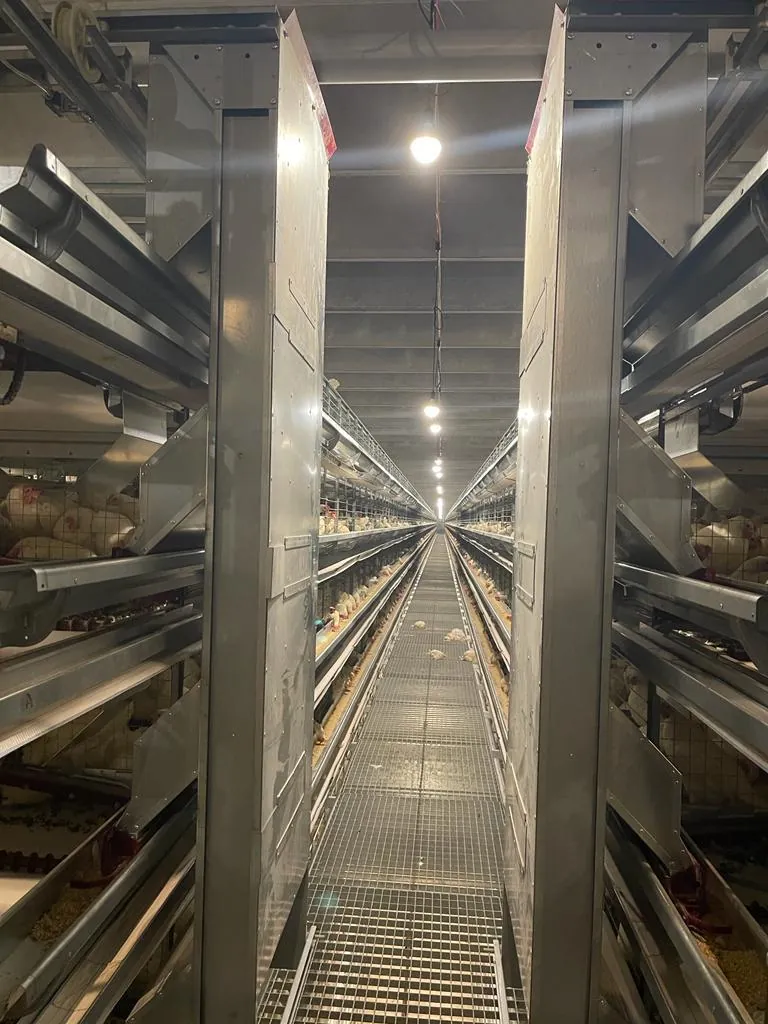
Automax is designed for high-density farming and performs best in environment-controlled houses. Vijay Raj lists it with fully automatic feeding, drinking, egg and manure handling. See all the vertical options on the layer battery cages page.
Automax Heights by Tier Count
Height is the first thing to check with an H-frame, because it sets the minimum roof height of your shed. These overall heights come from the Vijay Raj Automax layer drawing (dimension A). Vijay Raj confirms the final height with your layout, so treat them as planning figures.
| Tiers | Build | Overall height (cm) | Approx. feet |
|---|---|---|---|
| 4 | Single deck | 279 | 9.2 |
| 5 | Single deck | 336 | 11.0 |
| 6 | Single deck | 393 | 12.9 |
| 7 | Single deck | 450 | 14.8 |
| 8 | Single deck | 507 | 16.6 |
| 8 | Two decks (4 + 4) | 600 | 19.7 |
| 10 | Two decks (5 + 5) | 714 | 23.4 |
| 12 | Two decks (6 + 6) | 828 | 27.2 |
Add working clearance above the top tier for lights, drinker line lifting and air movement, then check the result against the eave height of your shed. If you are building a new house, decide the tier count first and size the pre-engineered poultry house around it. Retrofitting a tall stack into an existing low shed is where many projects go wrong.
Cage Types by Bird and Stage
Each frame family comes in versions for different birds and ages. A layer farm usually needs two of them (rearing and laying), a breeder farm needs male and female housing, and a broiler farm needs its own system entirely.
Layer Cages
Layer cages hold hens from point of lay to the end of the laying cycle. The floor slopes forward so eggs roll out of the bird’s reach onto an egg tray or belt, which keeps eggs clean and stops egg eating. Vijay Raj offers the California layer cage, the Comfort+ layer cage and the Automax layer cage, all covered in detail in the comparison table below.
Pullet and Rearing Cages
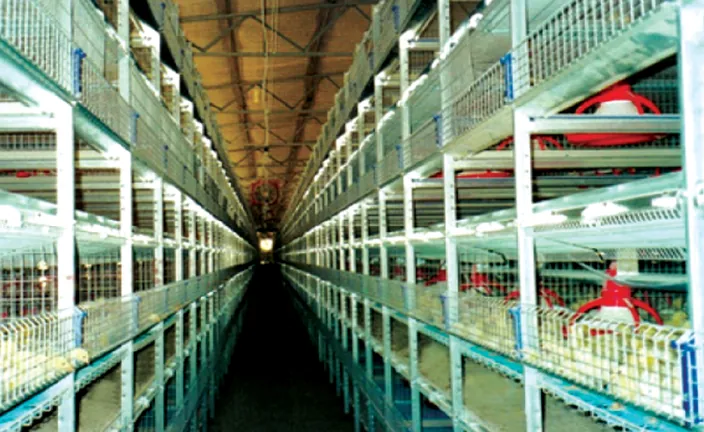
Rearing cages hold young birds from day one to about week 14, when they move to layer cages. These weeks decide how the flock lays later, so rearing cages give special attention to floor area and feed space per chick, and to a drinking line that rises as birds grow.
- California pullet rearing cage and Comfort+ rearing cage: day one to week 14, 2 or 3 tiers, drinking line lifts as birds grow.
- Automax pullet rearing system: an H-frame rearing battery from day old to week 14, in 3 to 8 tiers, with a front grating adjustable from the battery head so chicks reach the trough from the first days, a pull-out high tensile wire floor, separate brooder and grower sections, and belt cleaning with optional manure drying. The Vijay Raj brochure drawing gives an overall height of 224 cm at 3 tiers, rising 60 cm for each extra tier (524 cm at 8 tiers).
Chick Cum Grower Cages
A chick cum grower cage covers both brooding and growing in one system, so you do not shift birds between two sets of cages. The Comfort+ chick cum grower cage divides its tiers between chicks and growers and has stepping rails for vaccination. The California chick cum grower cage keeps chicks and growers in separate sections of one system. Both run from day one to week 14.
Check chick box loading against your breed guide as birds grow. The Vijay Raj Comfort+ chick box is 30 x 18 in for 12 chicks, which is 45 sq in per chick. The Hy-Line W-36 India edition growing guide recommends 54 sq in of cage floor per bird for the growing period in open housing, which the same box meets at 10 birds. Plan when you will thin boxes or move birds before you order.
Breeder Cages
Breeder cages house parent flocks that produce hatching eggs. They differ from layer cages in three ways: males and females are housed separately, workers need easy access for artificial insemination (AI), and hatching eggs must reach the egg room clean and unbroken.
- California breeder cages: 2 tier (females in the bottom tier, males in the upper tier) or 3 tier (two female tiers, males on top), with stepping rails for AI and a galvanised feed hopper system. Versions exist for breeder pullet rearing, broiler breeders (week 14 to the end of the cycle) and layer breeders.
- Comfort+ breeder cage: the stepped Comfort+ design in 2 or 3 tiers for hot, humid open houses, with stepping rails for AI and an egg roll set for zero breakage.
- Automax breeder cages: H-frame breeder housing in an EC house, with males and females on separate tiers and their own feeding, a stepping rail for AI, vaccination and induction, and lifter or Niagara egg collection to the egg room. Up to 25,000 females fit in a single house. The layer breeder version runs 2 to 4 tiers, the broiler breeder version 3 to 4 tiers.
- Automax breeder pullet system: rears broiler breeder chicks from day one to week 16 to 18 in one system, in 2 to 4 tiers, with soft floors and optional chick mats.
Breeder flocks are also kept on deep litter with automatic or manual nest boxes. Cages save floor space and make AI practical. Litter houses with nests suit natural mating. Your hatchery partner’s mating method usually settles the choice.
Broiler Cages
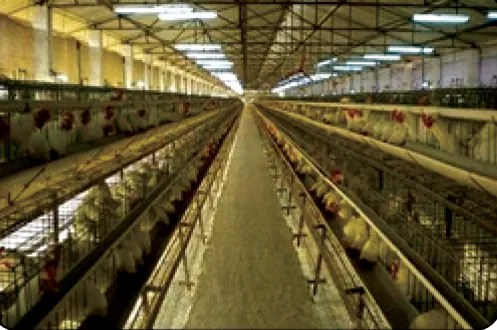
In India broilers are commonly grown on the floor, on deep litter or with automatic pan feeding. Broiler cages move the flock into tiers inside an EC house, with no litter to buy and far more birds per house than a floor system.
The Automax broiler cage system comes in two versions, BS60 and BS72, which differ only in the distance between tiers (60 cm and 72 cm). The BS72 lets you unload birds straight from the head of each line using the belt conveyor below. Day old chicks go straight into the system. A grill-less pan lets 18 to 20 growing chicks, or 12 to 14 grown broilers, feed at once, and a winch raises the pans as birds grow. The floor is wire netting or a graded polypropylene soft floor.
| Tiers | BS60 overall height (cm) | BS72 overall height (cm) |
|---|---|---|
| 3 | 205 | 241 |
| 4 | 265 | 313 |
| 5 | 325 | 385 |
| 6 | 385 | 457 |
Heights are dimension A on the Vijay Raj BS60 and BS72 drawings. The BS60 fits more tiers under a given roof. The BS72 gives more headroom per tier and belt unloading at the line head, which matters when you harvest large flocks quickly.
If you are not ready for a fully controlled house, compare cages with the floor options on the broiler systems page: automatic pan feeding for houses of 3,000 birds and more, open or EC, or deep litter with manual feeders and drinkers for the simplest, lowest-cost start.
The 2023 Egg Laying Hens Rules and Space per Bird
Space per hen is no longer only a management choice in India. The Ministry of Fisheries, Animal Husbandry and Dairying notified the Prevention of Cruelty to Animals (Egg Laying Hens) Rules, 2023 on 27 February 2023 (G.S.R. 139(E)), as reported by TeamLease RegTech. Any layer cage you buy today should be planned against them.
What the Rules Say
From the text of the Rules:
- Scope: the Rules cover space allowance for commercial layer pullets and laying hens of the domestic fowl kept in conventional colony enclosures for egg production. The definition says these were previously called battery cages or California cages, so both A-type and H-type layer cages are covered.
- Floor space (Rule 8): not less than 550 sq cm per bird.
- Birds per enclosure (Rule 8): each enclosure should preferably hold a minimum of six to eight birds, so hens can lie down, stand up, flap their wings, turn around and reach feed and water.
- Registration (Rule 5): farms register with the State Animal Husbandry Department. The certificate is valid for five years and renewable.
- Records (Rule 9): keep records of floor area, housing density, bird numbers, daily mortality and birds culled.
- Prohibited practices: forced moulting by feed withdrawal, antimicrobial growth promoters, and dead chick remains in feed. Therapeutic antimicrobials only under a veterinarian.
- Deadline: existing farms must comply by 1 January 2029.
Penalties fall under the Prevention of Cruelty to Animals Act, 1960. Your state may have added its own administrative provisions, so check with your State Animal Husbandry Department before you finalise a layout.
Tip: 550 sq cm is about 85.25 sq in. To test any cage quote in seconds, multiply the box front by the box depth in inches and divide by the number of birds. If the answer is below 85.25, the box is overloaded under the 2023 Rules.
How Common Box Sizes Measure Up
This is the table most quotations leave out. It takes real box sizes, converts them to sq cm per bird, and shows the largest number of hens each box can hold at 550 sq cm. The first three rows are common small box sizes at the loadings traditionally used across the industry. The last two rows show the box floor area you need for the six to eight birds the Rules prefer.
| Box (front x depth) | Box floor area | Traditional loading | Sq cm per bird at that loading | Most hens at 550 sq cm | Sq cm per bird at that number |
|---|---|---|---|---|---|
| 18 x 15 in | 270 sq in (1,742 sq cm) | 4 birds | 435 | 3 | 581 |
| 20 x 15 in | 300 sq in (1,935 sq cm) | 5 birds | 387 | 3 | 645 |
| 20 x 18 in | 360 sq in (2,323 sq cm) | 6 birds | 387 | 4 | 581 |
| Box for 6 hens | at least 512 sq in (3,300 sq cm) | 6 birds | 550 | 6 | 550 |
| Box for 8 hens | at least 682 sq in (4,400 sq cm) | 8 birds | 550 | 8 | 550 |
Two things stand out. First, the traditional small-box loadings used across the industry work out to less than 550 sq cm per hen. The TNAU Agritech page still describes cages as giving 450 to 525 sq cm per bird, and the Hy-Line W-36 India guide gives 67 to 86 sq in (about 432 to 555 sq cm) for laying hens in open housing. The 2023 Rules put the floor at the top of that old range.
Second, you can comply with the same box by housing fewer birds, but that cuts birds per house. A 20 x 18 in box drops from 6 to 4 hens, a third fewer. The better route for a new farm is to specify larger boxes sized for the bird count you want. Vijay Raj customises box sizes to each project, so ask for a layout that shows sq cm per bird on the drawing.
What the Rules Mean for Your Cage Choice
- Buy on sq cm per bird, not birds per box. Every quote should state box size, birds per box and the resulting sq cm per bird, and you should check the arithmetic.
- Favour larger colony boxes. The six to eight birds per enclosure preference points towards wider, deeper boxes rather than 3 or 4 bird boxes. Note the word preferably: it is a stated preference, not the same hard minimum as the 550 sq cm figure.
- Recalculate the business plan. If an older project report assumed traditional loadings, your birds per house fall and your cost per bird rises. Redo the numbers at 550 sq cm or more before you apply for a loan.
- Existing farms have until 1 January 2029. If you are expanding, build new houses to the Rules now, and plan how you will thin or re-cage older houses by the deadline.
- Pullets: the Rules’ scope mentions layer pullets as well as laying hens. Confirm with your State Animal Husbandry Department how the space figure applies to rearing cages for young birds.
- Uttarakhand is different. In Gauri Maulekhi v State of Uttarakhand (14 August 2018), the Uttarakhand High Court banned battery cage use throughout the state. If your farm is in Uttarakhand, get legal advice on the current position before you order any cage.
For context: Vijay Raj states that it follows the minimum space standards of European Union Council Directive 1999/74/EC when producing Automax cages. The EU itself has banned unenriched cages since 1 January 2012 and requires at least 750 sq cm per hen in enriched cages, according to the European Commission. Ask any supplier, including Vijay Raj, which figure their box sizing for your project is based on.
Comparison Table: A-Type vs H-Type, California vs Comfort+ vs Automax
This table compares the frame families first, then the three Vijay Raj layer systems. Vijay Raj facts come from its brochure, catalogue and product document. Where Vijay Raj has not published a figure, the table says so rather than guessing.
| Feature | A-type (stepped), general | H-type (vertical), general | VJR California | VJR Comfort+ | VJR Automax |
|---|---|---|---|---|---|
| Shape | Tiers stepped outwards | Tiers stacked vertically | Stepped | Stepped | H-frame |
| Tiers | Usually 2 to 3 | Usually 3 and up | 2 or 3 | 2 or 3 | 4 to 12 (10 and 12 as two decks) |
| Overall height | Low | High | Project specific | Project specific | 279 cm (4 tiers) to 828 cm (12 tiers) |
| Best house type | Open-sided with curtains | Environment-controlled | Open-sided, tropical and subtropical | Open-sided, hot and humid | EC house recommended |
| Birds per sq m of shed | Lower | Higher | Lower | Lower | Highest of the three |
| Layer box sizes | Varies | Varies | Customised to the project | Customised to the project | Customised to flock, land and climate |
| Frame | Varies | Varies | Tubular galvanised steel (GI) | Tubular galvanised steel (GI) | Profile in graded, corrosion-resistant alloy steel |
| Wire | Varies | Varies | 275 GSM galvanised (Bezinal option on the family page) | 275 GSM galvanised or Bezinal | 275 GSM galvanised or Bezinal |
| Feeding | Manual or trolley | Automatic trolley or chain | Manual or automatic trolley with feed regulation | Manual or automatic | Automatic feeding, even distribution along every trough |
| Drinking | Nipple lines | Nipple lines | Nipple lines | Nipple lines | Nipple lines |
| Egg collection | Manual or belt | Belts, usually automatic | Manual, or automatic on request | Manual or automatic | Egg-roll slope for zero breakage, automatic egg handling |
| Manure | Falls to floor or pit | Belts under each tier | Removal and drying options, no automatic remover needed | Removal and drying options | Automatic manure handling |
| Automation range | Manual to automatic | Mostly automatic | Semi-automatic up to fully automatic | Can be fully automated | Fully automatic |
| Rearing versions | Chick cum grower, grower | Rearing battery | Pullet rearing, chick cum grower | Rearing, chick cum grower | Pullet rearing, 3 to 8 tiers |
| Upfront cost per bird | Lower | Higher | Most economical VJR system | One of the most economical VJR systems | Higher equipment cost, less land and shed per bird |
California or Comfort+?
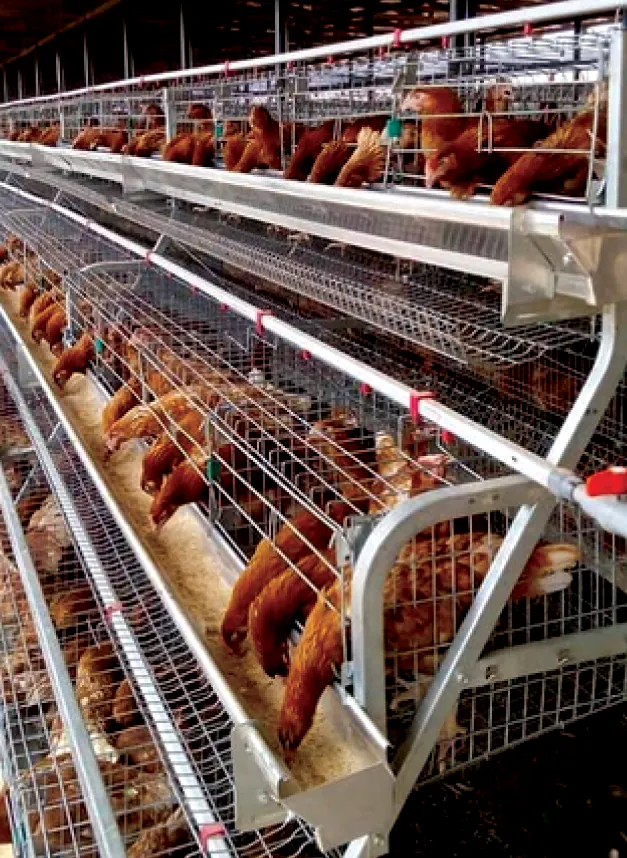
Both are stepped cages for open houses with GI frames, 2 or 3 tiers and matching rearing cages, so the choice is about detail rather than concept. California is the long-proven workhorse and Vijay Raj’s most economical system, with box sizes customised per project. Comfort+ is positioned for the hottest, most humid sites and has published box sizes, which makes it easier to check sq cm per bird on paper. If you farm near the coast or in a humid belt, ask about Bezinal wire for either.
Stepped or Vertical?
Go stepped if you have land, an open house and a flock that fits within one open house. Go vertical if land is expensive, you want one large house instead of several small ones, or you already plan an EC house for climate control. The decision matrix further down puts numbers around this.
Open House or EC House: Match the Cage to the Air
The house decides the cage more than the other way round. A cage system is only as good as the air reaching the bird in the middle of the top tier on the hottest afternoon of May.
Open-Sided Houses
An open house is long and narrow with side curtains, relying on wind and the stack effect for ventilation, often helped by foggers or sprinklers in summer. It is cheaper to build and run, and it works across most of peninsular India. Its limit is air: a wide house or a tall, dense cage stack blocks the breeze and birds in the middle suffer.
Stepped California and Comfort+ cages were designed for these houses. The Vijay Raj brochure sets an open house limit of 33,000 birds for layers and 25,000 birds for broilers, which is a practical ceiling for one open house.
Environment-Controlled (EC) Houses
An EC house is closed. Exhaust fans pull air through evaporative cooling pads along the length of the house (tunnel ventilation), and a control panel runs fans, inlets and lights. Temperature and air exchange no longer depend on the weather, so every tier of a tall stack can get fresh air.
That is why tall H-frame systems belong in EC houses. The house costs more to build and uses more electricity, and you need a reliable power supply and a generator. In return you house more birds per square metre, smooth out summer production dips, and fit a large flock on a small plot. For cooling options, see the guide to cooling a poultry house.
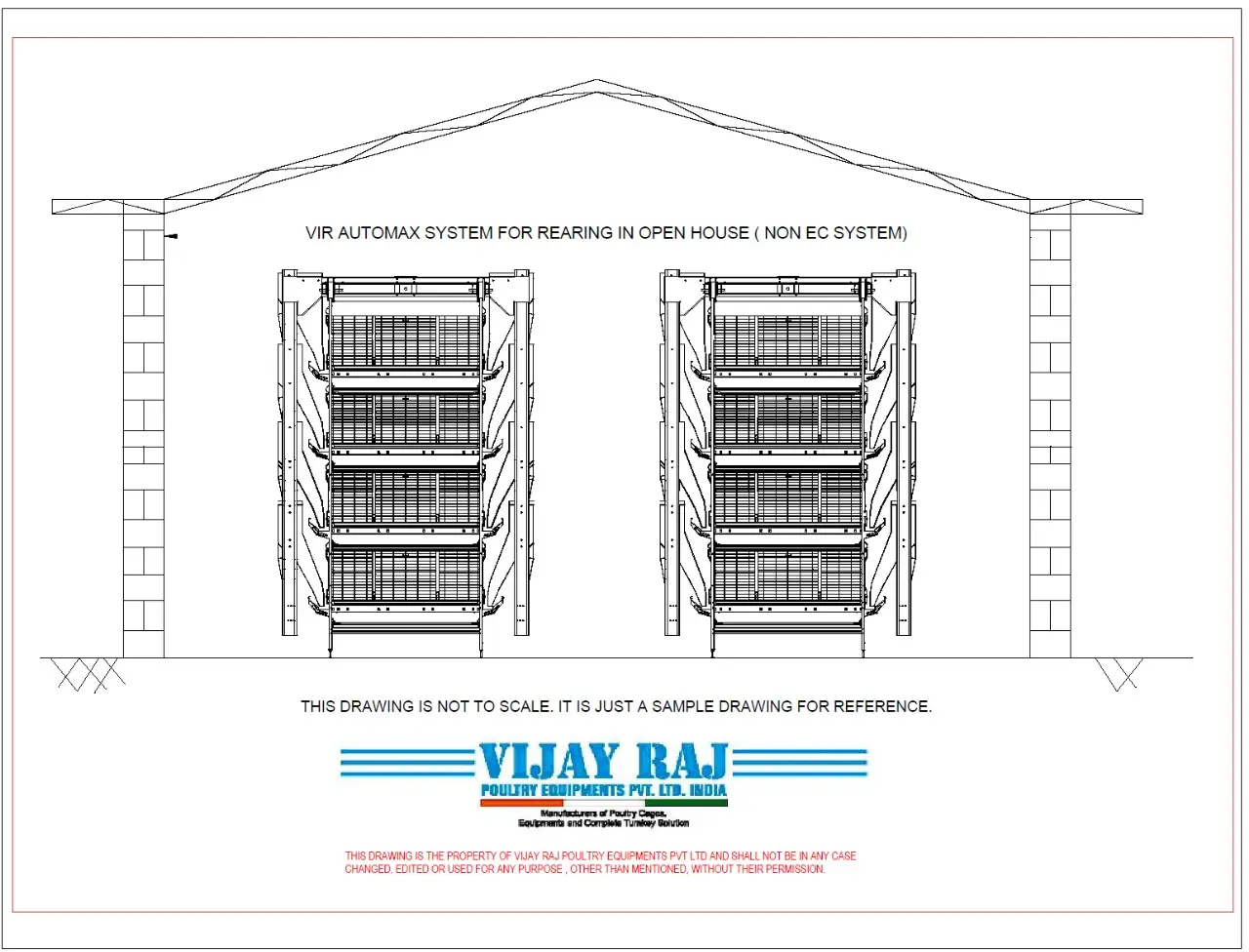
Tiers and Stocking Density: How Many Birds Fit
Birds per house is the number that drives your whole project: shed size, equipment, feed, labour, loan and income. Work it out from the cage upward, not from a round number downward.
The Method
- Set birds per box from box floor area at 550 sq cm per hen or more (the table above).
- Boxes per metre of row: 100 cm divided by the box front in cm (inches x 2.54).
- Birds per running metre of row: birds per box x boxes per metre x 2 sides x number of tiers.
- Row length: house length minus the front service area and the rear area for manure exit and fans.
- Rows per house: house width minus side walkways, divided by (row width + walkway). A stepped row is wide at the base. An H-frame row is narrower but tall.
- Birds per house = birds per running metre x row length x rows. Then check it against the open house limit if you are not building an EC house.
A Worked Example
Take a Comfort+ 20 x 18 in box loaded at 4 hens (581 sq cm each). The 20 in front is 50.8 cm, so a metre of row holds about 1.97 boxes per side. That gives about 7.9 hens per metre, per side, per tier. A 3 tier stepped row with two sides holds about 47 hens per running metre (7.9 x 2 x 3).
At a traditional loading of 6 hens per box, the same row held about 71 hens per metre. That gap is what the 2023 Rules cost in density, and it is why you should get your supplier to redraw an old layout rather than reuse its bird count.
For a vertical system the method is the same, with more tiers. If box floor area per bird is equal, each extra tier adds the same number of birds per running metre, so an 8 tier row holds 8/3 (about 2.7) times the birds of a 3 tier row of equal length. Rows differ in width and walkway, so run both layouts for your actual shed before comparing.
The Vijay Raj poultry house calculator runs this layout arithmetic for you by system, tier count and house size. Its page shows which figures come from Vijay Raj and which are planning guidelines, so use it for a first estimate and confirm with a drawing.
A Benchmark for Shed Area
For a bank-style first check, the NABARD Unit Cost 2023-24 (Jharkhand Regional Office) model for a 5,000 bird cage layer unit assumes 1 sq ft (about 0.093 sq m) of shed per bird. Stepped 2 or 3 tier cages in an open house are close to this. Tall H-frame systems need much less shed per bird, which is where their land saving comes from.
Materials and Corrosion: Frames, Wire and Coatings
Indian poultry houses are hard on steel. Ammonia from manure, humidity, fogging water, disinfectant sprays and coastal salt all attack the cage from the day it is installed. A cage that rusts through in year six costs far more than the price gap you saved on a thinner coating.
Frames
- Tubular GI (galvanised iron) frames: used on Vijay Raj California and Comfort+ cages. Round or square galvanised tube is light, rigid and well suited to 2 or 3 stepped tiers.
- Profile frames in graded alloy steel: used on Automax. A tall stack carries far more load (birds, feed, manure belts, egg belts), so the frame is an engineered profile with precise load points, in a specially graded, corrosion-resistant alloy steel.
Wire: What “275 GSM” Means
GSM is grams of zinc per square metre of surface. For galvanised sheet, GalvInfo explains that a Z275 coating means 275 g/sq m in total across both sides, which works out to roughly 21 microns of zinc on each face. More zinc means more metal to corrode away before the steel underneath starts to rust.
Vijay Raj specifies 275 GSM galvanised wire for its cages. When you compare quotes, do not accept “galvanised” alone. Ask for the coating mass in g/sq m, how it is measured for wire, and whether the mesh is galvanised before or after welding, and get a test certificate with the delivery.
Bezinal (Zinc-Aluminium) Wire
Bezinal is Bekaert’s zinc and aluminium wire coating. Bekaert states that Bezinal-coated wire resists corrosion up to six times longer than hot-dip galvanised wire, and two to six times longer in heavily corrosive areas. Those are the maker’s own claims, tested outside poultry houses, so treat them as a direction rather than a promise.
Vijay Raj offers Bezinal wire as an option on its California, Comfort+ and Automax systems. It is worth pricing for coastal farms, humid belts, and houses that fog heavily in summer.
Tip: the most corrosion-prone parts of a cage are the ones that stay wet and dirty: the cage floor, the lower tier and anything under a leaking nipple. Leak-free nipples and good manure drying protect the wire as much as the coating does.
Feeding, Drinking, Egg Collection and Manure Handling by Type
The running systems decide your labour bill and your daily routine. Each cage family supports a range, from hand-filled troughs to full automation, so pick the level that matches your labour availability, power supply and flock size.
| Function | California / Comfort+ (stepped) | Automax (H-frame) | What to check in a quote |
|---|---|---|---|
| Feeding | Troughs filled by hand, or by a manual or automatic feed trolley | Automatic feeding with even distribution along every trough | One trolley per row? Feed regulation? Hopper capacity per pass? |
| Drinking | Nipple lines, one per tier per side | Nipple lines, height adjustable in rearing versions | Nipple model, pressure regulators per line, filter set, medicator |
| Egg collection | Egg roll angle for zero breakage; manual picking or an egg collection system | Egg-roll slope for zero breakage, automatic egg handling | Belts per tier, collection table, breakage and dirty egg rates |
| Manure | Falls to the floor or pit; removal and drying options available | Automatic manure handling; rearing versions add belt cleaning and optional drying | Belt material, drive per row, cross conveyor, where manure goes |
| Labour | Higher with manual options, falls with trolley and egg collection | Lowest per bird | Workers needed per 10,000 birds at your chosen automation |
| Power | Low; manual versions run without power | High; needs reliable power and backup | Connected load of every motor, generator size |
For drinkers, Vijay Raj makes stainless steel pin nipples for each bird type, including the VRND-L1 (single lock, 180 degree) and VRND-L2 (twin lock, 360 degree) for layers and low-pressure chick nipples for rearing cages. See the nipple drinking system and the guide to choosing poultry nipple drinkers. For the wider picture on feed lines and trolleys, see automatic poultry feeding systems.
What Drives Cage Price, and How to Compare Quotes per Bird
Vijay Raj does not publish prices, and cage prices change with steel and zinc costs, so this section gives you the cost drivers and a method rather than a rate card. Always get a current, written quotation.
The Cost Drivers
- Steel and coating: wire gauge, coating mass (275 GSM or more), Bezinal instead of zinc, frame section and material.
- Frame type and tiers: tall H-frames need heavier profile frames, and each tier adds boxes, troughs, drinker lines, egg belts and manure belts.
- Box size and birds per box: bigger boxes cost more each but can cost less per bird, because fewer partitions and doors are needed per hen.
- Automation level: manual troughs and hand picking are cheapest to buy. Automatic trolleys, egg belts, manure belts, drives and control panels add cost but cut labour every day the house runs.
- Scope: is installation included? Freight? GST? Electricals? Water filters and medicators? Spares?
- The house: an H-frame system needs an EC house with fans, pads and a control panel. A stepped system can go into a cheaper open shed. Compare total project cost, not cage cost alone.
A Public Benchmark
The NABARD Unit Cost 2023-24 (Jharkhand Regional Office) gives a model 5,000 bird cage layer unit at Rs 32.1 lakh in total. It budgets cage and layer equipment at Rs 170 per bird (Rs 8.5 lakh) and the civil structure at Rs 275 per sq ft at 1 sq ft per bird (Rs 13.75 lakh). NABARD says its unit costs are indicative, and banks may set their own for local conditions.
Use it as a floor for a simple manual stepped system, not as a quote. Automated and vertical systems cost more per bird in equipment and less per bird in land and shed. A layout built to 550 sq cm per hen also houses fewer birds in the same cage row than an older model assumed, which pushes cost per bird up.
Why “Price per Box” Misleads
Online listings often quote cages per piece or per box. A 5 bird box and a 3 bird box can look similar in price, but if the 5 bird box is overloaded under the 2023 Rules, you will only legally house 3 birds in it. The only fair comparison is total price divided by birds housed at a compliant density, with the same scope in every quote.
Worksheet: Compare Cage Quotations per Bird Housed
Fill one column per supplier. Ask each supplier for the same flock size and the same house, and make them state every line.
| Line | Quote A | Quote B | What to ask or check |
|---|---|---|---|
| 1. System and frame type | Stepped or H-frame, frame material and section | ||
| 2. Box size (front x depth) | In inches or cm, as built | ||
| 3. Birds per box | As loaded on the drawing | ||
| 4. Sq cm per bird | Box area in sq cm divided by line 3; must be 550 or more for layers | ||
| 5. Tiers, rows and boxes | Total box count on the layout | ||
| 6. Birds housed | Line 3 x total boxes; this is your divisor | ||
| 7. Wire and coating | Gauge, g/sq m, zinc or Bezinal, test certificate | ||
| 8. Cage structure price | Frame, boxes, troughs, egg trays | ||
| 9. Feeding system | Manual or automatic trolley, hoppers, silo link | ||
| 10. Drinking system | Nipples, lines, regulators, filters, medicator | ||
| 11. Egg collection | Belts, drives, collection table | ||
| 12. Manure handling | Belts, drives, cross conveyor, drying | ||
| 13. Electricals and controls | Panels, cabling, connected load | ||
| 14. Freight, installation, commissioning | Included or extra, and by whom | ||
| 15. GST and other taxes | Rate and whether included | ||
| 16. Spares, warranty, service | Spares list, response time, where spares come from | ||
| 17. Total equipment price | Sum of lines 8 to 16 | ||
| 18. Price per bird housed | Line 17 divided by line 6 | ||
| 19. Shed and climate cost per bird | House cost divided by line 6; include fans and pads for EC | ||
| 20. Total project cost per bird | Line 18 + line 19; compare this number |
Tip: if one supplier’s cost per bird is far below the others, check lines 4 and 6 first. The usual reason is an overloaded box, which makes the divisor look bigger than the number of hens you can legally keep.
For funding the project, see poultry farm subsidy and loans in India.
Cage vs Cage-Free: The Debate, Fairly
You will hear strong views on both sides. Here is what the sources actually say, so you can make your own judgement and plan for where the market and the law may go.
The Case for Cages
The TNAU Agritech portal lists the practical advantages: more birds per unit area, easier records and culling of poor layers, fewer vices such as cannibalism and egg eating, cleaner eggs, easier control of coccidiosis and worms, and less feed wastage. It also reports higher egg production and better feed efficiency and egg weight in caged birds than on deep litter.
The same page lists the problems: ventilation is hard in summer at high density, and cage layer fatigue, leg problems, fatty liver, flies and bad odour increase. Good system design (tier spacing, manure drying, ventilation) is how you manage those risks.
The Case Against Cages
Welfare groups and some courts in India have pushed to end battery cages. The Law Commission of India’s Report No. 269 (2017) set out draft rules on housing egg laying hens and opposed confining birds in battery cages, as SCC Online reported. The Uttarakhand High Court banned battery cages in that state in 2018, and a petition seeking a ban was argued before the Delhi High Court in 2022, as LiveLaw reported. PETA India called the 2023 Rules “humane washing” and argued 550 sq cm is too little.
In Europe, the European Food Safety Authority recommended in 2023 that laying hens be housed in cage-free systems. The EU already requires 750 sq cm per hen in enriched cages and allows no more than 9 hens per sq m of usable area in alternative systems, according to the European Commission.
What About Mortality?
A common argument is that cage-free flocks die more. A 2021 meta-analysis by Schuck-Paim and colleagues covering 6,040 commercial flocks and about 176 million hens in 16 countries found that cage-free aviary mortality fell as producers gained experience. In the most recent data it found no significant difference between systems, with 3 to 5 percent cumulative mortality at 60 weeks. Management skill mattered more than the system.
What This Means for You
- Cages remain legal in most of India, subject to the 2023 Rules. Build to those Rules, not to older loadings.
- Rules can tighten during the long working life of a cage system. Larger boxes and fewer birds per box give you headroom if they do.
- If you sell to buyers who ask for cage-free eggs, floor or aviary systems may suit part of your production. Deep litter with nests is one route for breeders, see breeder deep litter systems.
Decision Matrix: Farm Size, House Type and Land Cost
This matrix is a starting point, not a final design. Find the row closest to your situation, then check it against your budget, power supply and labour. Flock sizes are birds per house. The 33,000 layer open house limit is from the Vijay Raj brochure.
| Birds per house | Climate and house | Land cost or availability | Budget | Suggested system | Why |
|---|---|---|---|---|---|
| Under 10,000 layers | Open house, dry or moderate climate | Land cheap and available | Low | California, 2 or 3 tiers, manual trough or manual trolley, manual egg picking | Lowest upfront cost, no power dependence, simple to run |
| Under 10,000 layers | Open house, hot and humid or coastal | Land available | Low to medium | Comfort+, 2 or 3 tiers, consider Bezinal wire | Built for humid heat; coating choice extends cage life |
| 10,000 to 33,000 layers | Open house, most of India | Land moderate | Medium | California or Comfort+, 3 tiers, automatic trolley and egg collection, manure drying option | Stays within one open house; automation cuts labour at this scale |
| 10,000 to 33,000 layers | EC house planned for heat or fly and odour control | Land expensive or limited, near a town | Medium to high | Automax, 4 to 6 tiers (279 to 393 cm high), manure belts | More birds on a small plot; manure leaves the house daily |
| Over 33,000 layers | EC house | Any, especially expensive land | High | Automax, 6 to 12 tiers (393 to 828 cm high), full automation | Beyond the open house limit; one large house instead of several |
| Pullets for your own layers | Match the layer house | Same as layer site | Follows layer choice | Same family as your layer cages: California or Comfort+ rearing, or Automax pullet (3 to 8 tiers) | Birds move between compatible systems; feeding and drinking stay familiar |
| Breeders, small to medium | Open house | Land available | Medium | California or Comfort+ breeder cages, 2 or 3 tiers, males on top | Economical, stepping rails for AI |
| Breeders, large | EC house | Land limited | High | Automax breeder, up to 25,000 females per house | Separate male and female tiers, lifter or Niagara egg collection |
| Broilers, 3,000 to 25,000 | Open or EC floor house | Land available | Low to medium | Floor house with automatic pan feeding and nipple drinking | Simpler than cages; within the 25,000 broiler open house limit |
| Broilers, high volume | EC house | Land expensive | High | Automax broiler, BS60 or BS72, 3 to 6 tiers (205 to 457 cm high) | No litter, more birds per house, automated harvesting |
Many farms combine rows. A common path is to start with open houses and stepped cages, then add an EC house with a vertical system as the business grows. Vijay Raj turnkey layer farm projects cover the house, the cage system, feeding, drinking, egg handling and climate control from one supplier. For the full start-up picture, read how to start a layer poultry farm in India.
Common Mistakes When Choosing a Cage System
- Choosing the cage before the house. A tall H-frame in an open shed overheats. A stepped cage in a tunnel house wastes the house. Decide the house first.
- Buying on price per box. Compare total project cost per bird housed at a compliant density, using the worksheet above.
- Ignoring the 2023 Rules. A layout at traditional loadings can fall below 550 sq cm per hen. Existing farms must comply by 1 January 2029; new farms should comply from day one.
- Not checking roof height. A 12 tier Automax stands 828 cm tall. Match the tier count to the shed, or the shed to the tier count, before anyone cuts steel.
- Accepting “galvanised” without a number. Ask for the coating mass in g/sq m, the measurement basis and a test certificate. Consider Bezinal in humid or coastal sites.
- Automating beyond your power supply. Automatic trolleys, belts and EC fans need reliable power and a generator sized for the connected load.
- Planning laying and forgetting rearing. Pullets need rearing cages sized and scheduled so birds reach the layer house on time. Plan both together.
- Underestimating manure. Stepped cages drop manure to the floor; plan how you will dry and remove it, and where it goes. Flies and odour cause neighbour complaints and disease.
- Skimping on walkways. Narrow walkways slow feeding, egg collection and vaccination for the life of the house.
- Forgetting after-sales. Ask where spares come from, who installs and commissions the system, and how fast a service engineer can reach your farm.
Next Steps
Write down four things: birds per house, the house you plan (open or EC), your land situation and your automation budget. Run them through the decision matrix, estimate the layout in the poultry house calculator, then ask at least two suppliers to fill in the quotation worksheet for the same brief. You can also see built farms on the projects page or browse all Vijay Raj products.
If you want a layout drawn to 550 sq cm per hen for your plot, talk to a Vijay Raj engineer.
Frequently Asked Questions
What is the difference between A-type and H-type poultry cages?
A-type cages step the tiers outwards like a staircase, so droppings fall past the lower tier and air moves freely. They usually run 2 or 3 tiers and suit open-sided houses. H-type cages stack tiers vertically, need manure belts under each tier and mechanical ventilation, and go much higher. Vijay Raj Automax H-frame layer cages run from 4 to 12 tiers.
How much space does a laying hen need in a cage in India?
The Prevention of Cruelty to Animals (Egg Laying Hens) Rules, 2023 set a minimum floor space of 550 sq cm per bird, about 85 sq in, and say each enclosure should preferably hold six to eight birds. To check a cage, multiply box front by depth in inches and divide by the number of hens. Below 85.25 means the box is overloaded.
Are battery cages banned in India?
Not nationally. The 2023 Egg Laying Hens Rules regulate cages, which they call conventional colony enclosures, with a 550 sq cm per bird minimum, farm registration and a 1 January 2029 compliance deadline for existing farms. The Uttarakhand High Court banned battery cage use in that state in 2018, so farmers there should take legal advice before ordering cages.
Which cage system is best for an open-sided poultry house?
A stepped A-type cage, such as a California or Comfort+ cage in 2 or 3 tiers. The stepped layout lets natural airflow reach every bird, and droppings fall to the floor without automatic manure belts. Tall H-frame stacks block airflow and belong in environment-controlled houses. The Vijay Raj brochure gives an open house limit of 33,000 layers per house.
How many birds can I keep in one layer cage box?
Divide the box floor area by 550 sq cm, the legal minimum per hen. An 18 x 15 in box (1,742 sq cm) holds 3 hens, a 20 x 15 in box holds 3, and a 20 x 18 in box (2,323 sq cm) holds 4. For six hens you need at least 3,300 sq cm, about 512 sq in, of floor.
What is the price of a layer cage system in India?
Prices vary with steel and zinc costs, tiers, box size, automation and scope, so get a current written quote. As a public benchmark, the NABARD Unit Cost 2023-24 (Jharkhand Regional Office) budgets cage and layer equipment at Rs 170 per bird in a 5,000 bird cage unit costing Rs 32.1 lakh. Always compare quotes per bird housed at 550 sq cm.
What does 275 GSM galvanised wire mean?
GSM is grams of zinc per square metre of surface. More zinc means more coating to corrode away before the steel rusts, which matters in humid, ammonia-laden poultry houses. Vijay Raj uses 275 GSM galvanised wire, with zinc-aluminium Bezinal wire as an option. Ask any supplier for the coating mass, how it is measured and a test certificate.
Can broilers be raised in cages?
Yes, in environment-controlled houses. Vijay Raj Automax broiler cages come as BS60 and BS72, differing only in tier spacing (60 cm and 72 cm), in 3 to 6 tiers with overall heights from 205 to 457 cm. Day old chicks go straight in, there is no litter to buy, and the BS72 unloads birds from the head of each line by belt.
Sources
- Ministry of Fisheries, Animal Husbandry and Dairying: Prevention of Cruelty to Animals (Egg Laying Hens) Rules, 2023 (text via Legitquest, 2023)
- TeamLease RegTech: Prevention of Cruelty to Animals (Egg Laying Hens) Rules, 2023, G.S.R. 139(E) (2023)
- Uttarakhand High Court: Gauri Maulekhi v State of Uttarakhand (2018)
- LiveLaw: Battery cage petition argued in Delhi High Court (2022)
- SCC Online: Law Commission Report No. 269 on egg laying hens and broiler chickens (2017)
- PETA India: Response to the Egg Laying Hens Rules, 2023 (2023)
- TNAU Agritech Portal: System of poultry rearing, cage and deep litter
- Hy-Line International: Growing management of W-36 commercial pullets, India edition
- NABARD Jharkhand Regional Office: Unit Cost 2023-24 (2023)
- European Commission: Laying hens, Council Directive 1999/74/EC
- EFSA: Welfare of laying hens, plain language summary (2023)
- Schuck-Paim et al., Scientific Reports: Laying hen mortality in different indoor housing systems (2021)
- Bekaert: What is Bezinal coating?
- GalvInfo Center: Understanding coating weight designations (GalvInfoNote 1.1)