

In this guide 13 sections
- Manual vs automatic feeding: what actually changes
- Types of automatic poultry feeding systems
- How a pan feeding line works, step by step
- Feeder space norms from the breed guides
- How to size a pan feeding line: a worked example
- Feed wastage and FCR: putting a rupee value on it
- Labour savings: how to calculate yours
- Power, backup and controls
- Maintenance checklist
- What drives the cost of automation
- Fully automatic poultry farm cost in India, explained honestly
- What to automate first: a phased roadmap
- Common mistakes when buying an automatic feeder
An automatic poultry feeding system moves feed from a bulk store to every bird without hand filling. Broiler and breeder floor houses use pan feeding lines fed by an auger and hopper, cage layers use feed trolleys over troughs, and California breeder cages use hopper systems. You size it by birds per pan, lines per house width and power backup.
Feed is the biggest cost on any poultry farm, and feeding is the job that eats most labour hours. This guide explains how each type of automatic feeder works, shows a full pan-line sizing example for a real house size, and gives a phased plan for what to automate first when the budget will not stretch to everything at once.
Manual vs Automatic Feeding: What Actually Changes
On a manual farm, workers carry feed bags into the shed, fill tube or plate feeders by hand, and raise each feeder as birds grow. The work is repeated several times a day, every day of the flock. How well birds eat depends on how carefully that work is done.
An automatic system replaces the carrying and filling. Feed sits in a closed store, an auger or trolley delivers it on a timer or on demand, and the feeder height is changed for a whole line at once. The farm team moves from filling feeders to checking that the system is filling them correctly.
Feed is the single largest expense in poultry production, at 60 to 70% of total cost according to ICAR-CCARI’s 2023 extension folder on economic feeding. That is why small gains in how feed is delivered and how little is spilled matter more than any other line in the budget.
| Factor | Manual feeders | Automatic system |
|---|---|---|
| Feed handling | Bags carried and tipped by hand | Closed store and auger or trolley delivery |
| Timing | When workers get to it | Set by timer, sensor or control panel |
| Evenness | Feeders near the door often fuller than those at the far end | All pans or troughs filled in the same cycle |
| Height adjustment | Each feeder raised one by one | A winch lifts the whole line |
| Spillage | Depends on how full workers fill each feeder | Feed depth set once per pan or per hopper |
| Biosecurity | Frequent entry and handling | Fewer entries, less hand contact with feeders |
| Power need | None | Motors, sensors and a panel, so backup power is essential |
| Upfront cost | Low | Higher, recovered through feed and labour savings |
| Best fit | Small deep litter farms and backyard units | Commercial farms, contract broiler houses, cage layer and breeder houses |
Manual feeders still have a place. Vijay Raj supplies chick feeders, chick plate feeders, grower feeders and turbo feeders for economical semi-automatic broiler farms, listed on the manual feeding and drinking equipment page. Many farms start there and move to automation house by house.
Types of Automatic Poultry Feeding Systems
The right system depends first on how the birds are housed: loose on the floor, or in cages. After that, bird type and flock size decide the details.
| System | Housing | Birds | How feed reaches the bird |
|---|---|---|---|
| Pan feeding line | Floor (deep litter or EC house) | Broilers, breeders on the floor | Auger inside a tube fills pans hung along the line |
| Grill-less pan in cages | Multi-tier broiler cages | Broilers | Pans inside the cage, height set by winch |
| Chain (track) feeder | Floor | Broilers, breeders | A chain drags feed along an open trough loop |
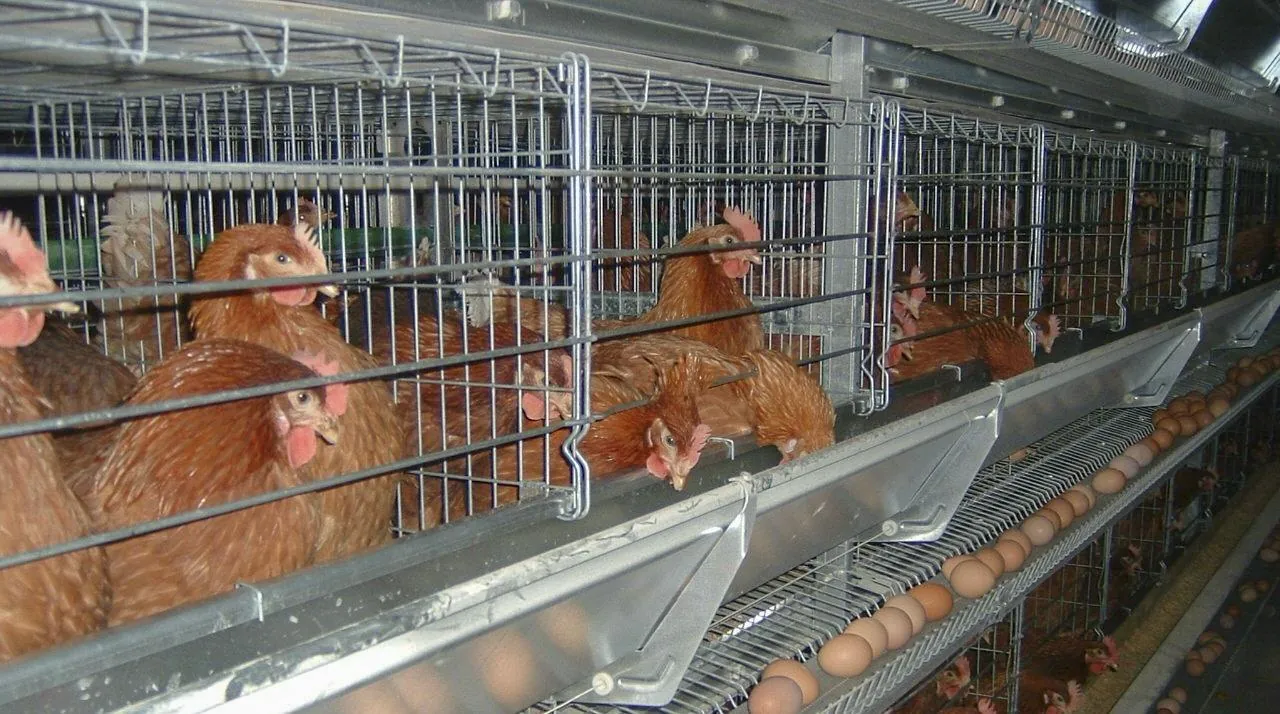
| Feed trolley over troughs | Stepped or H-frame cages | Layers, pullets, cage breeders | A trolley runs along the row and drops feed into troughs on every tier |
| Feed hopper system | California breeder cages | Broiler breeders | Hoppers travel along the row and spread feed into the troughs |
| Silo and auger fill system | Outside the house | All of the above | A bulk silo and fill auger keep the house hoppers or trolleys topped up |
Pan Feeding Lines for Broilers and Floor Breeders
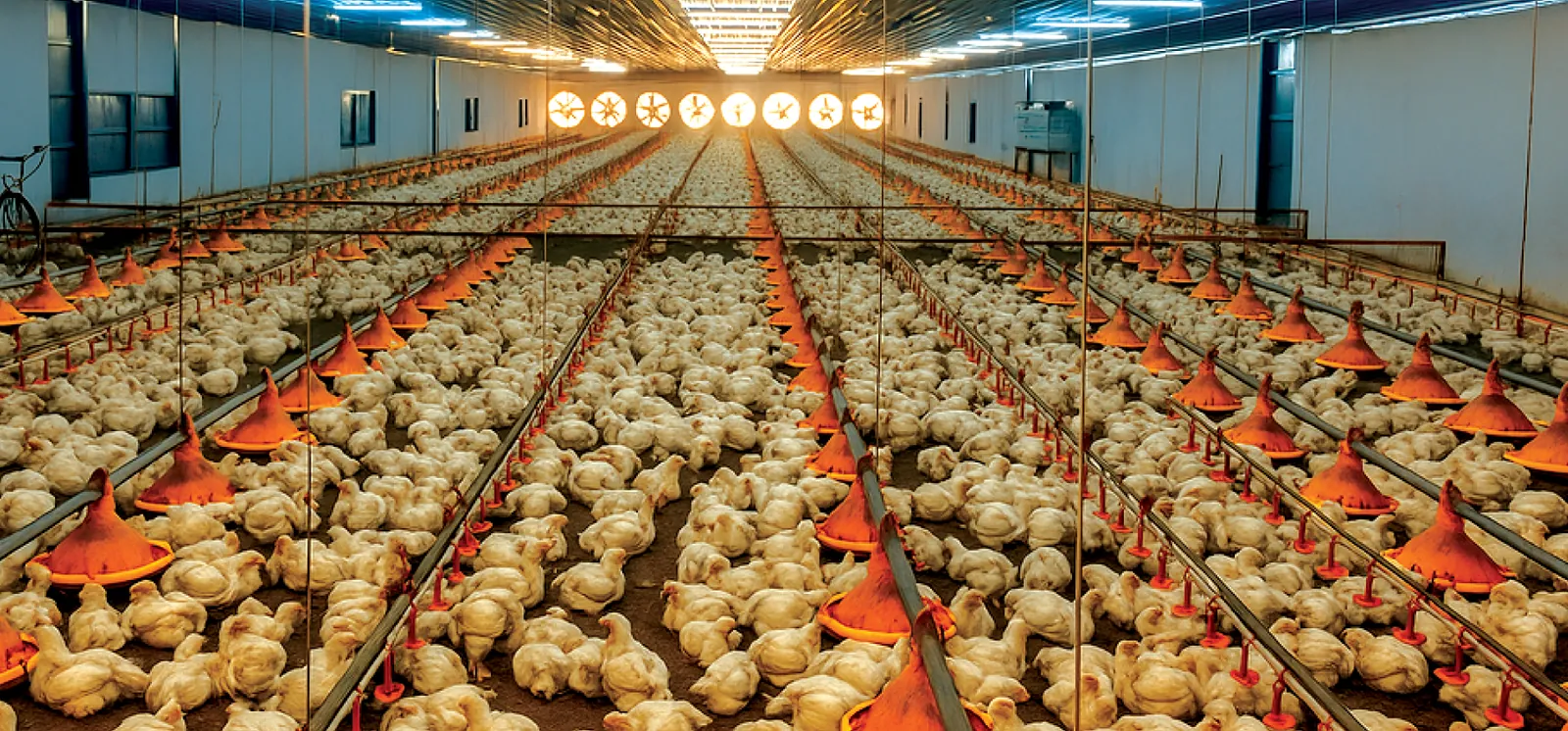
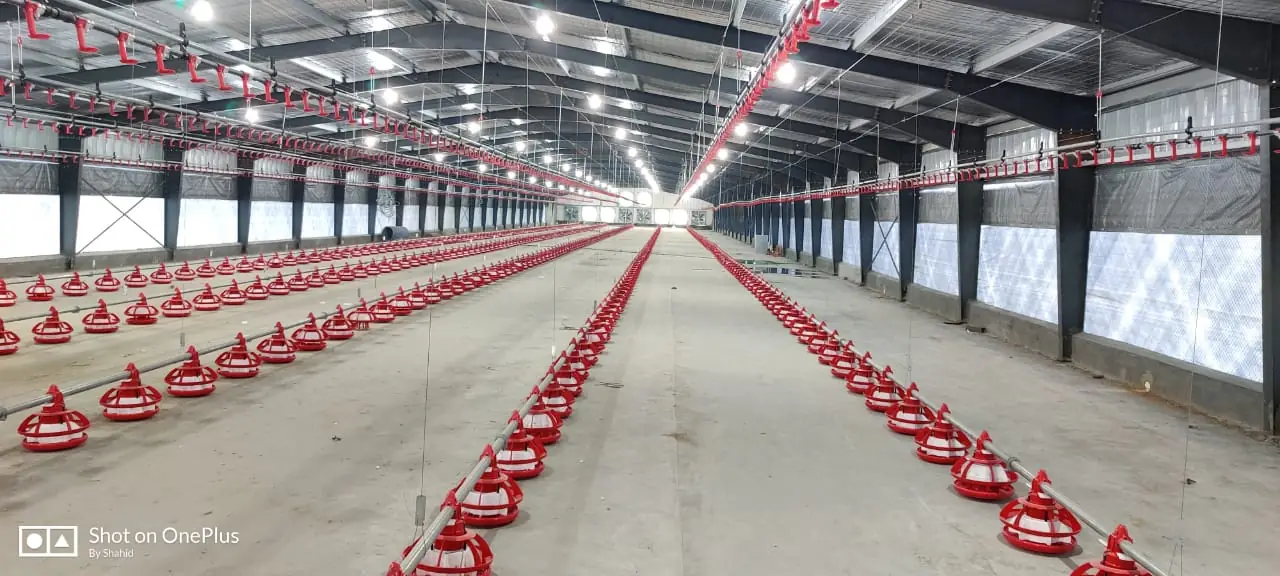
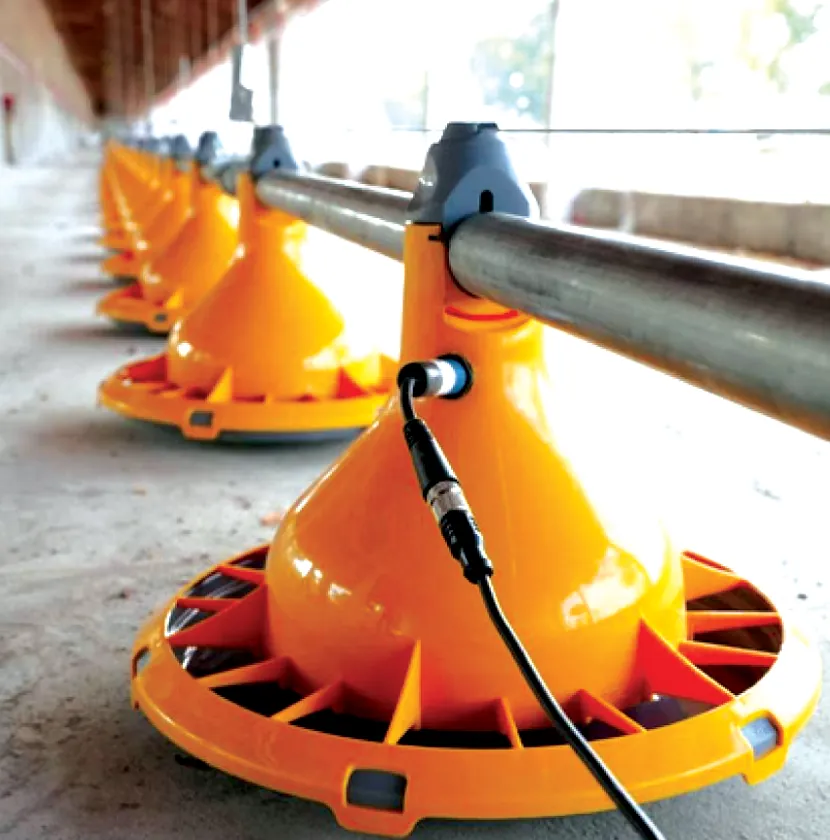
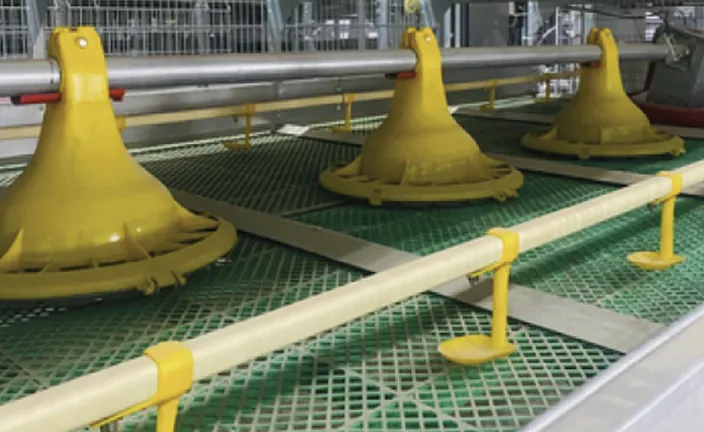
A pan line is a feed tube hung from the roof, with round pans spaced along it. An auger inside the tube pushes feed from a hopper at the front of the house down the line, and each pan fills through a drop hole. The last pan on the line usually carries a sensor that stops the motor once it is full, so the whole line fills before the auger shuts off.
Pan lines suit floor houses because birds can walk under and around them. The Cobb Broiler Management Guide recommends pan feeders in general, because they allow free bird movement through the house, spill less and improve feed conversion.
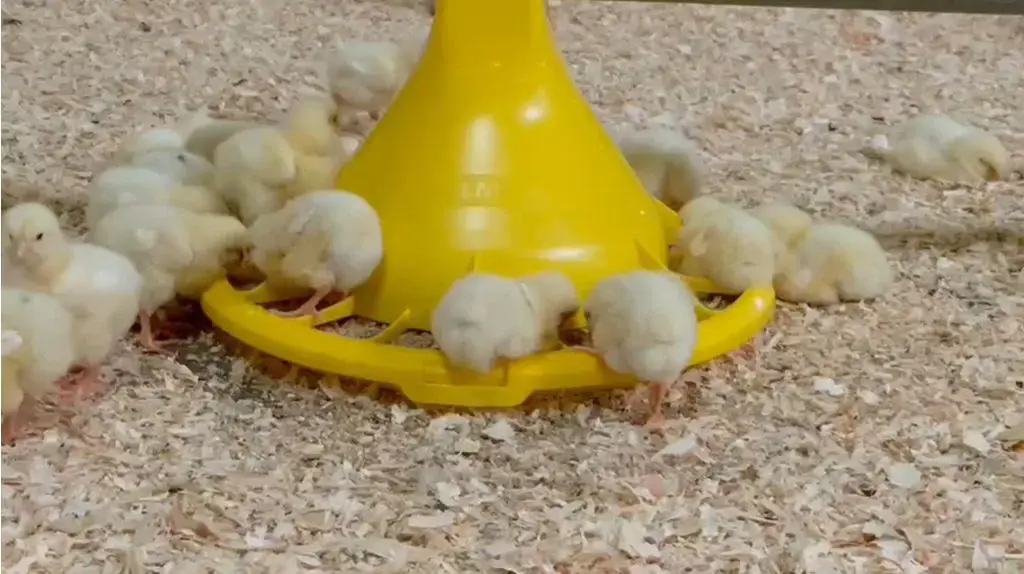
Vijay Raj’s automatic pan feeding system is built for farms of 3,000 birds and more. The standard pan serves 40 birds, with 45, 60 and 100-bird pans available. It works as a closed distribution with cycle delivery, the same pan and nipple line serve birds from day old to the end of the cycle, and feed to any single pan can be shut off with a push of a finger.
Pans Inside Broiler Cages
In multi-tier broiler cages, the pan sits inside each cage section instead of on a floor line. The Automax broiler cage system uses a grill-less Vijay Raj pan, so day-old chicks can feed easily. It has room for 18 to 20 growing chicks at a time, or 12 to 14 grown broilers, and a winch raises the pans as birds grow while nipple lines adjust in height through the cycle.
Cages change the rest of the farm plan too: harvesting, manure and ventilation. If you are still choosing between floor and cage broilers, read our guide to poultry cage systems and how to choose, and see the broiler battery cage range.
Chain Feeders
A chain feeder is an open trough loop with a chain that drags feed from a hopper around the house. The Cobb guide sets a minimum of 2.5 to 4 cm of feed space per bird, a chain speed of 18 m per minute for broilers, and the lip of the track level with the birds’ backs. The Ross Broiler Management Handbook 2025 uses 2.5 cm per bird, with birds eating from both sides of the track.
The trade-off is speed. The Ross handbook notes that chain feeders take longer to distribute feed, so feed is not immediately available to every bird, while automatically filled pans are all filled at the same time. Chain tracks can also act as a barrier on the floor if their height is not kept up with bird growth.
Feed Trolleys for Cage Layers and Pullets
In layer cages, feed sits in long troughs on the front of every tier. A feed trolley runs along the row on rails, carrying feed and dropping a set amount into each trough as it moves. The calculator’s bill-of-quantities rule is one feed trough run per tier per side of each row, and one trolley with its control panel per row.
The Vijay Raj feed trolley system comes in manual and automatic versions. On California cages, feed distribution can be manual or by automatic trolley with feed regulation, up to a fully automated house. The Automax layer cage system is designed for even feed distribution along every trough.
Feed Hopper System for California Breeder Cages
Broiler breeders are fed a controlled ration, so every bird must get its share at about the same time. The California breeder broiler cage uses a galvanised Vijay Raj feed hopper system that spreads feed evenly for uniform growth. In the Automax breeder battery, males and females sit on separate tiers, each with its own feeding, and the Vijay Raj feeding system discharges a uniform, accurate ration to both.
Speed matters for breeders. The Ross Parent Stock Handbook (2018) advises that feed should be distributed within 3 minutes during rearing, so that restricted-fed birds all get equal access.
Feed Silos and Augers
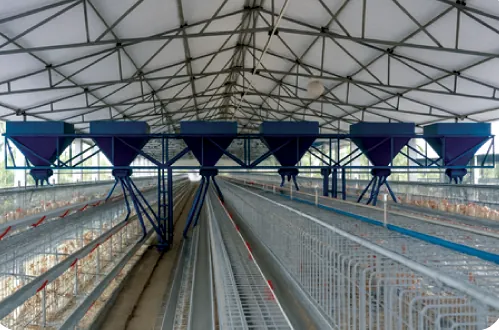
Most automatic systems start outside the house with a bulk feed silo. A fill auger carries feed from the silo into the hopper at the head of each pan line, or into a supply point for the trolleys. A level sensor in the hopper starts and stops the fill auger, so the house never runs dry.
The Cobb guide gives three silo rules worth following: hold about 5 days of feed consumption, install two silos per house so you can switch rations (for example grower to finisher) with an empty silo ready, and keep silos watertight and cleaned between flocks to prevent mould. In humid Indian conditions, the watertight rule deserves extra attention.
How a Pan Feeding Line Works, Step by Step
Every pan feeding line has the same chain of parts. Knowing each one helps you ask the right questions when you compare quotations.
- Bulk store. Feed arrives by truck or in bags and is stored in a silo outside the house, or in a feed room for smaller farms.
- Fill auger. Carries feed from the silo to the house hopper when the hopper level sensor calls for it.
- Line hopper. Sits at the head of each feed line inside the house. The calculator rule is one hopper per feed line, placed in the front service area.
- Feed tube and auger. A motor at the end of the line drives the auger, which pushes feed along the tube and drops it into every pan.
- Pans. Each pan holds a set depth of feed. On the Vijay Raj system, feed to any single pan can be shut off by hand, which is useful when part of the house is empty during brooding.
- Control pan or sensor. Once the last pan is full, the motor stops. The line then refills as birds eat.
- Winch. Cables from a winch at the end wall lift the whole line. Vijay Raj pan and drinker lines are winched up as birds grow with no hand contact, which keeps biosecurity tight. The calculator rule is one winch per line.
- Control panel. In Vijay Raj EC houses, a touch-screen control panel runs the fans, air inlets, lighting and feeding together.
Height, Depth and Daily Routine
Most feed wastage on a pan line comes from wrong settings, not from the equipment. The Ross handbook sets the lip of the pan at the top of the breast and asks for daily height checks. It warns that feeders set too high or too low increase spillage, make feed conversion figures inaccurate, and that spilled feed eaten off the litter carries a higher risk of bacterial contamination.
The same handbook asks for every pan to have the same depth setting, so feed is spread evenly through the house. From about day 10 to 12, let birds clear the pans once a day, then refill immediately. This reduces waste and improves feed efficiency. Cobb adds a simple warning sign: if birds are tipping pans to reach feed, the pans are too high.
For the first days, the Ross handbook advises flooding the pans at chick placement and also spreading feed on paper covering at least 70% of the floor, with the move onto the main feeding system complete by day 6 to 7. The Vijay Raj pan is designed so chicks can feed from it from day old, but many farm managers still use paper for the first few days as the breed guide suggests.
Tip: Walk the full length of each line on the first morning of every flock and look into the last five pans. If they are lower than the first five, the line is not filling evenly. Fix it before the birds are big enough for it to cost you weight.
Feeder Space Norms from the Breed Guides
Too little feeder space slows growth and ruins flock uniformity. Too much is wasted money. The breed companies publish clear figures, and your automatic system should meet them at the final bird weight, not at day old.
| Bird and system | Recommended feeder space | Source |
|---|---|---|
| Broilers, 33 cm pan | 45 to 65 birds per pan | Cobb Broiler Management Guide |
| Broilers, pan (post brooding) | 45 to 80 birds per pan, the lower figure for birds over 3.5 kg | Ross Broiler Handbook 2025 |
| Broilers, pan (brooding) | 100 chicks per pan, plus a little feed on paper | Ross Broiler Handbook 2025 |
| Broilers, chain feeder | 2.5 to 4 cm per bird (Cobb); 2.5 cm per bird, both sides (Ross) | Cobb; Ross |
| Broilers, tube feeder 38 cm | 70 birds per tube | Ross Broiler Handbook 2025 |
| Layers in conventional or colony cages | 4.5 cm per bird to 4 weeks, 5 to 7 cm to 15 weeks, 7 to 9 cm per bird from 15 weeks | Hy-Line Brown Performance Standards, Dec 2025 |
| Breeder females in rearing, pan | 4 cm (0 to 35 days), 8 cm (36 to 70 days), 10 cm (71 to 105 days) per bird | Ross Parent Stock Handbook 2018 |
| Breeder males in rearing, pan | 5 cm, 9 cm and 11 cm per bird over the same age bands | Ross Parent Stock Handbook 2018 |
Sources: Cobb, Ross broiler, Hy-Line Brown, Ross parent stock. Always follow the guide for the exact strain you place, and check local rules on space.
Vijay Raj’s standard 40-bird pan sits below the lower limit of both broiler ranges. In plain terms, it gives each bird a little more feeder access than the minimum the breed guides allow. The 45 and 60-bird pans sit inside both ranges. The 100-bird pan matches the Ross brooding figure, so check with your integrator or breed guide before using it for grown birds.
Tip: Vijay Raj’s own figure of 12 to 14 grown broilers at the pan at once is a useful second check. With 40 birds assigned to each pan, about a third of the flock can eat at the same moment, which keeps birds calm at feeding time.
How to Size a Pan Feeding Line: A Worked Example
Sizing follows the same order every time: floor area, house shape, number of lines, pans per line, then a spacing check against the breed guide. The figures below use the planning guidelines in the Vijay Raj poultry house calculator, which you can run for your own flock size.
Step 1: Floor Area from Bird Numbers
The calculator’s planning guideline is 0.75 sq ft per broiler in an EC house and 1 sq ft per broiler in an open house. For a 15,000-bird EC house, that is 15,000 x 0.75 = 11,250 sq ft, or about 1,045 sq m of bird area. The same flock in an open house would need 15,000 sq ft, or about 1,394 sq m.
Step 2: House Width and Length
The calculator’s default floor house width is 12.2 m (40 ft). Bird area length is 1,045 sq m / 12.2 m, which is about 85.7 m (281 ft). Add the calculator’s 4 m front service area for hoppers and controls and 2 m rear area for fans, and the house is roughly 92 m long. Your plot and the PEB frame span may push you to a different width, which changes every number below.
Step 3: Number of Feed Lines
Two rules of thumb exist, and they give different answers for a 12.2 m house:
- The Vijay Raj calculator divides house width by a 3 m line spacing: 12.2 / 3 gives 4 feed lines.
- The Cobb guide suggests 2 lines under 12 m width, 3 lines for 12 to 15 m, 4 lines for 15 to 20 m and 5 lines for 20 to 25 m, noting the actual number varies with stocking density and feeder spacing.
The pan spacing check in step 5 decides which one works for your pan size.
Step 4: Number of Pans
Pans = birds / birds per pan. With the Vijay Raj standard 40-bird pan: 15,000 / 40 = 375 pans. With 4 lines, that is about 94 pans per line (376 in total).
Step 5: Check the Pan Spacing
Allow roughly 84 m of usable line length inside the 85.7 m bird area. The Ross parent stock handbook gives a minimum of 0.75 m between pan centres in a line. It is written for breeders, but it is a sensible floor for broiler lines too, and your supplier’s drawing should show the spacing.
| Option | Total pans | Lines | Pans per line | Centre-to-centre spacing | Passes 0.75 m check? |
|---|---|---|---|---|---|
| 40-bird pan, 3 lines | 375 | 3 | 125 | about 0.68 m | No |
| 40-bird pan, 4 lines | 376 | 4 | 94 | about 0.90 m | Yes |
| 45-bird pan, 3 lines | 334 | 3 | 112 | about 0.76 m | Only just |
| 60-bird pan, 3 lines | 252 | 3 | 84 | about 1.01 m | Yes |
Spacing is usable line length divided by the gaps between pans (pans per line minus 1). The result: 40-bird pans need 4 lines in this house, while 60-bird pans fit on 3 lines. Fewer lines mean fewer hoppers, motors and winches, so the choice has a real cost effect. Match it against the breed guide range and the weight you sell at.
Step 6: Drinkers, Hoppers, Winches and Silo
- Nipple lines. The calculator rule is feed lines + 1, so 5 nipple lines for the 4-line option, placed so every bird has water and feed close together.
- Nipples. At the calculator’s guideline of 12 birds per nipple, 15,000 / 12 = 1,250 nipples, about 250 per line. Ross gives 12 birds per nipple for birds under 3 kg and 9 for heavier birds. See our guide to choosing poultry nipple drinkers and the Vijay Raj nipple drinking system.
- Hoppers and winches. One hopper and one winch per feed line: 4 each for the 4-line option.
- Silo. Silo capacity = birds x peak daily feed intake per bird x 5 days, following Cobb’s 5-day rule. Take peak daily intake from your breed’s performance objectives for your sale age. Plan two silos if you switch rations during the flock.
Step 7: The Eating-At-Once Check
With 376 pans and 12 to 14 grown broilers at each Vijay Raj pan, 4,512 to 5,264 birds can eat at the same moment. That is about 30 to 35% of the 15,000-bird flock. If a design gives a much lower share, birds will crowd the pans and uniformity will suffer.
Feed Wastage and FCR: Putting a Rupee Value on It
Suppliers often promise “zero wastage” and better FCR. Some of that is real: ICAR-CCARI notes that automatic flat chain and tube feeders on large farms supply small amounts of feed continuously, with “almost NIL wastage”, and it lists over-filled feeders as a cause of loss. But the exact saving on your farm depends on how badly feed is wasted now, which only you can measure.
Instead of trusting a headline percentage, work out what each 1% of wastage costs you. Here is the method with sourced inputs.
- Feed per bird. The Ross 308 performance objectives (2022) give an as-hatched live weight of 2,296 g at day 35 with an FCR of 1.418. Feed per bird is 2.296 x 1.418, or about 3.26 kg. These are breed targets; Indian field results are often weaker, so use your own records if you have them.
- Feed per flock. 15,000 birds x 3.26 kg = about 48,900 kg.
- Feed price. NABARD’s Unit Cost 2023-24 booklet (Jharkhand Regional Office) uses Rs 30 per kg in its broiler model. Replace it with your current price.
- Feed bill per flock. 48,900 x Rs 30 = about Rs 14.7 lakh.
- Value of 1% wastage. 489 kg, or about Rs 14,700 per flock. Over six flocks a year, that is close to Rs 88,000 for every 1% of feed lost.
- Value of FCR. An FCR 0.05 worse than target means 15,000 x 2.296 kg x 0.05 = about 1,720 kg of extra feed, or about Rs 51,700 per flock at the same price.
Now estimate your current loss. Weigh the feed that goes into the house for one flock, weigh the birds sold, and compare your FCR with the breed target. Look under feeders for spilled feed in the litter. If the gap to target is large and spillage is visible, an automatic line with correctly set pans will pay back faster than on a farm that is already well managed by hand.
Labour Savings: How to Calculate Yours
There is no reliable published figure for hours saved per 1,000 birds in Indian conditions, because it depends on the house, the feeders and the team. You can work it out for your own farm in four steps.
- For one week, record the time spent carrying feed, filling feeders, adjusting feeder height and cleaning spilled feed in each house.
- Convert it to worker-days per month: total hours per month divided by the hours in one working day.
- Multiply by your monthly wage. For reference, NABARD’s 2023-24 unit cost booklet budgets labour at Rs 12,000 per month in its layer model.
- Subtract the time the automatic system still needs: daily line walks, pan checks, winch adjustments and between-flock cleaning.
For example, if feeding work takes the equivalent of one full-time worker per house and automation frees that person for other jobs, the saving at the NABARD wage is Rs 1.44 lakh a year per house. The larger benefit is often consistency: feed arrives on time even on days when a worker is absent.
Power, Backup and Controls
Automatic feeding depends on electricity. If the auger stops in a hot afternoon, birds go without feed, and in an EC house the fans stop too. The Ross broiler handbook says a backup system or generator and an alarm must be installed in case of power failure, and recommends testing the backup at full capacity at regular intervals.
- Know your connected load. Ask every supplier for the rated kW of each motor: fill augers, line motors, trolley drives, winches (if motorised), fans and pumps. Add them to size the generator, with a margin for motor starting current.
- Automatic changeover. An automatic transfer switch starts feeding and ventilation again without waiting for someone to arrive.
- Alarms. A power-fail and high-temperature alarm that reaches a phone is cheaper than one lost flock.
- Manual fallback. Keep a few manual feeders and a way to hand-crank winches for long outages.
- Controller settings. In EC houses, the Vijay Raj touch-screen panel runs fans, air inlets, lighting and feeding together. Record your feeding times and settings so a new supervisor can restore them after a fault.
Ventilation and cooling are covered in detail in our guide to cooling a poultry house, and the equipment is on the exhaust fans and evaporative cooling pads pages.
Maintenance Checklist
Automatic systems fail slowly and then all at once. A simple routine keeps them working through many flocks.
Every Day
- Check that the last pan on every line is full after each cycle.
- Check pan or trough height against the birds, as the Ross handbook advises.
- Listen for auger or trolley motors running longer than usual, which can mean a blockage or an empty silo.
- Look for caked feed in pans, which points to leaks or wet feed.
Between Flocks
- Empty, wash and disinfect pans, hoppers and troughs.
- Clean the silo and check it is watertight, as Cobb recommends.
- Check auger wear, winch cables and pulleys, and the level sensors.
- On chain feeders, check corners and chain tension, which Cobb lists as key to preventing breakdowns.
- On trolleys, check rails, wheels, drive and the feed regulation setting on each row.
- Test the generator on full load and the changeover switch.
Tip: Keep a small stock of wear parts (pans, drop tubes, sensor, winch cable, auger connectors) on the farm. A two-day wait for a courier in the middle of a flock costs more than the parts.
What Drives the Cost of Automation
No government or bank source publishes a rupee cost for automated feeding lines in India. The NABARD Unit Cost 2023-24 booklet (Jharkhand Regional Office) does give useful benchmarks for small manual units:
| Item in NABARD model | Unit cost 2023-24 | What it covers |
|---|---|---|
| Broiler equipment, 500-bird deep litter unit | Rs 45 per bird | Manual feeders and drinkers |
| Broiler shed, 600 sq ft | Rs 319 per sq ft | Civil structure |
| Cage and layer equipment, 5,000-bird cage unit | Rs 170 per bird | Cages and layer equipment |
| Layer civil structure | Rs 275 per sq ft at 1 sq ft per bird | Civil structure |
| Feed | Rs 30 per kg | Model assumption |
These figures are for small manual units in one state, used by banks to appraise loans. They do not price an automatic pan line, silo, trolley or EC controller. For comparison, an older NABARD model scheme for a 10,000-bird broiler farm (hosted by TNAU Agritech) budgeted Rs 25 per bird for equipment and Rs 150 per sq ft for the shed, which shows how quickly these costs move. Always get a current, itemised quotation.
What pushes the price of an automatic feeding system up or down:
- Number of lines or rows. Each pan line needs its own hopper, motor and winch. Each cage row needs its own trolley and control panel.
- Line length and pan count. Longer houses need more tube, auger and pans, and may need a larger drive.
- Pan size. Larger pans reduce pan count and sometimes the number of lines, as the sizing table shows.
- Silo and fill system. Number of silos, their capacity, and the distance from silo to house.
- Controls. A simple timer costs far less than a touch-screen panel that also runs ventilation and lighting.
- Housing type. Cages carry more steel and more feeding points per square metre than a floor house.
- Power backup. Generator, changeover and alarms are part of the real cost.
- Installation, transport and site work. Ask whether they are included.
Fully Automatic Poultry Farm Cost in India, Explained Honestly
“Fully automatic” means different things to different sellers. For a broiler farm, it usually means automatic pan feeding, nipple drinking and an EC ventilation package. For a layer farm, it adds automatic feed trolleys, egg collection and manure removal. The cost difference between those two definitions is large.
Pages that quote a single lakh figure for a “fully automatic farm” rarely say what is included, and none of the ones we reviewed cited a source. The honest approach is to build your own estimate:
- Fix the flock size and bird type, then run the poultry house calculator for house size, lines, rows and equipment counts.
- Get a current rate for the shed (civil or PEB poultry house) per sq ft from at least two builders.
- Ask equipment suppliers for an itemised quote against the same bill of quantities: feeding, drinking, climate, egg and manure handling, controls.
- Add land development, water source, electrical connection, generator, feed store and staff facilities.
- Add working capital for the first flock: chicks, feed, medicine and wages.
- Check which items qualify for bank loans and government schemes. Our guide to poultry farm subsidy and loans in India covers the main routes.
If you want one partner to handle the house, equipment and commissioning, see what a turnkey poultry farm project includes and the turnkey broiler projects page.
What to Automate First: A Phased Roadmap
Few farms automate everything on day one. The right order puts money where it saves the most feed and labour, and never adds equipment the farm cannot power or maintain.
| Phase | What to add | Why this order | Must be in place first |
|---|---|---|---|
| 0. Foundations | Reliable power with backup, clean water supply, correct shed size and layout | Every automatic system depends on power and water; a wrong shed size cannot be fixed later | Site plan and calculator run |
| 1. Drinking | Nipple lines with pressure regulators and filters | Low cost per bird, keeps litter dry, removes daily drinker washing | Water source and header tank |
| 2. Feeding | Pan lines (floor broilers and breeders) or feed trolleys (cage layers), plus hoppers and winches | Feed is 60 to 70% of cost, so even distribution and less spillage give the biggest return | Backup power and a feed store or silo |
| 3. Bulk feed | Silo and fill auger, ideally two per house | Removes bag handling and keeps feed dry; needs a feed supply by truck | Phase 2 lines and a feed supplier who delivers bulk |
| 4. Climate | Exhaust fans, cooling pads and a control panel (EC house) | Allows higher stocking and steadier growth in summer; multiplies the benefit of automatic feeding | Closed house design and a generator sized for fans |
| 5. Layer and breeder extras | Automatic egg collection, manure belts and drying | Next largest labour item on layer and breeder farms | Cage system chosen with these options in mind |
| 6. Integration | One controller for feeding, climate and lighting, with alarms and records | Turns separate systems into one managed house | All of the above working reliably |
Two notes on the order. For a new EC broiler house, phases 1, 2 and 4 are usually installed together, because the house is designed around them. For a cage layer farm, choose cages that accept an automatic trolley and egg collection later, such as the California range, even if you start with manual feeding. The main broiler pan feeding and EC house page shows how Vijay Raj combines the pieces for floor broilers.
Common Mistakes When Buying an Automatic Feeder
- Sizing for day-old chicks. Lines and pans must meet the breed guide at final weight. Check birds per pan at the weight you sell at.
- Skipping the spacing check. As the sizing table shows, too many pans crammed on too few lines breaks the minimum pan spacing.
- No backup power. One long outage can undo years of feed savings. Budget the generator with the feeding line, not after.
- One small silo. Cobb recommends 5 days of feed and two silos per house. A small single silo forces rushed ration changes.
- Wrong pan height. The Ross handbook links wrong height directly to spillage and contaminated feed on the litter.
- Never letting pans empty. Letting birds clear the pans once a day from about day 10 to 12 cuts waste.
- Automating feed but not water. Birds eat as much as they drink. Pair pan lines with nipple lines from the start.
- Buying on price alone. Compare galvanising, spare parts, service response and training, not only the rate per pan.
- No training. The team must know how to set depth, height and timers, and what to do when an alarm goes off.
A good automatic feeding system is sized from the breed guide, backed by reliable power and maintained between every flock. If you want your house layout, line count and equipment list checked against your flock plan, talk to a Vijay Raj engineer.
Frequently Asked Questions
What is an automatic poultry feeding system?
It is equipment that moves feed from a bulk store to the birds without hand filling. On floor houses, an auger carries feed from a silo and hopper along a tube into pans. In cage houses, a trolley runs along each row and drops feed into troughs on every tier. A timer, sensor or control panel decides when feed is delivered.
How many birds can one pan feeder serve?
The Cobb broiler guide recommends 45 to 65 birds per 33 cm pan, and the Ross 2025 handbook gives 45 to 80 birds per pan after brooding, using the lower figure for birds over 3.5 kg. Vijay Raj's standard pan serves 40 birds, with 45, 60 and 100-bird pans available. Size to the weight you sell at, not day old.
How much does an automatic poultry feeder system cost in India?
No government or bank source publishes a rupee rate for automatic feeding lines. Cost depends on the number of lines, line length, pan size, silos, controls and power backup. NABARD's 2023-24 unit costs cover only manual equipment, for example Rs 45 per bird for broiler feeders and drinkers. Get an itemised, current quotation against your house plan.
Is automatic feeding worth it for a small poultry farm?
It depends on flock size, labour cost and current wastage. Vijay Raj's pan feeding system is designed for farms of 3,000 birds and more. Below that, good manual feeders and nipple drinkers are often the better first step. Work out what each 1% of feed wastage costs you per flock and compare it with the quotation.
Which is better for broilers, pan feeders or chain feeders?
The Cobb guide generally recommends pan feeders because birds move freely around them, they spill less and they improve feed conversion. The Ross handbook adds that automatically filled pans all fill at the same time, while chain feeders take longer to deliver feed along the track. Chain feeders make feed depth easier to adjust from one hopper.
How many feed lines does a broiler house need?
The Cobb guide suggests 3 feed lines for houses 12 to 15 m wide and 4 lines for 15 to 20 m. The Vijay Raj calculator divides house width by a 3 m line spacing, giving 4 lines for a 12.2 m house. Check the result against pan spacing: pans in a line should be at least 0.75 m apart, centre to centre.
What happens to an automatic feeder during a power cut?
The augers, trolleys and, in EC houses, the fans stop. The Ross broiler handbook says a backup generator and an alarm must be installed in case of power failure, and the backup should be tested at full capacity regularly. Size the generator from the rated kW of every motor and add automatic changeover so feeding restarts on its own.
Does automatic feeding improve FCR?
It can, mainly by cutting spillage and spreading feed evenly so all birds eat at once. The Ross handbook links wrong feeder height to extra spillage and inaccurate FCR figures. The gain depends on your current management. As an example, an FCR 0.05 above target on 15,000 Ross 308 birds at 2.3 kg means about 1,720 kg of extra feed per flock.
Sources
- Aviagen: Ross Broiler Management Handbook (2025)
- Aviagen: Ross 308 Broiler Performance Objectives (2022)
- Aviagen: Ross Parent Stock Management Handbook (2018)
- Cobb-Vantress: Cobb Broiler Management Guide (2021)
- Hy-Line International: Hy-Line Brown Commercial Layers Performance Standards Guide (2025)
- ICAR-CCARI: Economic feeding of backyard poultry, Extension Folder No. 105 (2023)
- NABARD Jharkhand Regional Office: Unit Cost 2023-24 (2023)
- NABARD (via TNAU Agritech): Model bank project, Poultry Broiler Farming