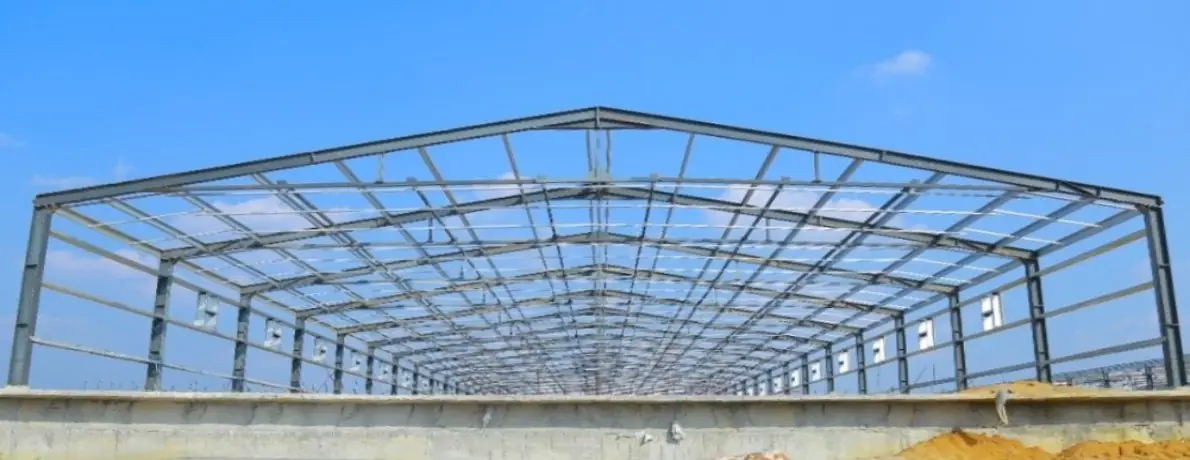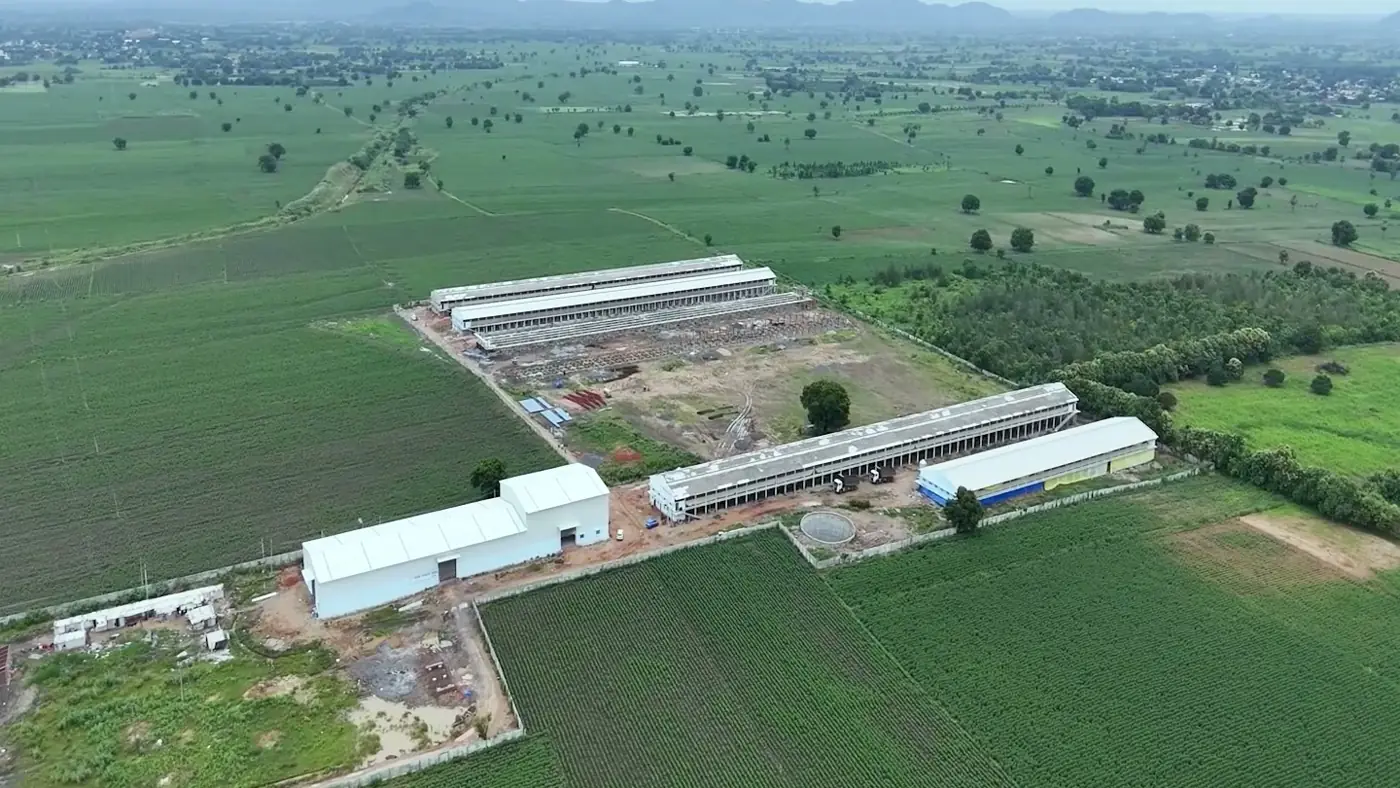


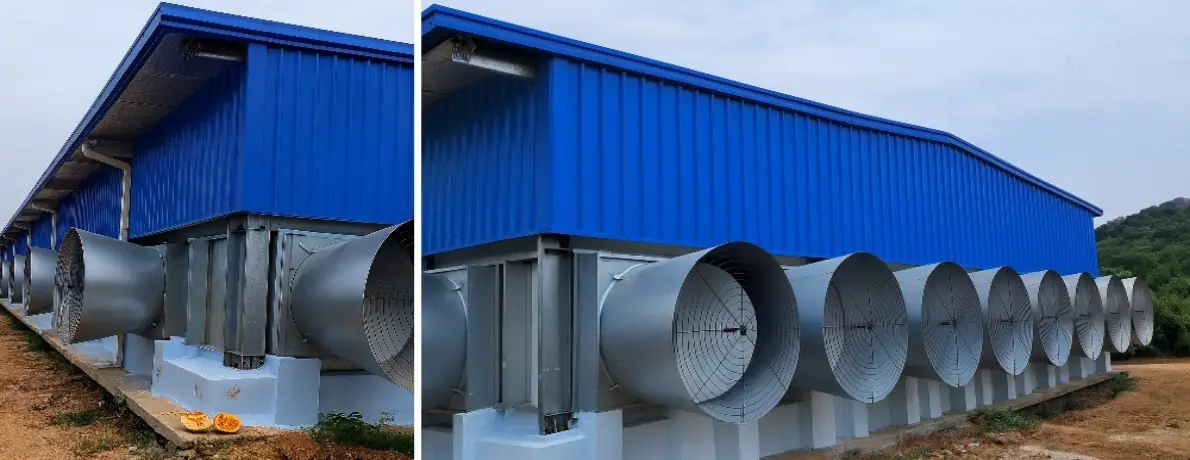
In this guide 13 sections
- What heat stress does to your birds
- How much heat stress costs
- The cooling options, from simplest to most controlled
- How a pad and fan system actually cools
- Sizing a tunnel ventilation system: the method
- Worked example: a typical EC broiler house
- Which cooling for your climate and house
- When fogging works and when it fails
- Water quality for pads and foggers
- Emergency plan for a heat wave
- Maintenance schedule
- Costs: what drives the price
- Putting it together
A poultry house cooling system in India combines air speed with evaporation. Open houses use curtains, roof sprinklers, foggers and stir fans. Environment-controlled (EC) houses use tunnel ventilation: exhaust fans pull air through wet cellulose cooling pads at about 3 m/s. Size fans from the house cross-section and pads from total fan airflow.
Heat is the most expensive seasonal problem on an Indian poultry farm. This guide explains how heat stress works, what each cooling option can and cannot do in your climate, and how to size fans and pads with a worked example you can repeat for your own house.
What Heat Stress Does to Your Birds
A chicken has no sweat glands. It loses heat by radiation, convection and conduction while the air is cooler than its body, and by panting once the air gets too warm. Hy-Line’s technical update on heat stress in layers puts the thermoneutral zone of the chicken at 18 to 25 °C, with a normal body temperature of 41 °C. Above that zone the bird spends energy on cooling itself instead of on growth and eggs.
The same Hy-Line document notes that above 33 °C high mortality and large production losses become obvious. Below that, losses are quieter: slightly smaller eggs, thinner shells, a few grams less weight gain per day. Many farms miss these because nobody is dying yet.
Signs to Watch for
- Panting: rapid, shallow, open-mouth breathing. Aviagen’s Arbor Acres bulletin says birds begin to pant when the temperature rises about 5 to 7 °C above their comfort zone.
- Wings held away from the body and drooping, to expose more skin to moving air.
- Birds moving to walls, inlets or wet spots, or lying flat on litter to lose heat by contact.
- Feed intake drops and water intake jumps. Hy-Line gives the water to feed ratio as about 2:1 at 21 °C, rising to 8:1 at 38 °C.
- Listless, then collapsed birds. When panting cannot hold body temperature, birds become listless, then comatose, and die.
- In layers: thin or weak shells, because heavy panting upsets the blood’s acid balance and less calcium reaches the shell gland.
Behaviour also tells you whether your system is working along the whole house. The Auburn University 10-point guide to tunnel ventilation points out that birds behaving differently at the two ends of a house usually means airflow is not enough.
Temperature Alone Is Not the Measure: Humidity Matters
Panting cools a bird by evaporating water from its airways. In humid air, that evaporation slows, so the same temperature feels much hotter. Two simple indices let you judge heat stress from a thermometer and a hygrometer.
Rule of thumb (Aviagen). The Arbor Acres service bulletin on hot season management in open-sided houses, written by Aviagen’s India technical team, adds temperature in °F and relative humidity (RH) in percent. From 27 °C upward, if the sum reaches 160 or more (107 or more when you use °C), expect heat discomfort and lost performance. For example, 35 °C and 72 percent RH add up to 107 in the °C version.
Heat stress index for layers (Hy-Line). Hy-Line uses an index adapted from Iowa State University research:
- Heat stress index = 0.6 x dry bulb temperature + 0.4 x wet bulb temperature (both in °F)
- Below 70: comfort zone, no action needed
- 70 to 75: alert. Increase ventilation, speed up fans, use foggers based on humidity
- 76 to 81: danger. Start pads and tunnel ventilation, move air over birds at 1.8 to 2.0 m/s
- Above 81: emergency. Avoid handling birds, do not feed in the hottest hours, dim the lights
On Hy-Line’s chart, 30 °C with 55 percent RH already reads 79 (danger), and 32 °C with 60 percent RH reads 83 (emergency). That describes a normal pre-monsoon afternoon across much of peninsular and coastal India.
Tip: Buy a digital thermo-hygrometer for every house and hang it at bird height in the middle of the house, not near the door. Record temperature and humidity at 6 am, 2 pm and 10 pm through the summer. Two weeks of readings will tell you more about which cooling system suits your site than any brochure.
How Much Heat Stress Costs
Losses come from three places: birds that die, birds that grow or lay less, and feed that is wasted because conversion gets worse. Research figures give a sense of scale.
- Broilers: a 2013 review in the journal Animals, Impact of Heat Stress on Poultry Production (Lara and Rostagno), cites a study where broilers under chronic heat stress ate 16.4 percent less feed, weighed 32.6 percent less and had a 25.6 percent higher feed conversion ratio at 42 days.
- Layers: the same review cites a 12-day heat stress period that cut feed intake by 28.58 g per bird per day and egg production by 28.8 percent.
- National scale: the review quotes an estimate that heat stress costs the US poultry industry 128 to 165 million US dollars a year. We could not find a comparable published estimate for India.
- Heat waves in India: Deccan Chronicle reported in May 2026 that a heat wave killed about 20 lakh broilers and layers in the Godavari districts of Andhra Pradesh, with the state poultry federation putting the loss at about Rs 50 crore in one week.
The practical lesson: mortality is the loss everybody sees, but slower growth and lower lay across the whole summer usually cost more. A cooling system pays for itself by protecting daily production, not only by preventing deaths on the worst day.
The Cooling Options, from Simplest to Most Controlled
Every method works on one of two principles, often both. Air speed strips heat from the bird’s body (the wind chill effect). Evaporation cools the air itself by turning water into vapour. Shade and insulation reduce how much heat enters the house in the first place.
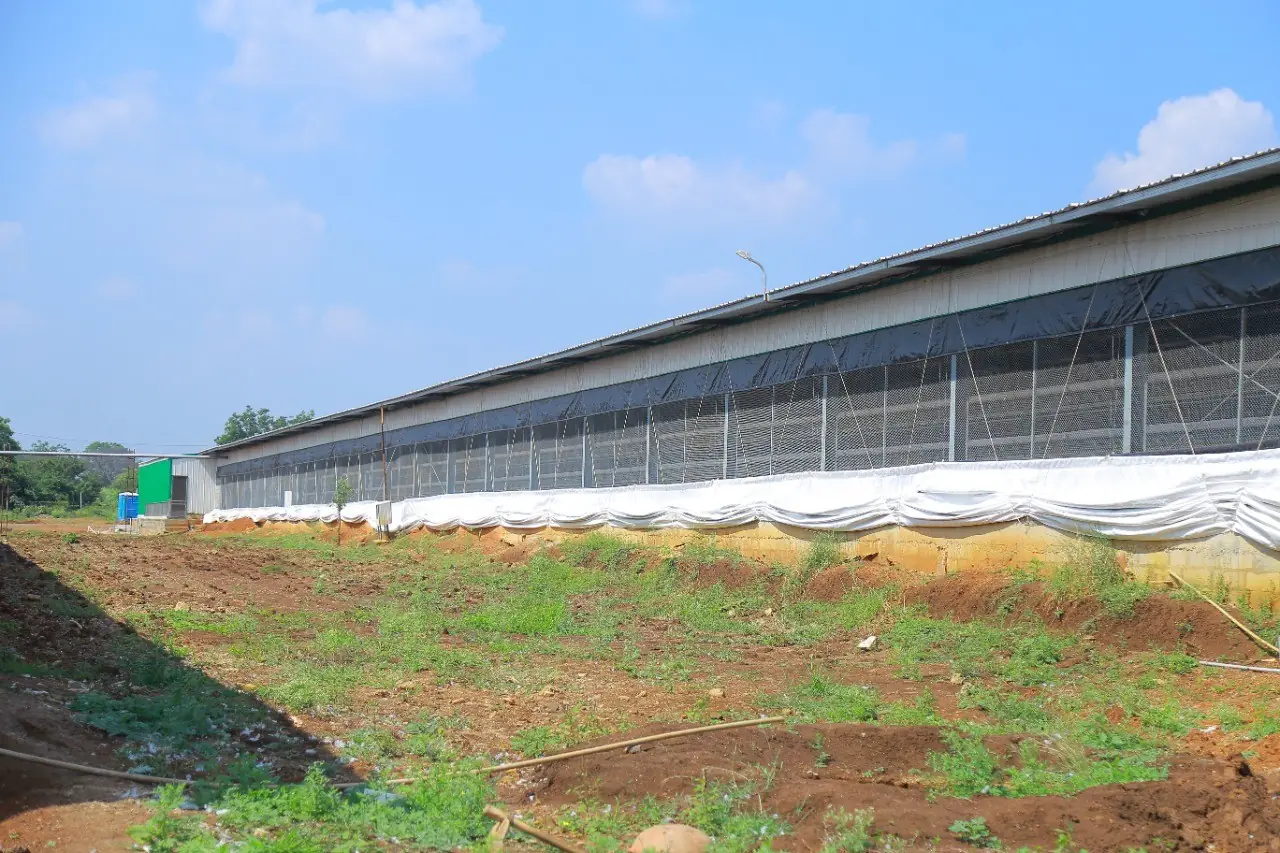
Natural Ventilation, Orientation and Curtains
An open house is cooled by cross breezes through the side walls and hot air escaping through a ridge vent. How well that works depends mostly on decisions made before construction. Hy-Line’s open-house guidance recommends an east-west orientation to reduce sun on the side walls, a roof overhang of more than 1.1 m so direct sun does not reach the birds, an open ridge for the chimney effect, and low-cut grass around the house instead of bare ground.
Curtains let you close the sides at night and in the rains and open them fully on hot days. In summer they should be fully open during the day unless you are converting the house to tunnel mode. Keep window screens free of dust and cobwebs, which quietly choke airflow.
Natural ventilation has a hard limit: on still, humid afternoons there is no breeze to use. That is why most open houses in India add stir fans. Hy-Line suggests stir fans in open houses to give at least 1.8 to 2.0 m/s of air speed in the bird zone, and its diagram shows 92 cm fans placed about 15 m apart.
Roof Insulation, Reflective Roofs and Roof Sprinklers
A bare metal or asbestos roof in April sun becomes a large radiant heater over your birds. Three fixes, in rising order of cost:
- Reflective paint or whitewash on the roof. Aviagen lists painting the roof white among its hot season measures.
- Thatch or insulation. Hy-Line shows paddy straw, corn stalks or sugarcane tops laid on roofs, and recommends insulated roofs to cut radiated heat.
- Roof sprinklers. Hy-Line notes that sprinkling the roof during extreme heat removes heat from the roof and cools the house below. It uses water, so check your borewell yield before relying on it.
For new sheds, the roof decision is made with the structure. Vijay Raj pre-engineered poultry houses are built either as insulated EC houses or as curtain-sided open houses, designed for the site’s wind, seismic, rain and collateral loads. If you are still comparing frames and spans, see our guide to PEB poultry sheds, frame types and spans.
Sprinklers Inside the House
In-house sprinkler lines spray coarser droplets than foggers. Vijay Raj’s sprinkler cooling system produces 50 to 100 micron mist, a range chosen to cool the air and settle dust without soaking the litter, with typical cooling of 5 to 10 °C depending on humidity. The dust and ammonia control is a real bonus on dry, dusty sites. The risk is wet litter if droplets get too large or the system runs too long, so run sprinklers in short cycles with fans on.
Fogging and Misting
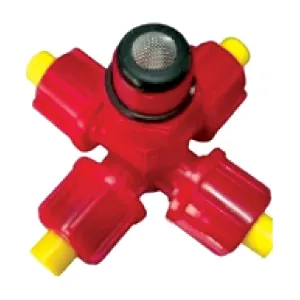
Foggers break water into very fine droplets that evaporate in the air, pulling heat out of it. Droplet size depends on pressure. The University of Kentucky’s chapter on fogging and misting systems gives about 72 microns at 40 psi and about 32 microns at 200 psi. For scale, it notes that a printed full stop is about 500 microns.
Vijay Raj’s high-pressure fogging system produces 10 to 12 micron droplets that evaporate before reaching birds, lowering house temperature by 3 to 8 °C depending on humidity, with low litter wetting and lower energy use than pad cooling. The system is designed to hold relative humidity at 50 to 70 percent.
Fogging works best in open houses with stir fans, and as a boost in EC houses on the hottest days. Aviagen’s field data from India show why foggers must run with fans: foggers alone lifted humidity so much that birds stayed above the heat stress line from evening until morning. Its bulletin states plainly that fogging without circulation fans is not recommended.
Evaporative Cooling Pads with Tunnel Ventilation
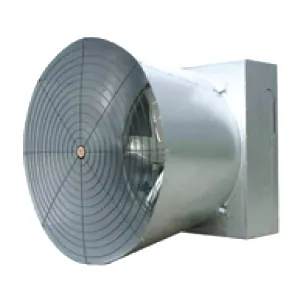
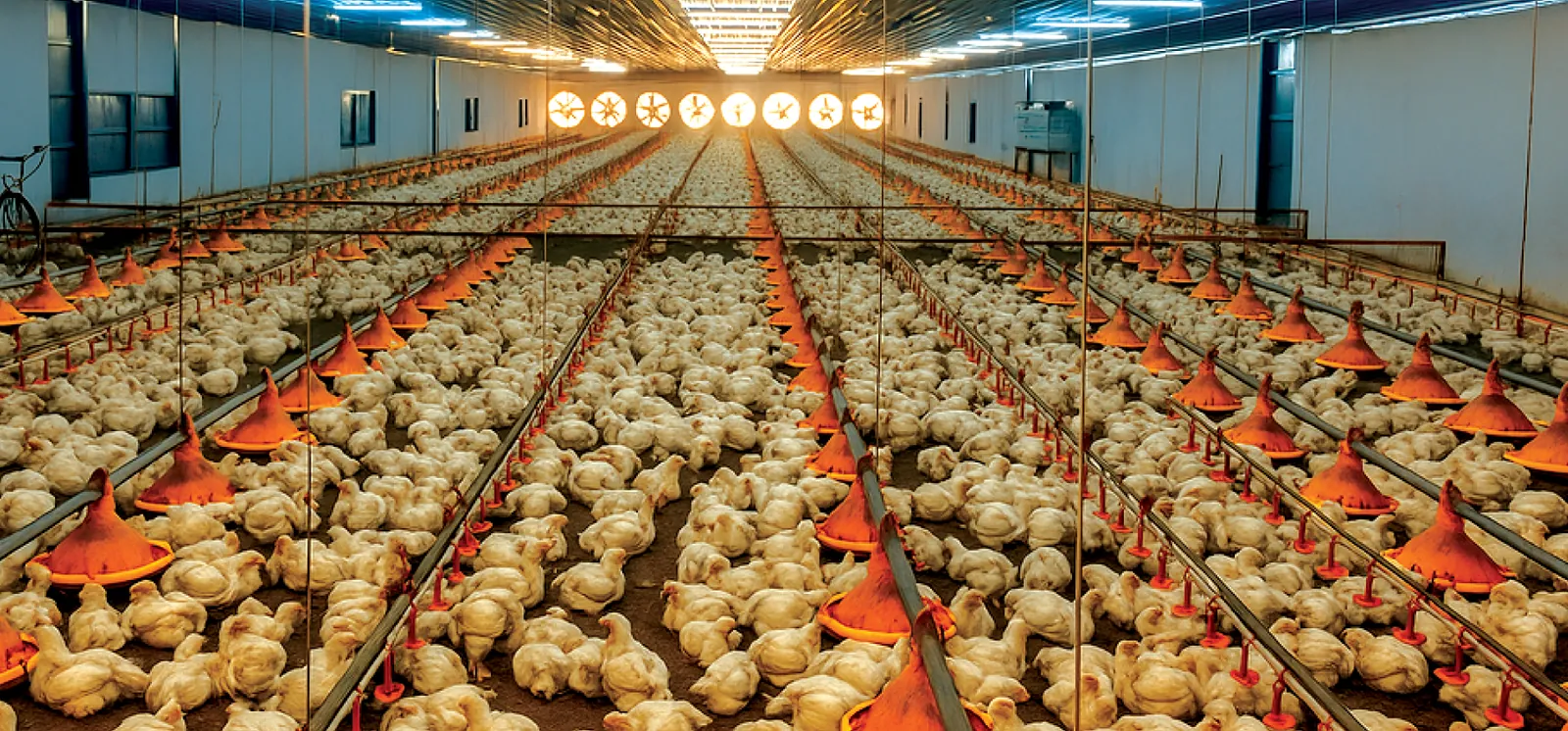
This is the most controlled system and the standard for EC houses. The house is closed. Large exhaust fans at one end pull all incoming air through wet cellulose pads at the other end, and the air travels the full length of the house at high speed. Birds get two effects at once: cooler air from the pads and wind chill from the air speed.
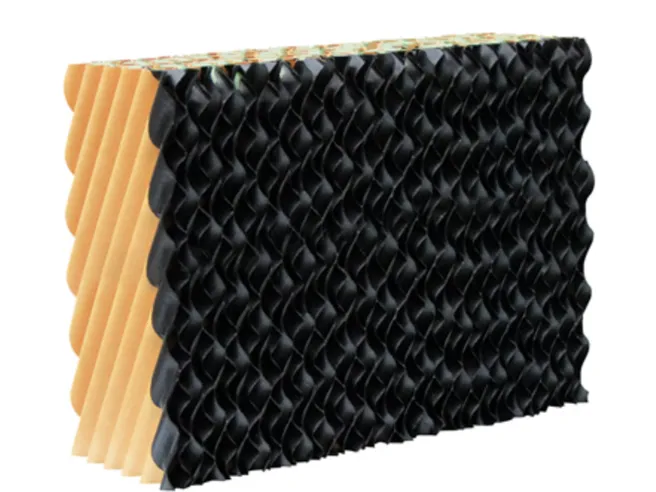
Vijay Raj evaporative cooling pads use impregnated cellulose with a cross-fluted, unequal-angle structure (60/45 and 30/15 degree flutes) that mixes air and water at a low pressure drop. The pad edges are coated to resist algae and scale, and the pads work with tap water. In Vijay Raj broiler projects the EC package pairs box fans and cooling pads with pan feeding and nipple drinking in an EC house.
Vijay Raj’s planning guidance is that open houses suit flocks under about 33,000 layers or 25,000 broilers. Larger flocks and tall multi-tier cage systems generally need an insulated EC house with tunnel ventilation.
Exhaust Fans: Box Fans and Cone Fans
Fans do the real work in tunnel ventilation, so choose them on tested airflow and efficiency, not on diameter alone. Two points from the Mississippi State University Extension publication Fan Selection for Poultry Housing (2019):
- Tests of 50 inch fans at 0.10 inch of static pressure showed airflow from 18,000 to 28,600 CFM and efficiency from 14.3 to 24.5 CFM per watt. Two fans of the same size can differ by more than 50 percent.
- A discharge cone and good housing design can improve airflow by at least 15 percent. The authors suggest choosing fans with at least 20 CFM per watt at 0.10 inch.
Vijay Raj supplies both types as exhaust box fans and cone fans, developed from Vijay Raj airflow data. Box fans come in 24, 36, 48 and 50 inch sizes and move about 10,000 to 28,000 CFM. Cone fans run from 36 to 57 inch and reach about 55,000 CFM for tunnel ventilation in long houses. Housings are galvanised, blades are stainless steel, and both direct and belt drives are available.
| Point | Box fan | Cone fan |
|---|---|---|
| Vijay Raj sizes | 24, 36, 48, 50 inch | 36 to 57 inch |
| Vijay Raj airflow | About 10,000 to 28,000 CFM | Up to about 55,000 CFM |
| Best use | Shorter EC houses, minimum and transition ventilation, stages of a tunnel system | Long tunnel houses where you want fewer, larger fans |
| Efficiency | Depends on tested model | Discharge cone improves airflow by at least 15 percent (MSU Extension) |
| What to ask the supplier | Airflow and CFM per watt at your working static pressure, usually 0.10 to 0.15 inch of water | |
How a Pad and Fan System Actually Cools
Understanding the mechanism helps you run it well.
- The house is sealed. Doors, curtains, gaps and ceiling traps are closed so all air must enter through the pads. Auburn’s guide lists sealing all leaks as essential, because air that sneaks in elsewhere is uncooled.
- Fans create a slight vacuum. Hy-Line gives a working static pressure range of 12.5 to 30 Pa (0.05 to 0.12 inch of water) for adequate, uniform airflow.
- Air passes through wet pads. Water trickles down the flutes from a distribution pipe. Air evaporates some of it and loses heat. Kentucky’s chapter on evaporative cooling systems gives 80 to 90 percent efficiency as typical for well-designed cellulose pads in good condition.
- Air speeds through the house. Cobb’s breeder management guide uses 3 m/s (600 feet per minute) as the design air speed for production houses. The wind chill lowers the temperature the birds feel. Cobb says this effective temperature can be 1 to 8 °C below ambient, depending on air speed, bird age and humidity, and it should be kept below 30 °C.
- Warm air leaves through the fans. Air picks up bird heat along the house. Cobb targets a rise of no more than 2.8 °C from the pad end to the fan end on the hottest day.
Why Humidity Limits Every Evaporative System
Pads and foggers can only cool air down towards its wet bulb temperature, the lowest temperature evaporation can reach. The drier the air, the bigger the gap between dry bulb and wet bulb, and the more cooling you get. The pad outlet temperature can be estimated with a simple formula:
- Air leaving the pad = outside temperature minus (pad efficiency x (outside temperature minus wet bulb temperature))
The table below applies that formula with an 80 percent efficient pad, the low end of Kentucky’s typical range. Wet bulb values are calculated from temperature and RH with the standard psychrometric approximation. The last two columns apply Hy-Line’s heat stress index to the outside air and to the air leaving the pad, before any wind chill.
| Outside air | Typical of | Wet bulb | Air after pad | Cooling | Index outside | Index after pad |
|---|---|---|---|---|---|---|
| 42 °C, 20% RH | Dry inland summer afternoon | 24.1 °C | 27.7 °C | 14.3 °C | 95 | 79 |
| 40 °C, 30% RH | Deccan plateau, April and May | 25.9 °C | 28.7 °C | 11.3 °C | 94 | 82 |
| 38 °C, 40% RH | Late summer inland | 27.0 °C | 29.2 °C | 8.8 °C | 92 | 83 |
| 35 °C, 55% RH | Pre-monsoon | 27.6 °C | 29.0 °C | 6.0 °C | 90 | 83 |
| 34 °C, 70% RH | Coastal summer | 29.3 °C | 30.3 °C | 3.7 °C | 90 | 86 |
| 32 °C, 85% RH | Monsoon break, humid coast | 29.8 °C | 30.3 °C | 1.7 °C | 88 | 86 |
Two lessons stand out. First, a pad that gives 14 °C of cooling in a dry May afternoon gives under 2 °C on a humid monsoon day. Second, even well-cooled air still sits in Hy-Line’s danger or emergency band in still air. The air speed is what brings birds back to comfort. That matches Auburn’s guidance that airflow is the most important factor in hot weather, and a Mississippi State study summarised by The Poultry Site noting that above about 80 percent humidity pads give very little benefit.
Tip: On humid days, do not add more water to fight the heat. Add air speed. Run every tunnel fan, keep inlets fully open and turn the foggers off. Wet air with no evaporation left in it only raises the heat stress index.
Sizing a Tunnel Ventilation System: The Method
You can check any quotation with five calculations. Metric and CFM are both used because fan ratings in India are usually quoted in CFM. Convert with 1 m³ per minute = 35.3 CFM.
Step 1: Pick the Design Air Speed
Cobb uses 3.0 m/s (600 feet per minute) for production houses. The University of Georgia’s Poultry Housing Tips newsletter works examples at 600 and 800 feet per minute (about 3.0 and 4.1 m/s) for modern broiler houses. For layer cage houses, Hy-Line’s danger-zone guidance is to move at least 1.8 to 2.0 m/s over the birds. Ask your integrator or breed company for the target for your bird type and age.
Step 2: Work Out the Cross-Section
Cross-section = inside width x average inside height. Air speed depends on the area the air has to pass through, not on house length. A ceiling or a lower eave height reduces the cross-section and so reduces the fans needed.
Step 3: Required Airflow and Number of Fans
- Required airflow (m³/s) = cross-section (m²) x design air speed (m/s)
- Number of fans = required airflow / airflow of one fan at your working static pressure, rounded up
Use the fan’s tested airflow at 0.10 to 0.15 inch of static pressure, not its free-air figure. Auburn advises never tunnel ventilating on fewer than half the installed fans, so plan fan stages with that in mind.
Step 4: Check the Air Exchange
Air exchange time = house volume / total fan capacity. Cobb’s worked example lands at 40 to 50 seconds. If your figure is well over a minute, air is warming too much along the house and you need more fan capacity.
Step 5: Pad Area and Pad Length
The University of Georgia’s Poultry Housing Tips, Vol. 36 No. 4 (2024) gives the long-standing rule: one square foot of 6 inch (15 cm) cellulose pad for every 350 CFM of tunnel fan capacity, which is a pad face velocity of 350 feet per minute (about 1.8 m/s). Pad area is set by fan capacity, not house size.
- Pad area (sq ft) = total tunnel fan capacity (CFM) / 350
- Pad length = pad area / pad height
Kentucky advises keeping pad height to no more than 6 ft (about 1.8 m) so the pad wets evenly. Too little pad raises static pressure and cuts air speed. Too much adds cost and a dead zone near the inlet end.
Worked Example: A Typical EC Broiler House
Take a single EC broiler house of 120 m x 12.2 m (about 15,750 sq ft or 1,464 m²), with an average inside height of 3.0 m. The 12.2 m width is the default floor house width used in the Vijay Raj poultry house calculator. The design air speed is Cobb’s 3.0 m/s, and the fan is the Vijay Raj 57 inch cone fan at about 55,000 CFM.
| Step | Calculation | Result |
|---|---|---|
| Cross-section | 12.2 m x 3.0 m | 36.6 m² |
| Required airflow | 36.6 m² x 3.0 m/s | 109.8 m³/s = 6,588 m³/min = about 232,700 CFM |
| Number of 57 inch cone fans | 232,700 / 55,000 = 4.2, rounded up | 5 fans (275,000 CFM) |
| Actual air speed with 5 fans | 275,000 CFM = 7,787 m³/min; / 60 / 36.6 m² | About 3.5 m/s |
| House volume | 120 m x 12.2 m x 3.0 m | 4,392 m³ |
| Air exchange time | 4,392 m³ / 7,787 m³/min | 0.56 min, about 34 seconds |
| Pad area | 275,000 CFM / 350 | 786 sq ft = about 73 m² |
| Pad length at 1.8 m height | 73 m² / 1.8 m | About 41 m, or about 20 m on each side wall at the inlet end |
Reading the result: five fans give a little more than the 3.0 m/s target, which leaves headroom for dirty shutters and ageing belts. The air exchange of about 34 seconds is comfortably under a minute. The pad area is calculated from installed fan capacity, as the UGA rule requires, so it will not starve the fans.
Two cautions. The 55,000 CFM figure is the fan’s catalogue airflow. Ask for the airflow at your house’s working static pressure (0.10 to 0.15 inch is typical in tunnel mode) and redo step 3 with that number, because it will be lower. And if your house is a tall multi-tier layer house, the cross-section and so the fan count rise sharply; run the numbers with the real inside dimensions.
Tip: The poultry house calculator gives a first estimate of cone fans and pad area from your flock size and house type. Use it to start, then check the result against the cross-section method above before you order.
Which Cooling for Your Climate and House
Use your summer temperature and humidity log to pick a row. Most farms end up with a combination, and the table shows the usual one.
| Your situation | Summer climate | Main cooling | Add | Avoid |
|---|---|---|---|---|
| Small open house, floor broilers or California cages | Hot and dry (RH mostly under 40% in the afternoon) | Open sides, ridge vent, roof insulation or reflective paint | Foggers with stir fans; roof sprinklers on peak days | Closing curtains in the day |
| Small open house | Hot and humid (coastal, RH over 70%) | Stir fans for air speed | Roof insulation; sprinklers in short cycles only | Foggers in the evening and at night |
| Open house on a dusty site | Dry, windy, dusty | Natural ventilation with stir fans | In-house sprinklers for dust and ammonia control | Long sprinkler runs that wet litter |
| Large broiler farm, over about 25,000 birds per house | Any | EC house: tunnel fans and cooling pads | Foggers as a boost on the hottest dry days | Running tunnel mode on fewer than half the fans |
| Large or multi-tier layer house, over about 33,000 layers | Any | Insulated EC house with tunnel ventilation and pads | Nighttime full ventilation to pre-cool the house | Overstocked cages that block air between birds |
| Existing open house you want to upgrade | Hot and dry to moderate | Curtain-sided house converted to tunnel mode with fans and pads | Seal curtains and gaps; add roof insulation | Leaving leaks that bypass the pads |
The bird thresholds in the table come from Vijay Raj’s open house guidance. For the full equipment picture on a new farm, see the poultry farming equipment list, and for how cooling fits a broiler project from day one, the guide on how to start a broiler poultry farm in India.
When Fogging Works and When It Fails
Fogging is the cheapest evaporative option and the easiest to misuse. It works when the air has room to take up more water and fails when it does not.
Fogging Works When
- Afternoon humidity is low. Aviagen advises running foggers intermittently during the day and only in periods of lower humidity, below 70 to 80 percent RH.
- Fans are running. Fans spread the fog, speed evaporation and carry the moist air out.
- Droplets are fine enough to evaporate in the air. That needs high pressure, sound nozzles and clean water.
- Run times are short. Hy-Line gives a starting pattern of 2 minutes on in every 10 minutes, adjusted to house temperature and humidity.
Fogging Fails When
- Humidity is high. In the evening, as temperature falls and humidity rises, Hy-Line warns that the added humidity from foggers may increase heat stress.
- There is no air movement. Aviagen’s India data showed foggers alone pushing the heat stress index above the danger line from 7 pm to 9 am.
- Nozzles drip. Worn or partly blocked nozzles throw larger drops that fall on birds and litter, causing wet litter, ammonia and footpad problems.
- Foggers sit in front of fans. Kentucky advises keeping nozzles at least 15 ft (about 4.5 m) from circulation fans.
In a pad-cooled EC house, Auburn’s guidance is to start in-house foggers only after all tunnel fans are running and the temperature rise along the house is 5 °F (about 2.8 °C) or more. Give each fogging line its own shut-off valve so you can stop a line if birds or the floor start to get wet.
Water Quality for Pads and Foggers
Evaporation leaves minerals behind. Hard or dirty water is the main reason pads clog and fogger nozzles drip, so treat cooling water as seriously as drinking water.
For Cooling Pads
- pH: keep recirculating water at pH 6 to 8, as both Kentucky and Illinois Extension advise. The Poultry Site’s guide to pad deposits treats a pH above 8.5 as a sign of excess mineral buildup.
- Bleed-off: Kentucky suggests bleeding off about 5 to 10 percent of the flow continuously so minerals do not concentrate. Use more bleed with harder water. Draining and refilling the sump is also effective.
- Even wetting: dry streaks let air bypass evaporation. The Poultry Site gives about 0.75 gallons per minute per foot of pad length (about 9.3 litres per minute per metre) for 6 inch pads.
- Daily drying: let pads dry fully once every 24 hours to stop algae.
- Chemicals: Illinois advises against bleach and bromine, which shorten pad life. Use products approved for evaporative coolers, such as quaternary ammonium algaecides.
- Source: deep borewells or municipal water carry fewer nutrients than open tanks or surface water, so algae grows less.
Vijay Raj pads have an edge coating to resist algae and scale and are designed to work with tap water, but no pad survives neglected water. If your borewell leaves white scale in kettles, plan for more bleed-off and descaling.
For Foggers and Sprinklers
- Fit a sediment filter and a fine cartridge filter before the high-pressure pump, and check them weekly in summer.
- Flush lines at the start of each season and after any repair.
- Replace nozzles that drip or spray unevenly. A dripping nozzle is not cooling, it is watering the litter.
- Test hardness once a year. Very hard water may need softening for a fogging system to stay reliable.
Emergency Plan for a Heat Wave
When the India Meteorological Department issues a heat wave warning for your district, use the lead time. Most of the measures below come from Hy-Line’s and Aviagen’s hot weather guidance and Auburn’s tunnel guide.
Before the Heat Wave
- Service and test the generator under full load. Auburn warns that without ventilation, heat and humidity in a house can reach lethal levels within 10 to 20 minutes.
- Tighten or replace fan belts, clean shutters and check every fan runs. Keep spare belts, fuses and nozzles on the farm.
- Check pad wetting, pump and float valves, and clear any dry patches.
- Check water storage. Birds may drink up to four times as much water relative to feed at 38 °C as at 21 °C (Hy-Line), and pads and foggers need water too.
- Shade or insulate overhead tanks. Hy-Line advises keeping drinking water below 25 °C, since water above 30 °C cuts intake.
- Stock electrolytes. Hy-Line cites potassium chloride, ammonium chloride or sodium bicarbonate at 2 to 3 kg per tonne of feed, plus vitamin and electrolyte supplements in water.
- Reschedule vaccination, beak trimming, bird transfers and catching to early morning, or postpone them.
During the Heat Wave
- Run all fans through the night and early morning to pre-cool the house.
- Do not run feeders during the hottest hours. Feed early morning and evening. Hy-Line suggests a 1 to 2 hour midnight feeding for layers.
- Flush drinking lines in the afternoon to bring cooler water to the birds.
- Dim lights in the hottest hours to reduce bird activity.
- Watch birds every hour in the afternoon. Panting across the house, or birds crowding at the inlet end, means you need more air.
- In EC houses, check static pressure. Auburn expects 0.05 to 0.10 inch with pads running; higher usually means clogged or too little pad.
- Remove dead birds quickly and record mortality by house and hour. The pattern shows where cooling is weakest.
After the Heat Wave
- Review your temperature, humidity and mortality records against each house’s cooling.
- Clean pads and nozzles that worked hard, and replace belts that stretched.
- Rebalance feed with your nutritionist if intake stayed low for several days.
Maintenance Schedule
The University of Georgia newsletter makes a blunt point: keeping birds cool depends less on exact pad area than on how well pads and fans are maintained. A fan running 10 percent slow because of a loose belt or worn pulley can lose up to 20 percent of its airflow, and dirty pads can more than double pad static pressure.
| When | Fans | Pads | Foggers and sprinklers |
|---|---|---|---|
| Daily in summer | Check all fans run; listen for slipping belts | Check even wetting; let pads dry once in 24 hours | Look for dripping nozzles and wet litter under lines |
| Weekly | Clean shutters and guards; check static pressure | Inspect for algae, sagging, damage and dry areas; clean sump debris | Clean filters; check pump pressure |
| Monthly | Check belt tension and pulley wear; clean blades | Check scale build-up and water pH; clean filters | Replace worn nozzles; flush lines |
| Before summer (February to March) | Replace belts on tunnel fans (MSU Extension advises every spring); test thermostats and controller; test generator | Drain, clean and disinfect the system; replace damaged pads | Pressure test; replace filter cartridges |
| Quarterly in the cooling season | Check motor current and bearings | Full drain and descale with approved products (Illinois Extension) | Descale nozzles if water is hard |
| After the monsoon | Clean and cover fans not in use | Dry out, inspect and replace pads damaged by algae | Drain lines |
Costs: What Drives the Price
Cooling costs vary so much by house size, site and specification that a single number would mislead you. Vijay Raj has not published prices, and no government unit cost sheet covers cooling systems separately. Use these cost drivers to compare quotations like for like, and get a current written quotation for your house.
- House cross-section: the bigger the width times height, the more fan capacity and pad area you need. This is the largest single driver.
- Design air speed: going from 3 m/s to 4 m/s needs about a third more fan capacity and pad.
- Fan efficiency: a fan with higher CFM per watt costs less to run every summer day for years. Compare tested CFM per watt at 0.10 inch, not just purchase price.
- Pad thickness and quality: thicker, better pads cost more but last longer and cool more.
- Insulation: an insulated roof reduces the heat the system has to remove.
- Controls: a controller that stages fans, pads and foggers by temperature and humidity saves power and water.
- Backup power: generator size is set by fan load. Include it in the budget, not as an afterthought.
- Water: pad and fogger water use, plus treatment if water is hard.
If you are building a new farm, pricing cooling together with the structure and equipment avoids mismatches between fan layout, pad walls and the house frame. See what a turnkey poultry farm project includes and Vijay Raj turnkey broiler projects. For funding, see our guide to poultry farm subsidy and loans in India.
Putting It Together
Start with the building: orientation, roof and overhangs decide how much heat you have to fight. Then match cooling to your humidity, not your neighbour’s farm. Evaporation helps most in dry heat; air speed is what saves you in humid heat. Size fans from the cross-section and pads from fan capacity, and keep both clean and tight through the season. Finally, make sure the birds’ drinking water keeps up, with the right drinkers and cool, clean supply, as covered in choosing poultry nipple drinkers.
If you would like your house dimensions, flock and site climate checked against these numbers, talk to a Vijay Raj engineer.
Frequently Asked Questions
Which cooling system is best for a poultry farm in India?
It depends on house type and humidity. Small open houses in dry regions do well with open sides, roof insulation, stir fans and foggers. Humid coastal sites need air speed more than water, so stir fans and short sprinkler cycles work better than foggers. Large broiler or multi-tier layer houses generally need an EC house with tunnel fans and evaporative cooling pads.
How much can a cooling pad reduce poultry house temperature?
It depends on outside humidity. An 80 percent efficient pad can cool 42 degrees C air at 20 percent humidity by about 14 degrees C, but 32 degrees C air at 85 percent humidity by less than 2 degrees C. That is why tunnel air speed, not the pad alone, keeps birds comfortable on humid days.
How do I calculate the number of exhaust fans for a poultry house?
Multiply the inside width by the average inside height to get the cross-section. Multiply that by the design air speed, often 3 m/s, to get required airflow. Divide by the tested airflow of one fan at your working static pressure and round up. For a 12.2 m wide, 3 m high house, that is about 232,700 CFM.
How much cooling pad area does a poultry house need?
Pad area is set by fan capacity, not house size. A long-standing University of Georgia rule is one square foot of 6 inch cellulose pad for every 350 CFM of tunnel fan capacity. Divide total fan CFM by 350 to get square feet, then divide by pad height to get pad length. Keep pads no taller than about 1.8 m.
At what humidity should foggers be switched off in a poultry shed?
Aviagen advises running foggers intermittently in the day and only while humidity is below about 70 to 80 percent. In the evening, as temperature falls and humidity rises, foggers can make heat stress worse. Always run foggers with fans, and switch off any line if birds or litter start getting wet.
What temperature causes heat stress in poultry?
Hy-Line puts the chicken's thermoneutral zone at 18 to 25 degrees C, and notes high mortality and large losses above 33 degrees C. Humidity changes the picture: Aviagen's rule of thumb says that from 27 degrees C, if temperature in degrees C plus relative humidity reaches 107 or more, birds are likely to suffer and performance drops.
What is the difference between a box fan and a cone fan for poultry?
A cone fan has a discharge cone that improves airflow, by at least 15 percent according to Mississippi State University Extension. Vijay Raj box fans come in 24 to 50 inch sizes moving about 10,000 to 28,000 CFM, while cone fans from 36 to 57 inch reach about 55,000 CFM, which suits long tunnel houses.
What should I do in a poultry farm during a heat wave?
Test the generator, tighten fan belts and check pad wetting before the heat arrives. Keep drinking water cool and plentiful, add electrolytes, and move handling and vaccination to early morning. During the heat, run all fans at night, stop feeding in the hottest hours, dim lights, flush drinker lines in the afternoon and watch birds hourly.
Sources
- Hy-Line International: Understanding Heat Stress in Layers, Technical Update (2016)
- Aviagen: Hot Season Management of Broiler Breeders in Open-Sided Houses, Arbor Acres Service Bulletin (2014)
- Cobb: Breeder Management Guide, transition and tunnel ventilation, via The Poultry Site (2024)
- University of Georgia: Poultry Housing Tips Vol. 36 No. 4, Is There a Benefit to Installing Extra Pad on a House? (2024)
- Auburn University: A 10-Point Guide to Successful Tunnel Ventilation Management
- University of Kentucky: Chapter 9, Evaporative Cooling Systems
- University of Kentucky: Chapter 9, Fogging and Misting Systems
- Mississippi State University Extension: Fan Selection for Poultry Housing, P2998 (2019)
- Illinois Extension: Evaporative Cooling Pads, Maintenance for a Longer Life (2019)
- The Poultry Site: What's all that gunk on my cool cell pads? (2018)
- The Poultry Site: Evaporative Cooling Systems, How and Why They Work (2013)
- Lara and Rostagno, Animals: Impact of Heat Stress on Poultry Production (2013)
- Deccan Chronicle: Heatwave Kills 20 Lakh Poultry Birds in Godavari Districts (2026)