

In this guide 15 sections
- How a nipple drinker works
- Nipple vs bell vs cup drinkers
- Types of nipple drinkers
- Vijay Raj nipple models by bird
- Flow rate and line height by age
- Water pressure: what to set and why
- How many birds per nipple
- Water consumption by age and temperature
- Water quality: pH, hardness, TDS and iron
- Cleaning and sanitising drinker lines
- Medication and vaccination through the line
- Leakage and wet litter
- Troubleshooting table
- Installation checklist
- Getting the right nipple system for your farm
A poultry nipple drinker is a valve on a closed water line that releases water only when a bird touches its pin. Choose the nipple by bird type (chick, layer, breeder or broiler), then set flow rate, line pressure and line height for the flock’s age. Most wet litter and poor intake comes from getting those three wrong.
This guide explains how nipple drinkers work, how they compare with bell and cup drinkers, and which Vijay Raj model suits each bird. It then gives flow, height, water quality and cleaning figures from the Ross, Cobb and Hy-Line breed guides, a worked example for a 10,000-bird house, and a troubleshooting table you can print for the shed.
How a Nipple Drinker Works
A nipple drinker is a small valve screwed into a water pipe that runs the length of the house. Inside the body sits a metal pin. When a bird pecks or pushes the pin, the valve opens and a small stream of water runs down the pin into the beak. When the bird lets go, the pin drops back and the valve closes.
Because the water stays inside a closed pipe until the bird drinks, it is not exposed to dust, feathers or droppings. That is the main reason commercial farms have moved from open drinkers to nipple lines. The system has four parts that must work together:
- Supply: an overhead tank or pump, with a filter and a water meter.
- Pressure regulator: at the head of each line, it drops the supply pressure to the low pressure the nipples need. Most regulators have a clear standpipe that shows the pressure as a column of water.
- Drinker line: a PVC or square pipe carrying the nipples, hung on a winch or fixed to the cage so its height can be changed.
- Nipples: spaced along the line, sometimes with a drip cup under each one to catch stray drops.
Pressure sets how much water comes out; height sets whether it reaches the bird or the floor. Most nipple problems trace back to these two settings, or to dirty lines.
Nipple vs Bell vs Cup Drinkers
Open drinkers still have a place. Bell drinkers run on gravity and low pressure, need no regulators, and are easy to understand. But every open water surface collects litter and droppings, and needs daily cleaning. The TNAU Agritech portal notes that nipple drinkers used on deep litter are often fitted with a cup underneath to stop the litter getting wet.
| Point | Nipple drinker | Bell drinker | Cup drinker |
|---|---|---|---|
| Water hygiene | Closed line, water not exposed | Open surface, collects litter and droppings | Small open surface, cleaner than a bell |
| Daily labour | Height and flow checks only | Clean, level and refill daily | Clean cups regularly |
| Spillage and wet litter | Low if pressure and height are right | Higher, especially when birds perch or swing the drinker | Medium |
| Water supply needed | Filtered water and a pressure regulator | Works on low gravity pressure | Regulated low pressure |
| Chick start | Needs a hanging drop and correct height in the first days | Chicks find open water easily | Easy to find |
| Best fit | Cages of all types, EC broiler houses, breeders | Small open deep litter farms, backup drinkers | Rearing and layer houses, where Hy-Line covers both cups and nipples |
For planning, the Ross handbook sets bell drinker numbers at 6 per 1,000 chicks at placement and 8 per 1,000 birds after brooding (Aviagen, Ross Broiler Management Handbook 2025). If you run a small open-sided farm with an unreliable supply, bell drinkers are a sensible start. Once you move to cages, an environment-controlled house or more than a few thousand birds, nipple lines save labour and keep the house drier.
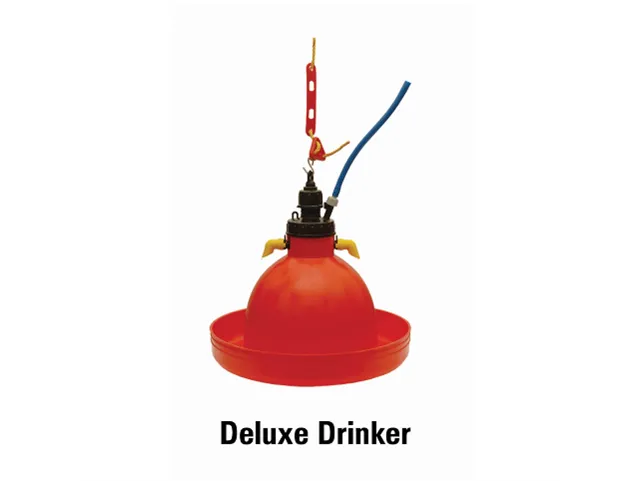
Vijay Raj supplies both routes: nipple lines through its nipple drinking system, and chick drinkers, grower manual drinkers, bell drinkers and drip cups through its deep litter feeders and drinkers range.
Types of Nipple Drinkers
Most nipples look alike from the outside. The differences that matter are how the pin moves, how the valve seals, how the body fixes to the pipe, and how well the parts are made.
180 Degree vs 360 Degree Pins
A 180 degree nipple has a pin that works mainly when pushed upward or from one side, the style the Hy-Line guide calls a vertical nipple. A 360 degree nipple opens when the pin is touched from any direction. That makes it easier for day old chicks, beak-treated chicks and heavy broilers that do not lift their heads far.
The breed guides are clear on this. The Ross handbook says broilers should, where possible, be grown on a 360 degree nipple, especially birds heavier than 3 kg. The Hy-Line Brown management guide says 360 degree nipples make drinking easy for chicks and that only 360 degree nipples should be used for chicks whose beaks were treated at the hatchery.
Single Lock vs Twin Lock
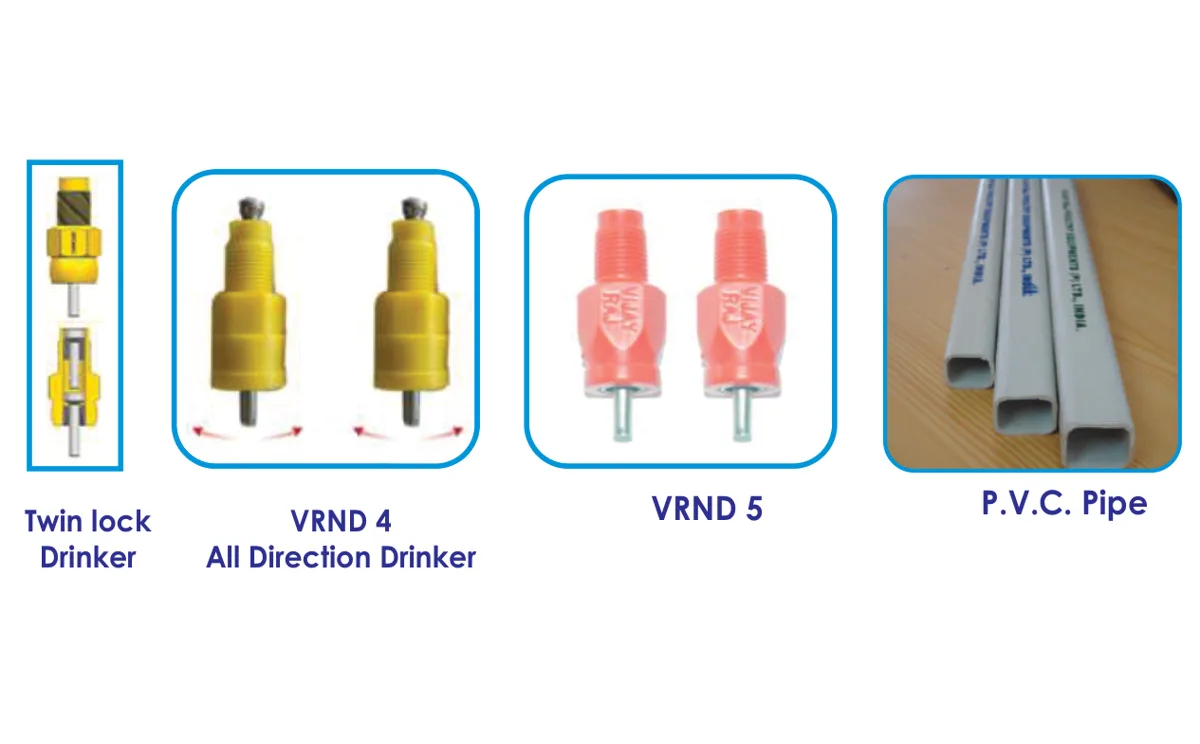
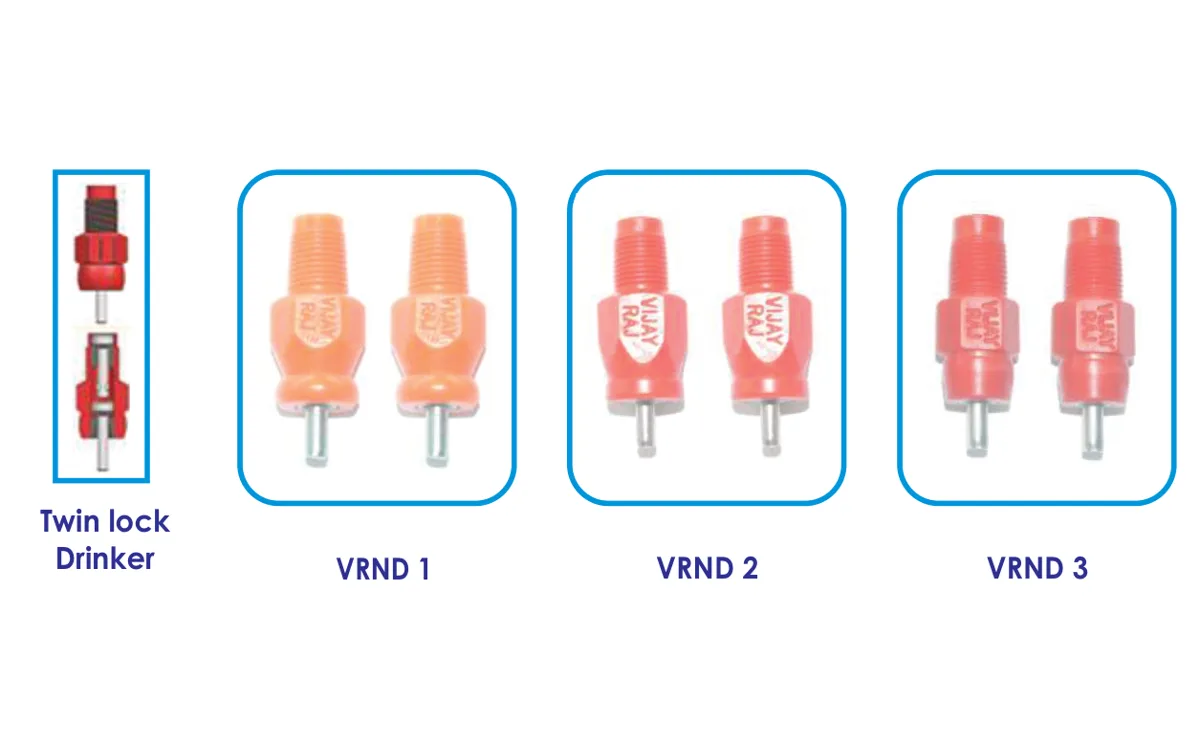
The lock is the seal that shuts the valve when the bird lets go. A single lock nipple has one sealing point; a twin lock nipple has two, which gives a second barrier against drips. Vijay Raj builds both designs for zero leakage. Twin lock suits floor birds and houses where any drip lands on litter, while single lock is a simpler, economical choice where a drip is less costly.
Threaded vs Clamp-On
Some nipples clip onto the pipe with a saddle clamp. Others screw into a threaded hole in the pipe or fitting. Threaded nipples are firmly seated, can be unscrewed and replaced one at a time, and are less likely to be knocked out of line by birds or during cleaning. All Vijay Raj nipple models are threaded.
Stamped vs Turned Pins, and High Flow vs Low Flow
The Cobb Broiler Management Guide (2021) separates stamped nipples, which are cheaper but leak more and are harder for day old chicks to trigger, from turned nipples, which are precision machined and trigger more easily. Ask your supplier what the pin is made of and how it is finished. Vijay Raj pins are specially alloyed stainless steel set in a graded plastic body.
Cobb also groups nipples by flow. High flow nipples run at 80 to 90 ml per minute, hold a bead of water at the tip and use drip trays. Low flow nipples run at 50 to 60 ml per minute, usually without drip trays, with pressure raised as birds grow. The flow type changes how many birds each nipple can serve, covered below.
Vijay Raj Nipple Models by Bird
Vijay Raj makes nipples for chicks, layers, breeders and broilers. Each model has a water discharge flow rate matched to the bird, and the chick nipples discharge at a low pressure to suit day old chicks.
| Model | Bird | Lock | Pin movement | Where it fits |
|---|---|---|---|---|
| VRND-C1 | Chicks | Single lock | 180 degree | Chick and rearing cages |
| VRND-C2 | Chicks | Twin lock | 360 degree | Chick brooding, beak-treated chicks |
| VRND-L1 | Layers | Single lock | 180 degree | Layer cages |
| VRND-L2 | Layers | Twin lock | 360 degree | Layer cages, flocks reared on 360 degree nipples |
| VRND-BJ1 | Breeders (jumbo) | Single lock | 180 degree | Breeder cages |
| VRND-BJ2 | Breeders (jumbo) | Twin lock | 360 degree | Breeder cages and deep litter breeders |
| VRND-B1 | Broilers (all-direction) | Single lock | 180 degree | Broiler cages |
| VRND-B2 | Broilers (all-direction) | Twin lock | 360 degree | Floor broilers and EC houses |
The “where it fits” column is a practical guide, not a rule. One point from Hy-Line is worth building into your purchase: use the same drinker type, and the same nipple type (vertical or 360 degree), in rearing and in the laying house, so pullets do not have to learn a new drinker at transfer.
Chicks
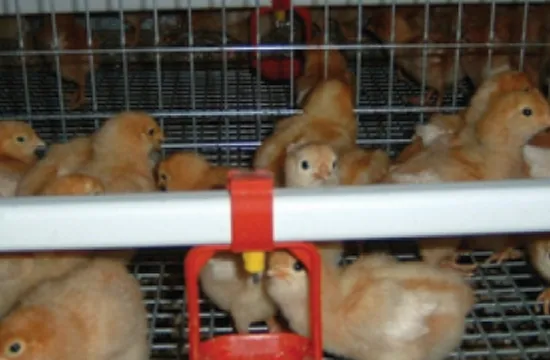
Day old chicks need a nipple that opens with a light touch and a line pressure low enough to hold a hanging drop of water at the tip. The VRND-C1 and VRND-C2 are built for this. In rearing cages such as the Automax pullet rearing system, all drinkers adjust in height together from the battery head, so one line serves chicks from day one to week 14.
Layers
Layers in cages drink from nipples fixed along the cage front or inside the cage. The VRND-L1 and VRND-L2 are set to the flow laying birds need. Vijay Raj layer houses such as the California cage and Automax layer cage systems are planned with one nipple per cage box.
Breeders
Breeders are heavier and drink more per visit, so Vijay Raj makes a jumbo breeder nipple, the VRND-BJ1 and VRND-BJ2. Breeder cages are planned with one nipple per female box and two per male box. Note that Cobb gives breeders lower flow rates than broilers of the same age (see the table below).
Broilers
For broilers, water intake drives growth. The all-direction VRND-B1 and VRND-B2 are tuned for the flow a broiler needs to reach target weight. In a Vijay Raj pan feeding EC house, the same pan and nipple lines serve birds from day old to the end of the cycle, and the lines are winched up as birds grow, with no hand contact.
Flow Rate and Line Height by Age
This is the table most farm managers ask for. It brings together the broiler flow targets from the Ross handbook, the broiler and breeder figures from the Cobb Nipple Drinker Guidelines, and the height rules from both. Both companies say these are guidelines and that the nipple maker’s settings come first, so use the table as a check, not a fixed rule.
| Age (days) | Broiler flow, Ross (ml/min) | Broiler flow, Cobb (ml/min) | Breeder flow, Cobb (ml/min) | Line height |
|---|---|---|---|---|
| 0 to 7 | 20 to 29 | 40 | 30 | At placement, nipple pin at chick eye level so chicks see the drop. Back at 35 to 45 degrees to the floor while drinking (Ross). |
| 8 to 14 | 30 to 39 | 50 | 40 | Raise so the bird’s back is at about 75 to 85 degrees to the floor, neck stretched slightly (Ross, after day 7). |
| 15 to 21 | 40 to 49 | 60 | 50 | Bird reaches slightly up to the pin, feet flat on the floor. Head at about 45 degrees to the nipple (Cobb). |
| 22 to 28 | 50 to 69 | 70 | 55 | Check and adjust daily. Never make birds stand on their toes or jump. |
| 29 and over | 70 to 100 | 90 | 60 | Same rule. A line too low makes birds turn their heads and spill water on the litter. |
For layers and pullets, Hy-Line sets a minimum of 60 ml per minute per nipple, with the nipple level with the chick’s head at the start and a hanging drop for the first 0 to 3 days and again at transfer to the laying house. A quick cross-check for broilers is the Lott formula quoted by Mississippi State University Extension: multiply the age in weeks by 7 and add 20 to get a minimum flow in ml per minute. An 8-week bird needs about 76 ml per minute.
Tip: Measure flow, do not guess it. Hold a measuring cylinder against a nipple so the pin is pushed for one minute (or 30 seconds and double it). Ross advises doing this every week at a minimum of three points along each line, and reading it while birds are drinking.
Why the Line Height Matters So Much
The Ross handbook puts it simply: lines that are too high for the birds’ age restrict water intake, and lines that are too low cause wet litter. When a nipple is low, the bird turns its head sideways to drink and the water runs off the beak onto the floor. When it is high, small or weak birds give up.
Water Pressure: What to Set and Why
Pressure is set at the regulator at the head of each line. The Cobb poster sets out the supply side: a header tank giving at least 2 bar (30 psi), or a pump supplying about 2.8 bar (40 psi) to the control room with an inline pressure reducing valve that holds a constant 2 bar to the nipple system. On standpipe regulators, Cobb advises changing pressure in 5 cm steps, as per the maker’s instructions.
Two points from Cobb are worth remembering. Higher pressure does not make birds drink more; it just spills more water. But pressure that is too low can cut water intake by as much as 20%, because birds spend about the same time at the nipple whatever the flow. So the aim is enough pressure to hit the flow target for the age, and no more.
- At placement, set the pressure low so a bead of water hangs on each nipple. Cobb advises raising pressure once chicks are drinking well, in the first hours.
- Where the house floor slopes, fit slope regulators. Cobb suggests one for every 10 cm of fall so pressure stays even down the house.
- Check that every line has the same pressure. Uneven pressure is a common reason why one end of a house is wet and the other end is thirsty.
How Many Birds per Nipple
The right number depends on the nipple’s flow, the bird’s size, the climate and the age at sale. The breed guides and the Vijay Raj planning figures line up closely:
| Situation | Birds per nipple | Source |
|---|---|---|
| Broilers after brooding, below 3 kg | 12 | Ross handbook 2025 |
| Broilers above 3 kg | 9 | Ross handbook 2025 |
| Chicks during brooding | 10 to 12 | Ross handbook 2025 |
| Broilers on high flow nipples (80 to 90 ml/min) | 10 to 12 | Cobb |
| Birds on low flow nipples (50 to 60 ml/min), breeders | 8 to 10 | Cobb |
| Layers in conventional and colony cages | 8 to 12, depending on age | Hy-Line Brown guide |
| Floor birds, planning figure | 12 | Vijay Raj poultry house calculator |
| Cage houses, planning figure | 1 nipple per cage box, 2 per male box | Vijay Raj poultry house calculator |
Two layout rules from Cobb complete the picture: no bird should have to walk more than 3 m to find water, and nipples should be no more than 35 cm apart on the line.
Worked Example: A 10,000-Bird EC Broiler House
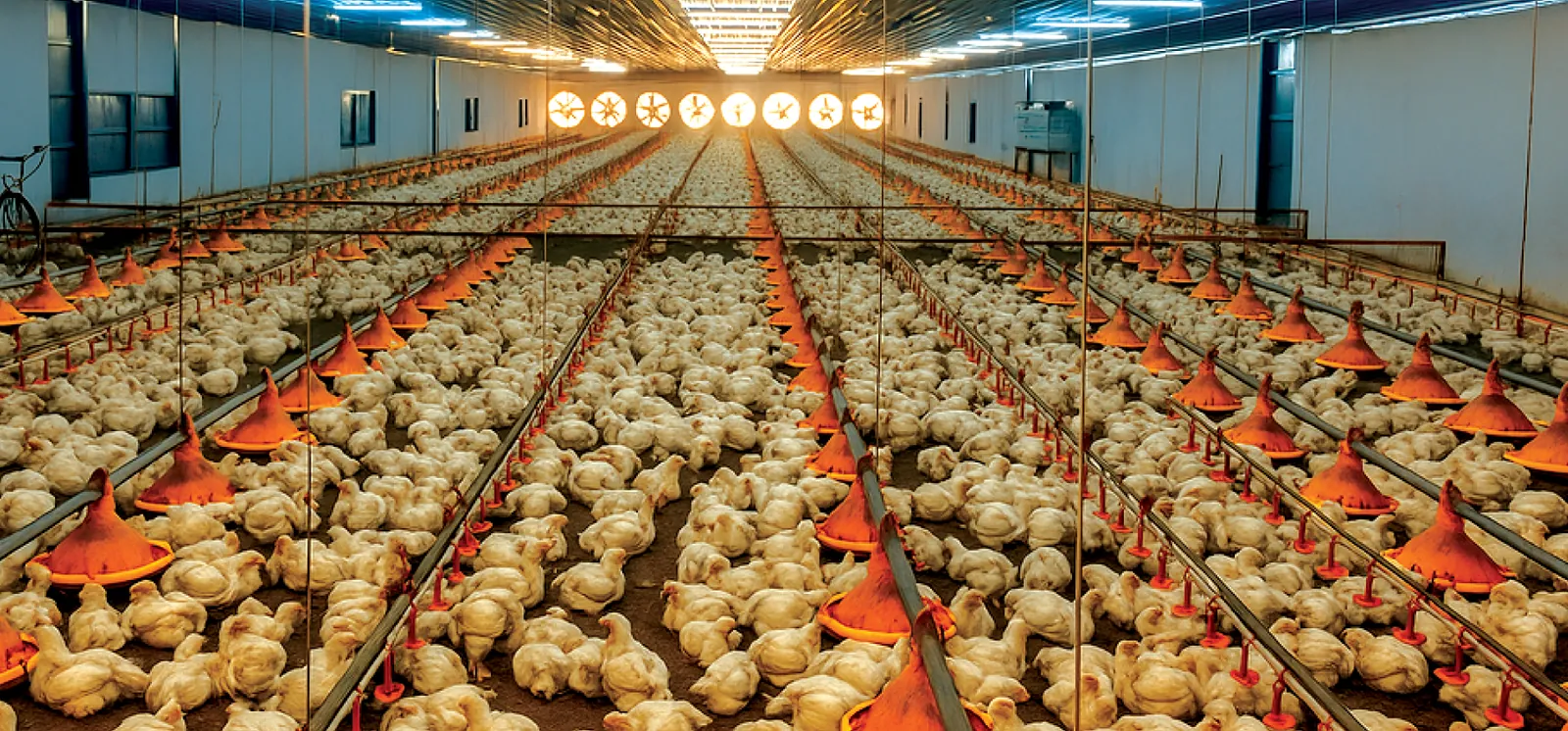
Here is how the planning figures in the Vijay Raj poultry house calculator work out for 10,000 broilers in an environment-controlled house.
- Floor area: at 0.75 sq ft per bird, the house needs 7,500 sq ft (about 697 sq m).
- House length: at the default width of 12.2 m, that is about 57 m long.
- Feed lines: 12.2 m divided by the 3 m feed line spacing gives 4 feed lines.
- Nipple lines: feed lines plus one, so 5 nipple lines.
- Nipples: 10,000 birds at 12 birds per nipple is about 834 nipples, or about 167 per line.
- Spacing check: 167 nipples on a 57 m line puts them about 34 cm apart, inside Cobb’s 35 cm limit.
If you plan to grow birds past 3 kg, rework step 5 at 9 birds per nipple (about 1,112 nipples) and the spacing drops to roughly 26 cm. Run your own numbers in the calculator, then confirm the final layout with your equipment supplier.
Water Consumption by Age and Temperature
You cannot manage a nipple system without a water meter. The Ross handbook asks for at least one meter per house, read daily, and Cobb advises reading it at the same time each day. A sudden drop in intake is often the first sign of disease, and a rise can point to a leak, heat stress or salty water.
Broilers: Use the Water to Feed Ratio
Ross states that at 21 C, broilers are drinking enough when litres of water are about 1.6 to 1.8 times the kilograms of feed eaten. Each 1 C rise above 21 C raises water need by about 6.5%, and prolonged tropical heat can double daily intake. Cobb’s poster gives a similar range of 1.6 to 2.0 times feed at 21 C, rising above 2.0 above 30 C.
A worked example: if a house ate 1,200 kg of feed yesterday at around 21 C, expect about 1,920 to 2,160 litres of water. On a 32 C day, which is 11 degrees warmer, add roughly 11 x 6.5% = 72%, giving about 3,300 to 3,700 litres. If the meter reads far below that, walk the lines before you do anything else.
Aviagen’s brief Water Utilization in Broilers (2025) adds a useful reminder: around 70 to 80% of the water a broiler drinks leaves the bird again as droppings or moisture, which the ventilation then has to remove. Wasted and spilled water adds to that load.
Layers and Pullets: Litres per Bird per Day
The Hy-Line Brown guide lists expected water intake per bird at 21 to 27 C. Selected weeks are below. Hy-Line notes that intake can rise to double these figures in hotter conditions.
| Age | Water (ml per bird per day) | Per 1,000 birds (litres per day) |
|---|---|---|
| Week 1 | 21 to 30 | 21 to 30 |
| Week 4 | 41 to 58 | 41 to 58 |
| Week 8 | 68 to 94 | 68 to 94 |
| Week 12 | 93 to 132 | 93 to 132 |
| Week 16 | 113 to 158 | 113 to 158 |
| In lay, from about week 24 | 162 to 228 | 162 to 228 |
For a 50,000-hen layer farm in full lay, that is roughly 8,100 to 11,400 litres a day in mild weather, and up to about double in a hot Indian summer. Size your tank, borewell pump and filters for the peak, not the average. The Ross handbook recommends storage for 24 hours of water at maximum consumption in case the main supply fails.
Water Temperature
Birds drink less when water is warm. The Ross handbook lists 18 to 21 C as ideal for chicks, says water above 30 C reduces intake, and notes that birds refuse to drink above 44 C. Cobb gives 10 to 14 C as ideal for grown birds and says water should never go above 25 C; if it does, flush the lines at least three times a day. In practice this means shading and insulating tanks and pipes, and not running supply pipes across a hot roof. Pair this with good house cooling, covered in our guide to cooling a poultry house.
Tip: Hy-Line warns against giving cold water to day old chicks. After flushing chick lines, let the water warm to house temperature before chicks arrive.
Water Quality: pH, Hardness, TDS and Iron
Poor water damages nipples as well as birds. Hard water leaves scale that makes pins stick or leak, iron feeds bacteria that block the line, and high pH weakens chlorine. Test the source and the end of a drinker line at least once a year. Cobb suggests every 6 months, and more often for surface water or open wells.
| Test | Target | What goes wrong outside the target | Source |
|---|---|---|---|
| pH | 6.0 to 6.8 ideal (Cobb poster); 6.5 to 8.5 satisfactory (Ross) | Below 5 to 6 corrodes metal parts; above 8 tastes bitter and makes chlorine far less effective | Cobb, Ross |
| Total dissolved solids (TDS) | Below 1,000 ppm good; 1,000 to 3,000 ppm satisfactory | Above 3,000 ppm: wet droppings, lower intake, poor growth, higher mortality | Ross, Cobb |
| Hardness (calcium and magnesium) | Below 100 ppm soft; Cobb poster limits calcium below 200 ppm and magnesium below 125 ppm | Scale inside pipes and nipples, pins that stick or leak; can interfere with medicines and disinfectants given in water | Ross, Cobb |
| Iron | Below 0.3 ppm | Iron bacteria that clog lines and cause odour; leaking drinkers | Ross, Cobb, Hy-Line |
| Manganese | Below 0.05 ppm | Black grainy residue on filters and drinkers | Cobb, Hy-Line |
| Bacteria | Zero coliforms; total bacteria ideally 0, maximum 100 CFU per ml | Any faecal coliform makes water unfit for birds | Cobb |
Cobb classes water up to 60 mg per litre of hardness as soft, 61 to 120 as moderately hard, 121 to 180 as hard and above 180 as very hard. Borewell water often carries more dissolved minerals than a municipal supply, so ask your water lab for hardness, iron and TDS every time, not just bacteria.
Chlorine and ORP
The Ross handbook says 3 to 5 ppm of free chlorine at drinker level is usually effective against bacteria and viruses, with water pH kept at 6.5 to 8.5. The Cobb poster targets 3 to 5 ppm where water enters the house and at least 2 ppm at the end of the line. An ORP meter is a cheap way to check that the sanitiser is working: Ross gives 650 to 800 mV as the ideal range, and a reading below 650 mV means you should check pH, chlorine dose and line cleanliness.
Cleaning and Sanitising Drinker Lines
A slimy layer called biofilm grows inside every water pipe. It narrows the pipe, hides bacteria from disinfectants and flakes off into nipples. The Ross handbook notes that biofilm forms faster in plastic pipes and tanks, and that vitamins and minerals added to water speed it up. Clean the system between every flock, and flush it during the flock.
During the Flock
- Flush lines 1 to 2 hours before chicks arrive, tapping the lines until every nipple shows a drop of water, so no airlocks remain (Ross).
- Flush twice daily for the first 3 to 4 days to keep water cool and fresh (Ross).
- Flush daily through the flock, and at least three times a week, using 1 to 2 bar of pressure to create enough turbulence to shift biofilm. Automatic flush systems are set at about 2 seconds per metre of line (Cobb).
- For layers and pullets, flush lines at least weekly through rearing and lay (Hy-Line).
- Fit a meter bypass so flushing water is not counted as bird intake (Cobb).
Between Flocks
This sequence combines the Ross and Cobb cleanout steps:
- Work out the volume of the drinking system so you can mix the right amount of cleaner.
- Drain the lines, header tanks and any dosing tank. Clean the pressure regulators.
- Scrub header tanks to remove scale and biofilm, and drain the dirty water outside the house.
- Mix an approved line cleaner at the maker’s dilution. Hydrogen peroxide products and potassium peroxymonosulphate are effective against biofilm (Cobb). Wear gloves and eye protection.
- Run the solution through each line until it appears at the far end, then close the end tap. Make sure there are no airlocks.
- Leave it to stand for at least 12 hours (Cobb).
- If your water is hard or high in iron, add a descaling step with a mineral and scale remover (Ross).
- Drain and flush thoroughly with clean water so no cleaner reaches the birds.
- Refill with fresh water carrying an approved sanitiser at working strength, ready for the next flock.
Medication and Vaccination Through the Line
A nipple system makes water medication easy because every bird drinks from the same closed supply. Most farms use a dosing pump (medicator), which injects a concentrated stock solution into the water line in proportion to the flow.
- Install the water meter and filter upstream of the medicator, as Cobb advises, so the meter reads true flow and the filter protects the pump.
- Work out the dose from actual water use: take yesterday’s meter reading, apply the vet’s dose per litre, and set the stock solution to suit the pump’s injection ratio.
- Remember that hard water can interfere with some medicines and disinfectants given in water (Ross). Ask your vet if a water conditioner is needed.
- Vitamins, electrolytes, acids, vaccines, antibiotics and probiotics all feed biofilm, so flush the lines after every course (Cobb).
- Hy-Line advises avoiding sugar-based products in chick water because they encourage microbial growth. Use a vitamin and electrolyte product instead of sugar water.
Water Vaccination on Nipple Lines
The Cobb guide gives a clear method. Turn off the chlorinator and clean the filters with non-chlorinated water 48 hours before, and switch off any UV unit. Plan for birds to drink the vaccine within 90 to 120 minutes: use about 30% of the previous day’s water use, or, without a meter, birds in thousands x age in days x 2 = litres for a 2-hour intake.
Keep vaccine water at pH 5.5 to 6.5 and neutralise chlorine with a commercial stabiliser or 2.5 g of skimmed milk powder per litre. Raise the lines, prime them until dyed water reaches the far end, then lower the lines so birds drink. Cobb treats the job as successful when 95% of a 100-bird sample shows dye staining after 2 hours. Vaccines differ, so always follow the vaccine maker’s and your vet’s instructions.
Leakage and Wet Litter
Wet litter under drinker lines is the most common complaint with nipple systems, and it is almost always a management problem rather than a faulty nipple. Wet litter raises ammonia, burns foot pads and breasts, and encourages coccidiosis. Aviagen’s water brief links wetter droppings and litter to a higher coccidiosis risk.
Work through the causes in this order. First, check line height against bird size. Second, check pressure at the regulator and measure flow against the age table. Third, look for individual nipples that drip when untouched. Fourth, check water quality, because scale and iron make pins stick open. Leaking nipples wet the house and encourage bacterial and fungal growth, which is why Vijay Raj nipples use single or twin locking to prevent leaks. Drip cups under each nipple, available in the Vijay Raj manual range, add a second line of defence on litter floors.
Tip: On lines with drip trays, Cobb reads the tray like a gauge. A slightly moist tray means pressure is right, a tray full of water means pressure is too high or the line too low, and a dry tray means the nipple may not be working.
Troubleshooting Table
| Symptom | Likely cause | Fix |
|---|---|---|
| Wet litter in strips under the lines | Line too low, pressure too high, or flow above the target for age | Raise the line so birds reach up slightly; lower pressure one standpipe step; measure flow at three points |
| Water standing in drip cups or trays | Pressure too high, or a worn nipple | Lower pressure; replace nipples that drip when untouched |
| Birds peck the nipple but get little water | Airlock, blocked nipple or filter, pressure too low | Bleed air from the line end; clean the filter; flush; raise pressure to reach target flow |
| Chicks not drinking on day one | Pin above eye level, no hanging drop, water too cold, hard-to-trigger pins | Lower line to eye level; reduce pressure to hold a drop; warm the water; use 360 degree chick nipples |
| Flow good at the front, weak at the far end | Biofilm or scale in the pipe, sloping floor without slope regulators | Flush at 1 to 2 bar; clean the line between flocks; fit slope regulators |
| One side or one line wetter than the rest | Uneven pressure between regulators, line not level | Set all regulators to the same reading; level the line along its length |
| Nipples start sticking or dripping after a few months | Hard water scale, iron or manganese deposits | Test hardness, iron and manganese; descale between flocks; treat or filter the water |
| Black grainy residue on filters and drinkers | Manganese in the water | Water test; oxidise and filter as your water specialist advises |
| Birds turn their heads sideways to drink | Line too low for their size | Raise the line; check daily as birds grow |
| Sudden drop in daily water use | Disease, very warm water, supply or pressure failure | Check the supply and regulators first, then call your vet if birds look unwell |
| Sudden rise in water use | Leak, heat stress, salty water or a gut problem | Walk the lines for leaks; check house temperature; test water for sodium and TDS |
| Low ORP reading or bad smell from the lines | Biofilm, high pH, chlorine dose too low | Check pH and chlorine; clean the lines; recheck ORP |
Installation Checklist
Use this when you commission a new house or refit an old one.
- Water source tested for pH, TDS, hardness, iron, manganese and bacteria before you buy treatment equipment.
- Storage for at least 24 hours of peak demand, with tanks shaded or insulated.
- One water filter set per house and one water meter per house, with a bypass for flushing, both upstream of the medicator.
- Pressure regulators: one per line on floor houses; in cage houses, one per tier per side of each row, as in the Vijay Raj bill of quantities.
- Nipple count checked against birds per nipple for your bird type and sale weight, with nipples no more than 35 cm apart and no bird more than 3 m from water.
- Nipple type matched to the bird, and the same type used in rearing and laying.
- Line height adjustment by winch on floor houses, or from the battery head on cages, so the whole line moves together.
- Lines level along their length, with slope regulators where the floor falls.
- Drip cups fitted on litter floors where needed.
- Flush points at the end of each line that drain outside the house.
- Before first placement: lines cleaned, sanitised and flushed, every nipple triggered by hand, height at chick eye level, pressure set low enough for a hanging drop.
- Records ready: a daily sheet for meter reading, flow checks, pressure settings and line height.
For how drinking fits with feeding, brooding and cooling in the complete equipment plan, see the poultry farming equipment list, the guide to automatic poultry feeding systems, and how to start a broiler poultry farm in India.
Getting the Right Nipple System for Your Farm
Pick the nipple for the bird and house, size the lines for birds per nipple and peak demand, then keep the daily habits: meter readings, weekly flow checks, height checks and clean lines between flocks.
Vijay Raj has built poultry equipment in Hyderabad since 1972 and supplies nipple lines as part of complete layer, breeder and broiler houses. If you want help choosing models or laying out lines for a new house, talk to a Vijay Raj engineer.
Frequently Asked Questions
What is a nipple drinker in poultry?
A nipple drinker is a small valve fitted to a closed water pipe. When a bird pecks or pushes the metal pin, the valve opens and water runs down the pin into the beak; when the bird lets go, it shuts. Because water stays inside the pipe, it stays cleaner than in open bell or trough drinkers and less is spilled on the litter.
Which is better, a nipple drinker or a bell drinker?
For cages, environment-controlled houses and most commercial flocks, nipple drinkers are the better choice: the water is enclosed, labour is lower and litter stays drier when pressure and height are set correctly. Bell drinkers still suit small open deep litter farms with a weak or unreliable water supply, because they work on low gravity pressure and need no regulators.
How many birds can one nipple drinker serve?
The Ross broiler handbook allows 12 broilers per nipple after brooding, or 9 per nipple for birds heavier than 3 kg. Cobb suggests 10 to 12 birds on high flow nipples and 8 to 10 on low flow nipples. In layer and breeder cages, plan one nipple per cage box and two per male box, and check against your breed guide.
What is the right nipple drinker flow rate for broilers?
The Ross handbook suggests 20 to 29 ml per minute in the first week, 30 to 39 in week two, 40 to 49 in week three, 50 to 69 in week four and 70 to 100 ml per minute after day 28. Cobb's figures are a little higher. Always follow the nipple maker's settings and measure flow weekly with a measuring cylinder.
At what height should nipple drinkers be set?
At placement, the nipple pin should be at chick eye level so chicks see the water drop. As birds grow, raise the line so they stretch their neck slightly and reach up to the pin with their feet flat on the floor. Ross describes a back angle of 35 to 45 degrees in the first week and 75 to 85 degrees after that.
Why are my nipple drinkers leaking and making the litter wet?
Wet litter under nipple lines usually comes from a line set too low, pressure set too high, or flow above the target for the birds' age. Hard water scale and iron deposits can also make pins stick open. Check height first, then pressure and flow, then look for individual nipples that drip without being touched, and test your water.
What water quality do nipple drinkers need?
Aim for pH around 6.0 to 6.8, total dissolved solids below 1,000 ppm, iron below 0.3 ppm, low hardness and zero coliform bacteria, as set out in the Cobb and Ross guides. Hard or iron-rich water causes scale and deposits that block nipples and make them stick or leak, so test the source and the line end at least once a year.
How do you clean poultry nipple drinker lines?
Between flocks, drain the lines and tanks, clean the regulators, fill the lines with an approved cleaner such as a hydrogen peroxide product, leave it for at least 12 hours, then flush thoroughly. Add a descaler if your water is hard. During the flock, flush the lines regularly with 1 to 2 bar of pressure to remove biofilm and keep water cool.
Sources
- Aviagen: Ross Broiler Management Handbook (2025)
- Cobb-Vantress: Nipple Drinker Guidelines
- Cobb-Vantress: Broiler Management Guide (2021)
- Hy-Line International: Hy-Line Brown Commercial Layers Management Guide (2016)
- Aviagen: Water Utilization in Broilers, Aviagen Brief (2025)
- Mississippi State University Extension: Water-Related Factors in Broiler Production (P2742)
- TNAU Agritech Portal: Poultry Farm Equipments