

In this guide 18 sections
- What poultry farming is, and what makes broiler farming different
- Broiler farming in India: the market in numbers
- Integration or independent: choose your business model first
- Open, EC or cage: choosing your housing system
- Site selection and biosecurity
- Licences and approvals
- House design and sizing
- Equipment by stage
- The money: a worked 10,000-bird example, open vs EC
- Chick placement and the first 24 hours
- Week-by-week plan for your first batch
- Feed and FCR
- Vaccination and flock health
- Labour and the daily routine
- Finance and subsidies
- Common mistakes new broiler farmers make
- Launch checklist
- Getting help with your broiler farm
To start a broiler poultry farm in India, first choose between an integrator contract and selling independently. Then pick a site that meets CPCB siting rules, get pollution board consent above 5,000 birds, size the shed at about 1 sq ft per bird (open) or 0.75 sq ft (EC), equip it by stage and budget with NABARD unit costs.
This guide takes you from the first decision to the first batch sold. It uses published numbers from NABARD, CPCB, DAHD, the breed companies and state universities, and it shows the arithmetic behind a 10,000-bird farm so you can redo it with your own quotations.
What Poultry Farming Is, and What Makes Broiler Farming Different
Poultry farming is the rearing of domesticated birds, mostly chickens, for meat or eggs. The CPCB Environmental Guidelines for Poultry Farms (2022) group the commercial side into four activities: breeder farms that produce fertile eggs, hatcheries that turn them into day-old chicks, layer farms that produce table eggs, and broiler farms that grow meat birds.
A broiler farm buys day-old chicks, grows them for about five to six weeks and sells them live by weight. The house is then emptied, cleaned and rested before the next batch. That short cycle is the defining feature. You get several turns of your working capital each year, but every batch is a fresh bet on chick quality, feed price, weather and the market rate on the day you sell.
Compared with a layer farm, a broiler farm needs less capital per bird and no multi-tier cages or egg handling. The NABARD model scheme for broiler farming lists the attractions plainly: lower investment than layers, a rearing period of five to six weeks, several flocks a year in the same shed and a faster return. The trade-off is that you must be good at brooding, ventilation and biosecurity, because a mistake shows up within days, not months.
Broiler Farming in India: The Market in Numbers
Chicken is now the single biggest source of meat in India. The Department of Animal Husbandry and Dairying’s Basic Animal Husbandry Statistics 2025 put total meat production at 10.50 million tonnes in 2024-25, of which poultry meat was 5.18 million tonnes, about half. The top five meat-producing states were West Bengal, Uttar Pradesh, Maharashtra, Andhra Pradesh and Telangana, which together produced 57.55 percent of India’s meat.
The industry is also highly organised around a few large integrators. The NABARD model scheme traces how contract broiler farming started in Tamil Nadu in the early 1990s, spread across the state by 1995, moved into Karnataka between 1995 and 2000, and reached Maharashtra and Andhra Pradesh in 2001 and 2002 before expanding into West Bengal and Gujarat. Today, in most broiler belts, the company that sells you chicks and feed is often the same company that buys your birds.
Prices swing hard. ICRA’s March 2025 report on the Indian poultry industry found that bird flu fears cut broiler realisations by 22 to 25 percent year on year in western and southern markets in February 2025, and by 14 to 16 percent in the east and north. ICRA also notes that feed makes up about 70 percent of the variable cost of poultry companies, with maize and soyameal making up most of the feed bill. Any business plan that does not test a low-price month and a high-feed-cost month is incomplete.
Integration or Independent: Choose Your Business Model First
This decision changes almost everything else: how much money you need, who carries the market risk, how many batches you get a year, and even how you design the shed. Settle it before you buy land or talk to a builder.
How the Integrator (Contract) Model Works
Under contract broiler farming, the integrator supplies the day-old chicks, feed, medicines and vaccines, and sends a supervisor to advise you. You provide the land, shed, equipment, labour, electricity, water and litter. At the end of the batch the company lifts the birds and pays you a growing charge, also called a rearing charge. The MEAS evaluation study of contract broiler farming by Sasidhar and Suvedi (2015), based on 240 farmers in Karnataka, Telangana and Andhra Pradesh, describes this split in detail.
The growing charge is usually quoted per kg of live weight and then adjusted by performance. The contract examined in the MEAS study set a standard of 2 kg body weight, an FCR of 1.85 and 5 percent allowed mortality, and paid a base rate of Rs 4 per kg of live chicken. It added a small “rate incentive” when market prices were high, capped at Rs 2 per kg, and a bonus for farmers who kept FCR at or below 1.75 for three batches in a row. Losses above 5 percent mortality, and any missing birds, were recovered from the farmer, and the company could end the contract after repeated poor batches.
Rates have risen since, but they remain a flashpoint. DT Next reported on 1 January 2026 that Tamil Nadu contract farmers were paid Rs 6.50 per kg and had begun an indefinite production halt, demanding Rs 20 per kg. The same report put the farm procurement price at Rs 130 per kg and the production cost at Rs 100 to 105 per kg.
How the Independent Model Works
An independent farmer buys chicks and feed on the open market, pays for vaccines and a vet, and sells birds to traders, retailers or processors. All three risks sit with you: the investment, the production result and the selling price. In return, you keep the whole margin in a good month. The MEAS study found that independent farmers in its sample earned more per bird than contract farmers despite higher costs, while contract farmers traded a lower return for a steadier one.
| Question | Integrator contract | Independent |
|---|---|---|
| Who buys chicks, feed, medicine | Integrator | You |
| Working capital you need | Low: labour, litter, power, gas | High: chicks and feed for a full batch (see the worked example below) |
| How you are paid | Growing charge per kg live weight, with FCR and mortality incentives and penalties | Market price per kg on the day you sell |
| Market price risk | Carried by the integrator | Carried by you |
| Batches per year | Decided by the integrator. The MEAS study found companies supplied no more than five a year | Decided by you, subject to cleaning time |
| Technical support | Company supervisor visits | Your own vet or paid consultant |
| Best for | First-time farmers with land but limited capital | Experienced farmers with capital and their own buyers |
Questions to Ask an Integrator Before You Build
- What is the base growing charge per kg, and how exactly are the FCR and mortality incentives and penalties calculated? Ask for a written example batch.
- How many batches a year will you place, and what is the typical gap between lifting and the next placement?
- What house type and minimum flock size do you require? Some integrators will only place in EC houses above a certain capacity.
- Who pays for litter, brooding gas and electricity, and who bears the loss if the lifting date slips?
- How soon after lifting are you paid, and is tax deducted at source?
- Can you see a copy of the agreement before signing? The MEAS study reported farmers who were never given one.
Tip: Build the shed to suit more than one integrator in your district. If your only buyer stops placing chicks, a house designed to one company’s odd specification is hard to switch.
Open, EC or Cage: Choosing Your Housing System
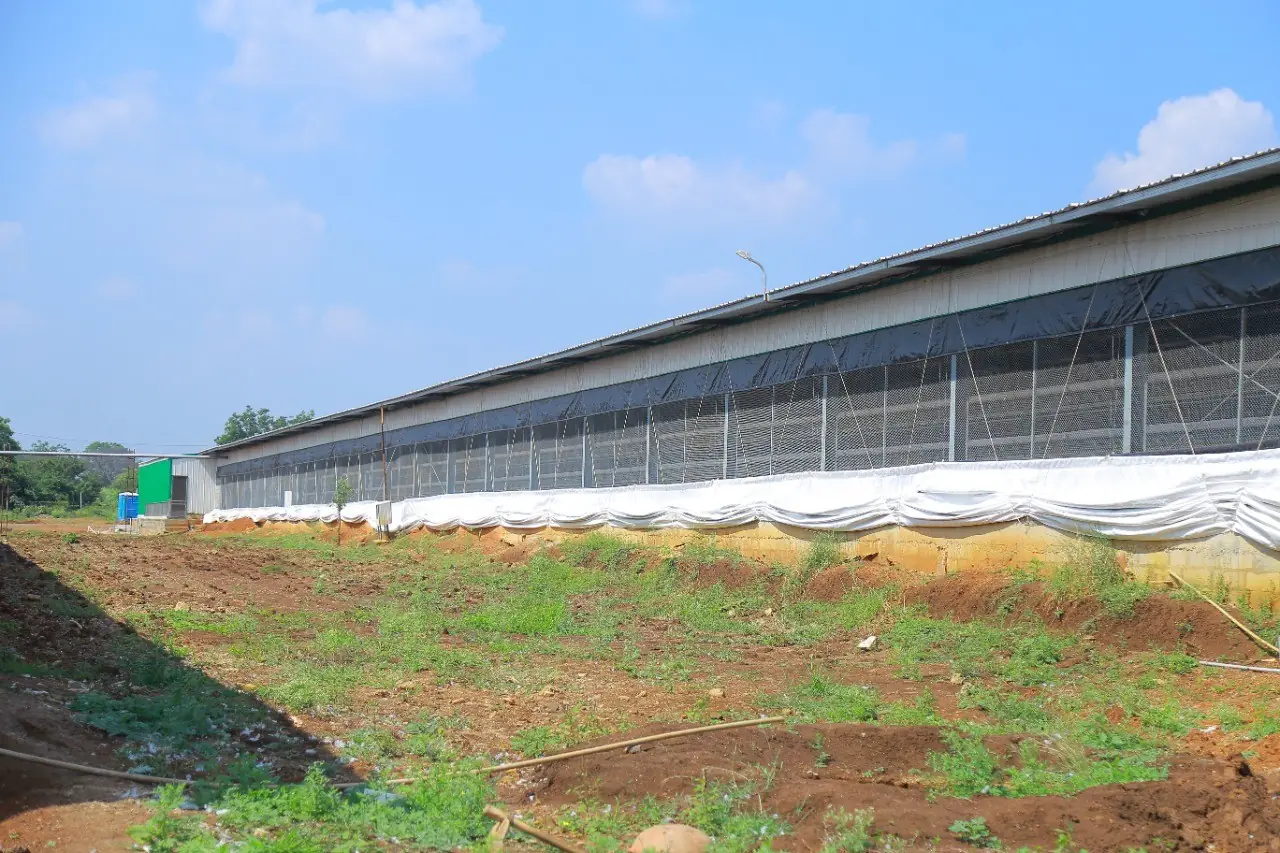
Indian broilers are grown in three kinds of house. Most farms still use open-sided deep litter sheds, where side curtains and natural airflow do the ventilating. Environment-controlled (EC) houses are closed tunnels where fans pull air through wet cooling pads, and a controller manages temperature, air inlets and lighting. A smaller number of farms now grow broilers in multi-tier cages inside an EC house.
| Factor | Open-sided deep litter | EC house, pan feeding | EC house, broiler cages |
|---|---|---|---|
| Floor space planning figure | 1 sq ft per bird | 0.75 sq ft per bird | Set by cage size and tiers |
| Climate control | Curtains, foggers or sprinklers, some fans | Tunnel fans, cooling pads, controller | Tunnel fans, cooling pads, controller |
| Feeding and drinking | Manual or semi-automatic feeders and drinkers | Automatic pan lines and nipple lines | Pans and nipples in each cage section |
| Capital per bird | Lowest | Higher | Highest |
| Dependence on power | Moderate | Total: a generator is essential | Total: a generator is essential |
| Litter | Yes, 5 to 6 cm topped up | Yes | No litter |
| Where it fits | Small and medium farms, mild climates, contract growers | Larger farms, hot regions, integrators that pay for performance | Land-scarce sites, very large flocks |
The space figures are the planning guidelines used in the Vijay Raj poultry house calculator. The litter depth is from the CPCB guidelines, which describe starting with 5 to 6 cm of rice husk, sawdust or similar material and topping it up by another 5 to 6 cm as birds grow.
Open-Sided Deep Litter Houses
An open house is the cheapest to build and the easiest to run by hand. It depends on the weather, so performance usually dips in peak summer and in humid monsoon weeks. Vijay Raj’s brochure gives 25,000 birds as the limit for a single open broiler house. Beyond that, the middle of the house is too far from fresh air. For a simple, low-cost setup, the broiler deep litter system pairs manual and semi-automatic feeders and drinkers with gas or electric brooders.
Environment-Controlled Houses
An EC house holds more birds on the same floor, keeps them cooler in summer and warmer in winter, and gives you control over lighting. Because conditions are steady, flocks are more even and easier to predict. The cost is a higher capital outlay, a much larger electrical load and a total dependence on backup power. The broiler pan feeding EC house combines automatic pan feeding and nipple drinking with box fans and cooling pads, for houses of 3,000 birds and more.
Broiler Cages
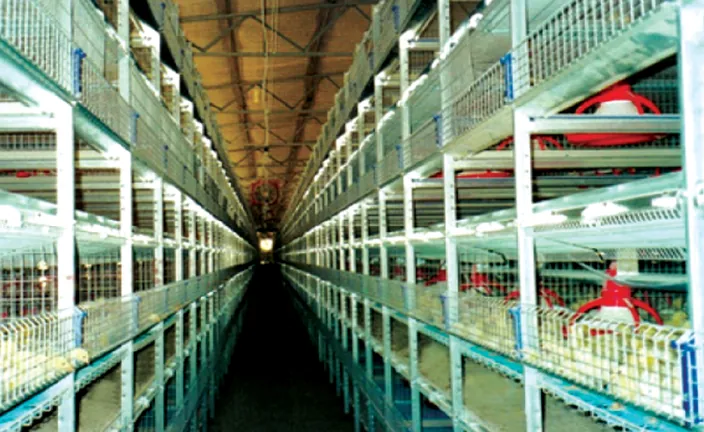
Cage rearing puts more birds on each square metre of land by stacking them. TNAU’s broiler management notes say cage floor space is about half of what deep litter needs, with no litter cost and no coccidiosis, but with risks of breast blisters and a higher initial investment. Vijay Raj’s broiler battery cages are the Automax broiler H-frame system, in BS60 and BS72 versions from 3 to 6 tiers. The two differ only in tier spacing (60 cm or 72 cm), and the BS72 lets you unload birds at the head of each line using the belt conveyor below.
Site Selection and Biosecurity
Once a shed is built, you cannot move it. The site decides your disease risk, your neighbours’ patience and whether the pollution control board will approve you, so check it against the rules before you pay an advance on the land.
Distances the CPCB Guidelines Ask for
The CPCB guidelines set siting criteria that apply to new farms and to consents and renewals for farms above 5,000 birds. New farms should preferably be at least the following distances from:
| Feature | Minimum distance | Reason given |
|---|---|---|
| Residential zone | 500 m | Odour and flies |
| River, lake, canal, well, summer storage tank or other drinking water source | 100 m | Contamination from leaks or spills |
| National Highway | 100 m | Odour and flies |
| State Highway | 50 m | Odour and flies |
| Rural roads, internal roads, village paths | 10 to 15 m | Odour and flies |
| Farm boundary (sheds) | 10 m | Cross ventilation and odour dispersal |
Banks add their own condition. NABARD’s Unit Cost 2023-24 terms say a new poultry farm may be one km away from existing farms or complexes. That rule protects you as much as the bank: disease spreads between neighbouring farms through people, vehicles, wild birds and dust.
What Else Makes a Good Broiler Site
- Reliable water. Broilers drink roughly 1.6 to 1.8 litres of water for every kg of feed at 21°C, according to the Ross Broiler Management Handbook 2025, and each 1°C above 21°C raises the need by about 6.5 percent. In tropical heat, daily consumption can double. Test the borewell for quality and yield before you buy.
- Three-phase power. Even an open house needs power for lights, brooders, pumps and foggers. An EC house needs a generator sized for all fans and pumps at once.
- High, well-drained ground. CPCB wants manure storage at least 2 m above the water table and burial pits at least 3 m above it. Low land that floods in the monsoon fails both.
- All-weather road access for chick vans, feed lorries and lifting vehicles, without those vehicles passing through the bird area.
- Room to grow. Plan the plot for the number of houses you may build in five years, with the spacing kept clear.
Biosecurity You Build in, Not Bolt on
Biosecurity is cheapest at the drawing stage. Fence the farm, keep one gate for vehicles with a tyre dip (which CPCB asks for at feed mill entrances), and put the feed store near the entrance so feed lorries never enter the bird zone. Provide a changing room with farm clothing and footwear, a footbath at every shed door, and bird-proof netting on open sides.
Run the farm all-in, all-out: one age group on the site at a time. TNAU’s notes describe this system as more hygienic, with fewer sub-clinical infections and better growth and feed efficiency than multiple-age farms. Plan the dead-bird disposal point and manure store at the downwind end, away from the gate.
Tip: Mark a clean side and a dirty side on the site plan before the builder starts. Visitors, feed and chicks come in on the clean side. Dead birds, used litter and lifting crates leave from the dirty side.
Licences and Approvals
Most online guides list company registration and a food licence and stop there. A broiler farm’s real approvals are about the environment, the local body and animal health. Rules differ by state, so treat this as a checklist to take to your district animal husbandry office.
Pollution Control Board Consent
This is the one most new farmers miss. The CPCB guidelines state that, following the National Green Tribunal’s order of 10 December 2021, poultry farms handling more than 5,000 birds at a single location must obtain consent to establish (CTE) and consent to operate (CTO) under the Water Act, 1974 and the Air Act, 1981 from the State Pollution Control Board, with effect from 1 January 2023. Poultry farms are in the Green category, so consent is valid for 15 years.
Apply for CTE before construction starts, because the board will check the site against the siting criteria above. Apply for CTO before you place the first chicks. CPCB also classifies farms by size: small (5,000 to 25,000 birds), medium (above 25,000 to 1,00,000) and large (above 1,00,000), and it sets manure and dead-bird rules for each.
Local Body Permission
You will need building permission for the shed and, in many states, a licence to run a livestock farm from the gram panchayat or municipality. Ask the panchayat secretary what they need; it usually includes land records, a site plan, the pollution board consent and a no-objection statement on neighbours. If the land is recorded as agricultural, check whether your state treats a poultry shed as a permitted agricultural use or needs a change of land use.
State Animal Husbandry Registration
Some states now require farms above a size to register with the animal husbandry department. For example, the Maharashtra State Poultry Development and Regulation Advisory 2018 asks every farm with a capacity of 5,000 birds or more to register with the District Deputy Commissioner of Animal Husbandry. The registration is free, is to be issued within one month, and is valid for three years. Ask your district office whether your state has a similar rule.
Other Approvals and Registrations
- Electricity connection from your DISCOM, with the load sized for the final number of houses. Ask which tariff category applies to poultry farms in your state, because it changes your running cost.
- Groundwater permission for a borewell if your block is notified by the state or central groundwater authority.
- Udyam (MSME) registration if you plan to borrow under schemes that use MSME limits.
- GST registration only if your business model or turnover requires it. Ask your accountant.
- Insurance for birds, shed and equipment. NABARD’s model scheme lists insurance of birds and assets as part of the project.
One more rule applies to how you run the farm. The CPCB guidelines note that BIS 1374:2007 on poultry feed does not recommend antibiotic growth promoters, and that antibiotics should be used only on prescription for sick birds.
House Design and Sizing
Sizing a broiler house is simple arithmetic once you fix three numbers: birds per batch, floor space per bird and house width. The poultry house calculator does this for you, and the steps below show what it is doing.
Step 1: Floor Area
Multiply the number of birds by the floor space per bird. The calculator’s planning figures are 1 sq ft (0.093 sq m) per bird for an open house and 0.75 sq ft (0.07 sq m) for an EC house. The NABARD model scheme also uses 1 sq ft per bird for a 10,000-bird deep litter unit.
- Open house, 10,000 birds: 10,000 sq ft (929 sq m).
- EC house, 10,000 birds: 7,500 sq ft (697 sq m).
TNAU’s figures show why these averages work. Birds need about 0.5 sq ft (450 sq cm) each up to 18 days and about 1.1 sq ft (1,000 sq cm) from 19 to 42 days in an open house. In an EC house the steady climate lets you stock tighter at the end of the batch.
Step 2: Width and Length
Width is set by the roof structure and by how far air must travel across the house. The calculator’s default floor house width is 12.2 m (40 ft). Divide the floor area by the width to get the length:
- Open house: 929 sq m divided by 12.2 m is about 76 m long.
- EC house: 697 sq m divided by 12.2 m is about 57 m long.
In an EC tunnel, a longer, narrower house gives a more even air speed from the pad end to the fan end. In an open house, keep the width modest so cross-breezes reach the centre, and run the long axis so the side walls face the prevailing wind.
Step 3: The Plot
Add clearances around each house. CPCB asks for sheds to be at least 10 m from the farm boundary, and the calculator uses 10 m between sheds. For a single 76 m by 12.2 m open house, that means a plot of about 96 m by 32 m, roughly 3,090 sq m or 0.76 acre, before the feed store, office, manure shed and burial pit. Two such houses side by side need about 96 m by 54 m, or 1.3 acres.
Step 4: The Structure
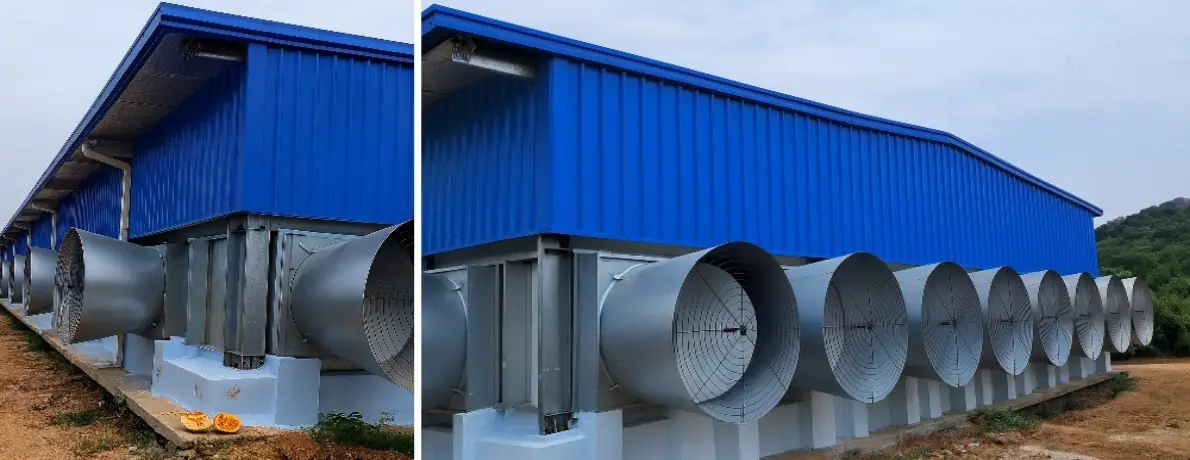
Most new broiler houses in India are pre-engineered steel buildings (PEB), because they go up quickly and span wide without internal columns. Vijay Raj’s PEB poultry houses come in open and closed versions, with frame types that range from clear spans of up to 30 m to multi-gable modules and tapered-column designs for very wide buildings. Final spans and bay lengths are engineered for each site. For more on frame choice, see PEB poultry sheds: frame types and spans.
Equipment by Stage
Broiler equipment falls into six jobs: brooding, feeding, drinking, ventilation, cooling and heating. What you need for each depends on whether the house is open or EC. Buy for the stage the birds are in, not for a generic list.
Brooding: Days 0 to About 14
Day-old chicks cannot hold their own body temperature, so the first two weeks are about warmth. You can heat a small area under brooders (spot brooding) or heat the whole house. The Ross handbook asks for 32°C at the brooder edge in spot brooding, or 30°C air temperature for whole-house brooding, with 60 to 70 percent relative humidity for the first three days.
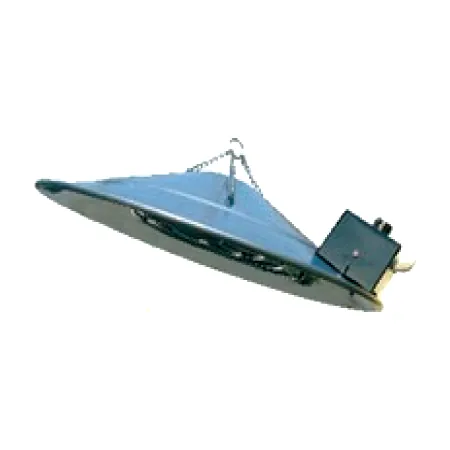
Vijay Raj makes two brooder types. The electric brooder warms 1,000 day-old chicks over about 200 sq ft, draws 2 kW and has an automatic cut-off switch. The gas brooder is an infrared unit with a heat-resistant stainless steel perforated bulb and an integrated stainless steel filter, sold as the Gas Brooder 1000. For 10,000 chicks you would plan 10 brooders, about 2,000 sq ft of brooding area and, if electric, a 20 kW brooding load.
Use a brooder guard or curtain to hold chicks near the heat, then expand the area as they grow. The Ross handbook says to open the whole house from 7 days of age, or 10 to 12 days in open-sided houses.
Feeding
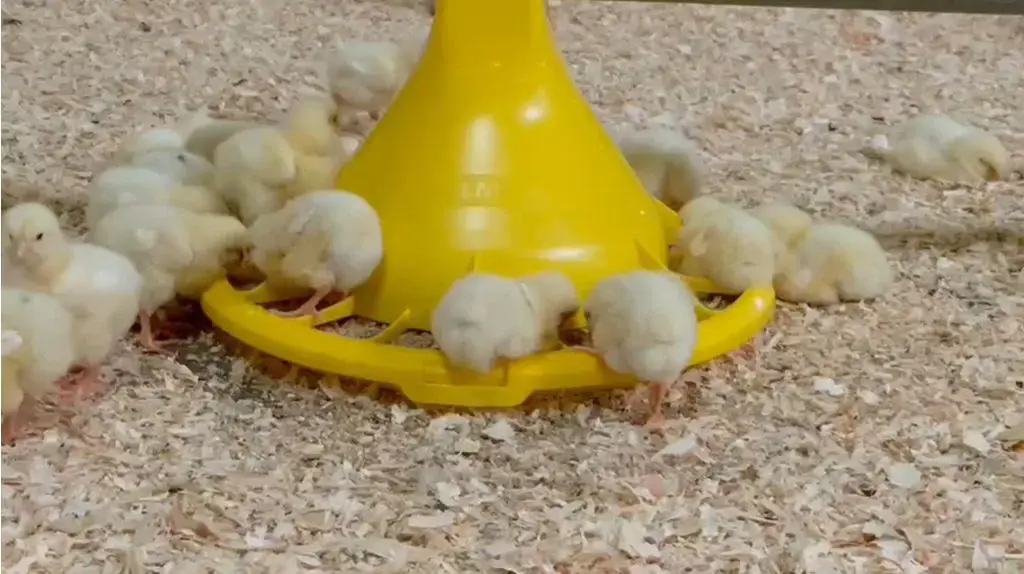
In an open deep litter house, feeding is manual or semi-automatic. Chicks start on chick feeders and plate feeders, then move to grower feeders or high-capacity turbo feeders. Vijay Raj’s manual feeding and drinking equipment covers each stage. TNAU suggests about 3 cm of feeder space per bird up to 18 days and 6 to 7 cm from 19 to 42 days, so 10,000 grown birds need 600 to 700 m of feeding edge in total.
In an EC house, automatic pan feeding carries feed through closed tubes to pans along each line. Vijay Raj’s standard pan serves 40 birds, with 45, 60 and 100-bird pans available, and its wide pan lets 18 to 20 growing birds or 12 to 14 grown broilers feed at once. The same pan works from day old to the end of the cycle, and lines are raised by winch as birds grow, with no hand contact. A touch-screen control panel runs fans, air inlets, lighting and feeding. For a full comparison of feeding options, see automatic poultry feeding systems.
Drinking
Broilers eat only as much as they drink, so water delivery matters as much as feed. Open houses often use chick drinkers for the first days, then bell drinkers or manual grower drinkers. The Ross handbook suggests 8 bell drinkers per 1,000 chicks during brooding. Closed nipple lines keep water cleaner and litter drier, which is why most EC houses use them from day one.
The Ross handbook recommends one nipple per 12 birds up to 3 kg and one per 9 birds above 3 kg, which matches the calculator’s planning figure of 12 birds per nipple on the floor. Vijay Raj’s nipple drinking system includes all-direction broiler nipples (VRND-B1 single lock and VRND-B2 twin lock) with stainless steel pins. For more, read choosing poultry nipple drinkers.
Ventilation
Ventilation removes heat, moisture, ammonia and carbon dioxide. In an open house it comes from curtains, roof ventilation and sometimes circulation fans. In an EC house it is done by exhaust fans at one end pulling air along the house. Vijay Raj supplies exhaust box and cone fans; its 57 in cone fan is rated at 55,000 CFM.
Young chicks must not feel a draught. Ross asks for air speed at chick level below 0.15 m/s during brooding. Older birds in hot weather need the opposite: fast air over their backs. The Ross handbook shows that an air speed of 2.5 m/s makes a 3.5 kg broiler in 29.4°C air feel about 5.6°C cooler.
Cooling
Open houses rely on fogging or sprinklers under the roof, plus good curtain management. EC houses draw air through evaporative cooling pads at the inlet end, so the air is cooled before it reaches the birds. Pad area has to match fan capacity. Our guide to cooling a poultry house compares fogging, sprinklers and pads.
Heating
Beyond the brooders, closed houses in cold regions and winter placements may need space heating. Vijay Raj’s LPG space heater is a direct-fired gas heater that hangs from the roof and circulates warm air, for closed houses with birds of any age. The catalogue model is the LPG Space Heater 5000, with stainless steel, natural gas and high-altitude versions available.
Worked Equipment Take-Off for a 10,000-Bird EC House
Here is what a 10,000-bird EC house, 12.2 m wide and about 57 m long, needs in quantities. The rules are the calculator’s bill-of-quantities rules and the Ross tunnel ventilation method. Your engineer will refine them for your site.
| Item | How it is worked out | Quantity |
|---|---|---|
| Feed lines | House width 12.2 m divided by 3 m line spacing | 4 lines, 4 hoppers, 1 winch per line |
| Feed pans | 10,000 birds divided by 40 birds per standard pan (or 60 per large pan) | 250 pans (or about 167) |
| Nipple lines | Feed lines plus 1 | 5 lines |
| Nipples | 10,000 birds divided by 12 birds per nipple | About 834 nipples |
| Brooders | 1 electric brooder per 1,000 chicks | 10 brooders, about 20 kW if electric |
| Tunnel air | Cross-section (12.2 m wide, 2.4 m side wall, 1.5 m roof rise) of about 38.4 sq m, times a design air speed of 3 m/s | About 4,15,000 cu m per hour, roughly 2,44,000 CFM |
| 57 in cone fans | Required airflow divided by 55,000 CFM per fan, rounded up | At least 5 fans, more once you use the fan’s output at working pressure |
| Cooling pad face | Total fan airflow divided by 350 ft per minute through the pad | About 786 sq ft (73 sq m) |
The 3 m/s design air speed, the cross-section formula and the 1.78 m/s (350 ft per minute) pad face speed all come from the tunnel ventilation example in the Ross handbook. Ross stresses that a fan delivers less air at operating pressure than its free-air rating, so ask your supplier for each fan’s output at about 40 Pa and recount.
Tip: Size the generator for every fan, pump and the controller running together in May, not for the average load. A power cut on a hot afternoon can kill a closed house of heavy birds within the hour.
The Money: A Worked 10,000-Bird Example, Open vs EC
This is the part most guides skip. The tables below use NABARD’s published unit rates so you can see how a bank will look at your project. They are indicative. Prices move every season, and NABARD itself says its unit costs are indicative and banks may set their own. Get current quotations before you apply.
Capital Cost
For the open house we use the rates in NABARD’s Unit Cost 2023-24 for a commercial broiler unit on deep litter: shed construction at Rs 319 per sq ft, broiler equipment at Rs 45 per bird and electrical installation at 3 percent of the civil cost. NABARD publishes no separate rate for an EC broiler house, so that column shows what changes and what you must get quoted.
| Item | Open house, 10,000 birds | EC house, 10,000 birds |
|---|---|---|
| Floor area | 10,000 sq ft (929 sq m) at 1 sq ft per bird | 7,500 sq ft (697 sq m) at 0.75 sq ft per bird |
| House size at 12.2 m width | About 76 m long | About 57 m long |
| Shed | Rs 31.90 lakh (10,000 sq ft at Rs 319) | Quotation. The Rs 319 open-house rate on 7,500 sq ft would be Rs 23.93 lakh, but an EC shell adds closed insulated walls and roof, a pad wall and a fan wall, so the rate per sq ft is higher |
| Equipment | Rs 4.50 lakh (Rs 45 per bird: manual feeders, drinkers, brooders) | Quotation for the items in the take-off table: pan and nipple lines, fans, pads, controller, brooders or heaters |
| Electrical installation | Rs 0.96 lakh (3 percent of civil) | Quotation. Much higher connected load plus a generator |
| Capital subtotal | Rs 37.36 lakh | From quotations |
| First-batch working capital (independent) | Rs 17.53 lakh (next table) | Rs 17.53 lakh on the same assumptions |
| Total, excluding land, borewell, fencing, feed store and generator | About Rs 54.9 lakh | From quotations |
Costs have risen sharply. An older NABARD model scheme for the same 10,000-bird unit assumed a shed at Rs 150 per sq ft and equipment at Rs 25 per bird, and came to a total project cost of Rs 30.96 lakh including a feed room and the first batch. At 2023-24 rates, the shed alone now costs more than that entire older project.
The EC advantage in capital terms is floor area. If you build the same 10,000 sq ft shell as an EC house, it holds about 13,300 birds at 0.75 sq ft each, one third more birds per batch from the same building. For a contract grower paid per kg, that is one third more income per batch from the same land.
Per-Batch Economics for an Independent Farmer
Assumptions: 10,000 chicks placed, 5 percent mortality (the rate NABARD uses and the allowance in the MEAS contract), 2.0 kg average sale weight (the MEAS contract standard), and an FCR of 1.8 (TNAU gives 1.8 or less at six weeks as preferable; ICRA puts Indian FCR at 1.6 to 1.9). Input rates are from NABARD’s Unit Cost 2023-24: chicks Rs 35, feed Rs 30 per kg, vaccines, medicines and miscellaneous Rs 32 per bird, bird insurance at 6 percent of chick cost, and labour at Rs 12,000 per month per worker (the NABARD layer model rate).
| Line | Working | Amount |
|---|---|---|
| Birds sold | 10,000 less 5 percent mortality | 9,500 birds |
| Live weight sold | 9,500 x 2.0 kg | 19,000 kg |
| Feed used | 19,000 kg x FCR 1.8 | 34,200 kg |
| Chicks | 10,000 x Rs 35 | Rs 3,50,000 |
| Feed | 34,200 kg x Rs 30 | Rs 10,26,000 |
| Vaccines, medicines, miscellaneous | 10,000 x Rs 32 | Rs 3,20,000 |
| Bird insurance | 6 percent of chick cost | Rs 21,000 |
| Labour | 2 workers x Rs 12,000 x 1.5 months | Rs 36,000 |
| Litter, electricity, brooding gas | Get local rates | Not included |
| Total variable cost | Rs 17,53,000 | |
| Cost per kg live weight | Rs 17,53,000 divided by 19,000 kg | About Rs 92 per kg |
Now test that cost against selling prices. DT Next reported a Tamil Nadu farm procurement price of Rs 120 per kg on 20 December 2025, rising to Rs 130 per kg by its 1 January 2026 report. ICRA shows how quickly a scare can pull prices down by a fifth or more. The margins below are before litter, power, gas, interest and depreciation.
| Sale price per kg live | Revenue (19,000 kg) | Margin over Rs 17.53 lakh variable cost |
|---|---|---|
| Rs 90 | Rs 17,10,000 | Loss of Rs 43,000 |
| Rs 110 | Rs 20,90,000 | Rs 3,37,000 |
| Rs 130 | Rs 24,70,000 | Rs 7,17,000 |
What Moves the Result Most
Feed dominates, so small changes in feed price or FCR swing the batch. With 19,000 kg sold:
- Feed price: each Rs 5 per kg rise costs Rs 1,71,000 per batch (34,200 kg x Rs 5). At Rs 40 per kg instead of NABARD’s Rs 30, the total variable cost rises to about Rs 20.95 lakh, or about Rs 110 per kg. That is closer to the Rs 100 to 105 per kg production cost DT Next reported in Tamil Nadu, and it is why you must use today’s feed price, not the bank’s benchmark.
- FCR: each 0.1 change in FCR is 1,900 kg of feed, worth Rs 57,000 at Rs 30 per kg or Rs 76,000 at Rs 40.
- Mortality: each extra 1 percent is 100 fewer birds, or 200 kg less to sell (Rs 22,000 to Rs 26,000 at Rs 110 to Rs 130 per kg), plus the feed those birds ate before they died.
- Sale weight: each 0.1 kg of average weight is 950 kg more to sell, but it also needs more feed at a rising FCR, so heavier is not always more profitable.
This is where an EC house earns its extra capital: not in a cheaper chick or cheaper feed, but in FCR, mortality and weight that hold steady through summer. Before you pay for EC, ask the supplier and the integrator what FCR and mortality they actually see in EC houses in your district, and run those numbers through the lines above.
The Same Flock on an Integrator Contract
On contract, the integrator pays for chicks, feed and medicine, so your per-batch working capital falls to labour, litter, power and gas. At the Rs 6.50 per kg growing charge reported in Tamil Nadu, 19,000 kg earns Rs 1,23,500 per batch before those costs. At five batches a year, the maximum the MEAS study found integrators supplying, that is about Rs 6.2 lakh a year; at seven batches it is about Rs 8.6 lakh.
Set that against Rs 37.36 lakh of capital for the open shed and equipment at NABARD rates, and you can see why contract growers are sensitive to both shed cost and batch frequency. It is also why several contract farmers push for EC houses: one third more birds on the same floor lifts the growing charge per batch by a third.
Tip: Rebuild these tables with your own quotations and prices in a spreadsheet. Keep the lines exactly as above, so your bank can follow your numbers the same way NABARD’s appraisal does.
Chick Placement and the First 24 Hours
The first day sets the tone for the whole batch. The Ross handbook recommends that you clean and disinfect the house and equipment, then preheat it and set minimum ventilation so temperature and humidity are stable for at least 24 hours before the chicks arrive. Floor temperature should be 28 to 30°C and litter temperature 28 to 32°C before chicks go down.
- Spread litter evenly. Ross suggests 2 to 4 cm before placement in warm climates, more in cold regions. Uneven litter blocks chicks from feed and water.
- Fill feeders and drinkers and flush nipple lines 1 to 2 hours before placement. Ross also recommends flushing twice daily for the first four days so the water stays cool.
- Get the chick details from the hatchery: chick weight, vaccination record, parent flock age and health status. Marek’s disease vaccine is normally given at the hatchery on day one, according to TNAU.
- Unload the chicks quickly and gently, spreading them evenly over paper in the brooding area. No chick should have to travel more than 2 m to reach feed or water in the first 24 hours.
- Leave the chicks to settle for 1 to 2 hours, then check feed, water, temperature and humidity.
- Check crop fill. Gently feel the crops of 30 to 40 chicks in three or four places. Ross targets full crops in at least 75 percent of chicks at 2 hours, 80 percent at 4 hours, above 85 percent at 12 hours and above 95 percent at 24 hours.
- Watch the chicks. If they huddle under the brooder they are cold; if they crowd the edges and pant, they are too hot. Evenly spread, active chicks are comfortable.
Week-By-Week Plan for Your First Batch
Use this as a working checklist for a batch sold at about 35 to 42 days. The target weights are from the Cobb500 Broiler Performance and Nutrition Supplement (2022) for mixed-sex flocks. They are the breed company’s objectives under good conditions; most Indian farms land below them, so use them as a direction, not a promise. Temperatures are from the Ross handbook, set by body weight, and vaccination days follow TNAU’s broiler schedule.
| When | Key jobs | Targets and checks |
|---|---|---|
| Day -14 to -2 | Remove old litter and manure, wash, disinfect, lime the floor, repair curtains and nets, service fans, brooders and generator. NABARD’s model allows two weeks between batches for cleaning. | House empty and dry. Rodent and fly control done. Dead-bird pit or compost bay ready. |
| Day -1 | Spread fresh litter, set up brooder guards, fill feeders and drinkers, preheat. | Air 30°C (whole house) or 32°C at brooder edge. RH 60 to 70 percent. Stable for 24 hours. |
| Day 0 | Place chicks, check crop fill, 23 hours of light at 30 to 40 lux. | Day-old weight about 42 g. Crop fill 95 percent by 24 hours. |
| Week 1 (days 1 to 7) | Lower temperature as weight rises (28°C at 100 g, 27°C at 180 g). Give Ranikhet (Newcastle) vaccine, RDV F1, on day 5 to 7 by eye or nose drop. Pre-starter feed. Weigh 1 percent of birds or 100, whichever is larger, on day 7. | Day 7 weight at least 4.5 times day-old weight (Ross). Cobb objective 202 g. Record daily mortality with cause. |
| Week 2 (days 8 to 14) | Expand brooding area to the whole house (by day 7 in EC, 10 to 12 days in open houses). Raise feeders and drinkers with the birds. Give IBD (Gumboro) vaccine on day 14. | 26°C at about 290 g, 25°C at about 425 g. Cobb objective 570 g at day 14, FCR about 1.03. |
| Week 3 (days 15 to 21) | Move from pre-starter to starter feed (TNAU: starter for weeks 3 and 4). Give Ranikhet La Sota vaccine in drinking water on day 21. Increase ventilation. | 24°C at about 590 g, 23°C at about 790 g. Cobb objective 1,116 g at day 21. |
| Week 4 (days 22 to 28) | Give IBD booster in drinking water on day 28. Full floor space in use (about 1.1 sq ft per bird in open houses). Watch litter moisture and ammonia. | 22°C at about 1,015 g, 21°C at about 1,260 g. Cobb objective 1,783 g at day 28. |
| Week 5 (days 29 to 35) | Finisher feed (TNAU: weeks 5 and 6). Maximum cooling and air speed on hot days. Book the buyer or confirm the lifting date. | 20°C after day 27 or as bird behaviour shows. Cobb objective 2,521 g at day 35, FCR 1.44. |
| Week 6 (days 36 to 42) and sale | Remove feed 8 to 12 hours before processing (Ross), keep water on, dim lights during catching. Weigh the sold birds and close the batch record. | Calculate FCR, livability and cost per kg. TNAU gives 97 to 98 percent livability as normal. |
On lighting, the two sources differ. TNAU’s notes for open-sided Indian houses recommend 24 hours of light during brooding and then 23 hours of light and 1 hour of dark until sale, so birds get used to darkness in case of a power cut. The Ross handbook recommends building up to at least 4 hours of continuous darkness by day 7, which is easier to control in an EC house. Agree the programme with your integrator or vet.
Feed and FCR
Feed is the largest cost you control. TNAU describes three feeds for broilers from day old to sale: pre-starter mash or crumble for weeks 0 to 2, starter mash for weeks 3 and 4, and finisher mash for weeks 5 and 6. On contract, the integrator supplies these. As an independent farmer, you either buy from a feed mill or mix your own, and either way you should check quality for every lot.
How to Calculate FCR
Feed conversion ratio (FCR) is the kilograms of feed eaten for each kilogram of live weight produced. TNAU’s formula is total feed consumed per bird divided by mean body weight gain. On the farm, divide the total feed delivered to the house, minus feed left over, by the total live weight sold. A lower FCR is better.
For context, the Cobb500 objective is about 1.44 at 35 days for a mixed flock, ICRA puts Indian commercial FCR at 1.6 to 1.9 depending on breed, feed and environment, and the contract in the MEAS study used 1.85 as its standard. TNAU also gives two useful index formulas you can track batch to batch:
- Broiler Performance Efficiency Factor: live weight in kg x 100, divided by FCR. A value of 100 or more is desirable.
- Broiler Farm Economy Index: average live weight in kg x percent livability, divided by FCR x growing period in days. A value of 2.0 and above shows good management; below 1.3 shows poor performance.
As a check, a flock sold at 2.0 kg with 95 percent livability, an FCR of 1.8 and 40 days of growing gives an economy index of 2.0 x 95, divided by 1.8 x 40, which is about 2.6.
Habits That Protect FCR
- Keep feeders at the height of the birds’ backs and never overfill them; spilt feed counts against your FCR.
- Keep water cool and clean. If water intake falls, feed intake follows.
- Store feed off the floor, dry and in first-in, first-out order. Mouldy feed wrecks both FCR and health.
- Weigh a sample of birds every week and compare with your target curve, so you correct problems in days, not at sale.
Vaccination and Flock Health
Your vaccination programme must come from a veterinarian who knows the disease pressure in your area and the vaccines the hatchery has already given. As a reference, TNAU’s broiler management notes list this schedule:
| Age | Vaccine | Route |
|---|---|---|
| Day 1 | Marek’s disease (at the hatchery) | Under the skin at the neck |
| Day 5 to 7 | Ranikhet disease (Newcastle), RDV F1 | Eye or nose drop |
| Day 14 | Infectious bursal disease (IBD, Gumboro) | Eye or nose drop |
| Day 21 | Ranikhet disease, La Sota strain | Drinking water |
| Day 28 | IBD booster | Drinking water |
NABARD’s lending terms back this up: a regular vaccination schedule prescribed by the vet should start immediately after chicks arrive, and the bank expects a veterinary health check of the flock at least once a month. For water vaccines, stop any chlorine or sanitiser in the water beforehand, and make sure every bird drinks within the time the vaccine maker specifies.
Handling Dead Birds and Litter
The CPCB guidelines require dead birds to be separated from live birds promptly, kept in closed containers and disposed of within 24 hours. For burial, the pit should be 3 to 4 m deep and 0.8 to 1.2 m across, at least 3 m above the groundwater table, with a vermin-proof cover and a layer of soil and lime over each drop. A composting facility must be at least 300 m from the nearest dwelling and 100 m from any well or water course.
Used litter is removed with the manure at the end of each cycle, then the shed is washed, limed and rested. CPCB recommends composting for small farms, and composting or biogas for medium and large farms. Well-composted litter is a saleable fertiliser, so plan a covered store for it.
Labour and the Daily Routine
An open house with manual feeders and drinkers needs more hands than an EC house with pan lines, but even a fully automatic house needs a trained person on site day and night. Plan labour from the jobs, not from a rule of thumb:
- Morning round: check temperature, bird behaviour and water flow, remove and record dead birds, top up feeders.
- Midday: in summer, manage curtains, foggers or pads, and watch for panting.
- Evening: second feed and water check, adjust curtains or ventilation for the night, check the generator.
- Weekly: weigh a sample, clean the water tank and header lines, rake or turn wet litter, record feed stock.
- At lifting: extra hands for catching, often hired for the day.
The MEAS study notes that integrators expect contract farmers to keep full records of mortality, FCR, growth and feed use, and that supervisors check them on every visit. Keep the same records as an independent farmer; they are the evidence your bank will ask for when you want a second shed.
Finance and Subsidies
Most broiler farms are financed by a bank term loan for the shed and equipment, plus working capital for the first batch. The NABARD model scheme says the margin (your own contribution) depends on the borrower category and ranges from 10 to 25 percent, and that repayment for broiler farming is usually spread over 6 to 8 years. NABARD’s Unit Cost 2023-24 lists small broiler units with a 5-year repayment and a gestation period of six months to a year. Loans are released in stages, usually for civil works and equipment first, then for chicks, feed and medicine.
What the Central Schemes Actually Cover
Be careful with claims that every broiler farm gets a big subsidy. Read the scheme rules yourself:
- National Livestock Mission (NLM-EDP): the NLM operational guidelines (January 2025) give a 50 percent capital subsidy, up to Rs 25 lakh a unit, for a parent farm, rural hatchery and mother unit with at least 1,000 parent layers of low-input technology birds. It is aimed at rural poultry breeding, not at a commercial broiler grow-out shed.
- Animal Husbandry Infrastructure Development Fund (AHIDF): the AHIDF implementation guidelines offer a 3 percent interest subvention, loans of up to 90 percent of project cost, repayment up to 8 years including a 2-year moratorium, and a credit guarantee of up to 25 percent for eligible MSMEs. The eligible activities listed are dairy processing, meat processing and animal feed plants. It becomes relevant if your plan includes a feed mill or a processing unit alongside the farm.
- State schemes: several states run their own livestock or poultry schemes from time to time. Your district animal husbandry office and your bank will know which are open.
Our guide to poultry farm subsidy and loans in India explains these schemes and what banks ask for in more detail.
What Goes into Your Business Plan
For a bank, your business plan is the detailed project report (DPR). The NABARD model scheme lists what it should contain:
- Technical: land and site map, capacity, civil structures, equipment, housing type (deep litter or EC), chick source and strain, feed source and price, water, power and fuel, veterinary support, production parameters (weight, FCR, mortality), a flock projection chart, marketing and the scope for integration.
- Financial: capital and recurring costs, funding pattern, techno-economic assumptions, income and expenditure statement, cash flow with IRR, NPW, BCR and DSCR, repayment schedule and break-even analysis.
- Managerial: your profile, experience and training, and the staff you will employ.
- Other: the bank, training arrangements, government support sought and regulatory clearances.
The worked tables above give you the structure for the costs and the batch economics. Add a flock chart showing how many batches you will run each year. NABARD’s 10,000-bird model assumes 6 weeks of rearing and 2 weeks of cleaning, which gives 6 batches in year one and 7 in later years.
Common Mistakes New Broiler Farmers Make
- Building before the integrator or buyer is fixed. A shed with no chick supply earns nothing. Sign the placement agreement, or line up buyers, before construction.
- Skipping the pollution board consent. Above 5,000 birds, CTE and CTO are mandatory. A farm built without them risks closure orders.
- Buying land that fails the siting rules. A plot 200 m from a village or next to a well cannot meet CPCB’s distances, however cheap it is.
- Budgeting with the bank’s benchmark feed price. Use the price you will actually pay this season, and test a higher one.
- Undersizing ventilation and backup power. In an EC house, too few fans or a small generator costs more than the savings.
- Poor brooding. Cold or dehydrated chicks in week one never recover their lost growth. Preheat for a full day and check crop fill.
- Short cleaning breaks. Placing the next batch into a half-cleaned house carries disease forward. Protect the downtime.
- No records. Without daily mortality, feed and weight records you cannot find the cause of a bad batch, and your bank cannot see a good one.
Launch Checklist
Before You Buy Land
- Business model chosen: contract or independent, with a written offer or buyer list
- Site checked against CPCB siting distances and NABARD’s 1 km spacing from existing farms
- Water yield and quality tested; three-phase power available
- Plot sized for the houses you plan in five years, with 10 m clearances
Before Construction
- House type decided (open, EC or cage) and sized with the calculator
- Consent to establish applied for from the State Pollution Control Board
- Building permission and local body licence in hand
- DPR and quotations submitted to the bank; loan sanctioned
- Site plan shows the clean and dirty sides, feed store at the gate, dead-bird pit and manure store downwind
Before the First Chicks
- Consent to operate received; state registration done where required
- All equipment installed and tested: brooders, feeders, drinkers, fans, pads, foggers, generator
- Chick supply, feed supply and vaccination programme confirmed with the hatchery, feed supplier or integrator and your vet
- Staff trained on brooding, daily rounds and record-keeping
- Insurance in place for birds, shed and equipment
- House cleaned, disinfected, littered and preheated for 24 hours
After the First Batch
- FCR, livability, average weight and cost per kg calculated
- Results compared with your plan and the weekly targets; one improvement chosen for the next batch
- House cleaned out, litter composted and downtime protected
Getting Help with Your Broiler Farm
Vijay Raj has been building poultry equipment in Hyderabad since 1972, and supplies open and EC broiler equipment, broiler cages and PEB houses. If you want the whole farm planned and delivered by one supplier, see what a turnkey broiler farm covers, or read what a turnkey poultry farm project includes. For a single list of everything a new farm needs, use the poultry farming equipment list, and browse all broiler systems.
When your site and flock size are clear, talk to a Vijay Raj engineer about a house layout and an itemised quotation for your DPR.
Frequently Asked Questions
How much does it cost to start a 10,000-bird broiler farm in India?
Using NABARD's Unit Cost 2023-24 rates, an open deep litter house for 10,000 birds costs about Rs 37.4 lakh for the shed, equipment and electricals, plus about Rs 17.5 lakh of working capital for the first batch if you farm independently. That excludes land, borewell, fencing, feed store and generator. An EC house needs less floor area but costs more per sq ft, so get itemised quotations.
How much floor space does a broiler need?
A common planning figure is 1 sq ft (0.093 sq m) per bird in an open-sided house and 0.75 sq ft per bird in an environment-controlled house. TNAU gives about 0.5 sq ft per bird up to 18 days and about 1.1 sq ft from 19 to 42 days in open houses. Cages need roughly half the deep litter floor space.
Do I need pollution control board permission for a broiler farm?
Yes, if you will house more than 5,000 birds at one location. Following a National Green Tribunal order, the CPCB guidelines require consent to establish and consent to operate from the State Pollution Control Board from 1 January 2023. Poultry farms are in the Green category, so consent is valid for 15 years. Apply before construction starts.
How do integrators pay contract broiler farmers?
The integrator supplies chicks, feed, medicines and technical support, and the farmer provides the shed, equipment, labour, power and litter. The farmer is paid a growing charge per kg of live weight, adjusted up or down for FCR and mortality against the company's standards. In January 2026, DT Next reported Tamil Nadu farmers being paid Rs 6.50 per kg.
How many batches of broilers can I raise in a year?
NABARD's 10,000-bird model assumes 6 weeks of rearing and 2 weeks of cleaning per batch, which gives 6 batches in the first year and 7 in later years. On an integrator contract, the company decides placements; a study of contract farms in Telangana, Andhra Pradesh and Karnataka found companies supplying no more than five batches a year.
Is there a government subsidy for starting a broiler farm?
Not usually for a plain commercial grow-out shed. The National Livestock Mission's 50 percent subsidy, up to Rs 25 lakh, is for parent farms and hatcheries of rural low-input birds with at least 1,000 parent layers. AHIDF offers 3 percent interest subvention for processing and feed plants. Check state schemes with your district animal husbandry office and bank.
What is a good FCR for broilers in India?
TNAU treats an FCR of 1.8 or less at six weeks as preferable, and ICRA puts Indian commercial FCR at 1.6 to 1.9 depending on breed, feed and environment. The Cobb500 breed objective is about 1.44 at 35 days under good conditions. Each 0.1 change in FCR on a 10,000-bird batch sold at 2 kg is about 1,900 kg of feed.
How much land do I need for a 10,000-bird broiler farm?
An open house for 10,000 birds at 1 sq ft each is about 76 m long and 12.2 m wide. With the 10 m clearance from the boundary that CPCB asks for, the plot is about 96 m by 32 m, roughly 0.76 acre, before the feed store, office, manure shed and burial pit. Plan extra land if you may add houses.
Sources
- NABARD Jharkhand Regional Office: Unit Cost 2023-24 (2023)
- NABARD: Model bank scheme, Poultry Broiler Farming, 10,000-bird unit (hosted by TNAU Agritech)
- Central Pollution Control Board: Environmental Guidelines for Poultry Farms (2022)
- PIB / DAHD: Release of Basic Animal Husbandry Statistics 2025 (2025)
- MEAS, Sasidhar and Suvedi: Integrated Contract Broiler Farming, an Evaluation Case Study in India (2015)
- DT Next: Tamil Nadu poultry farmers begin stir on rearing charges (2026)
- ICRA: Indian Poultry Industry, March 2025 (2025)
- Cobb-Vantress: Cobb500 Broiler Performance and Nutrition Supplement (2022)
- Aviagen: Ross Broiler Management Handbook (2025)
- TNAU Agritech Portal: Expert System for Poultry, Broiler Management
- DAHD: National Livestock Mission Comprehensive Operational Guidelines (2025)
- DAHD: Animal Husbandry Infrastructure Development Fund Implementation Guidelines (2023)
- Commissioner of Animal Husbandry, Maharashtra: State Poultry Development and Regulation Advisory (2018)