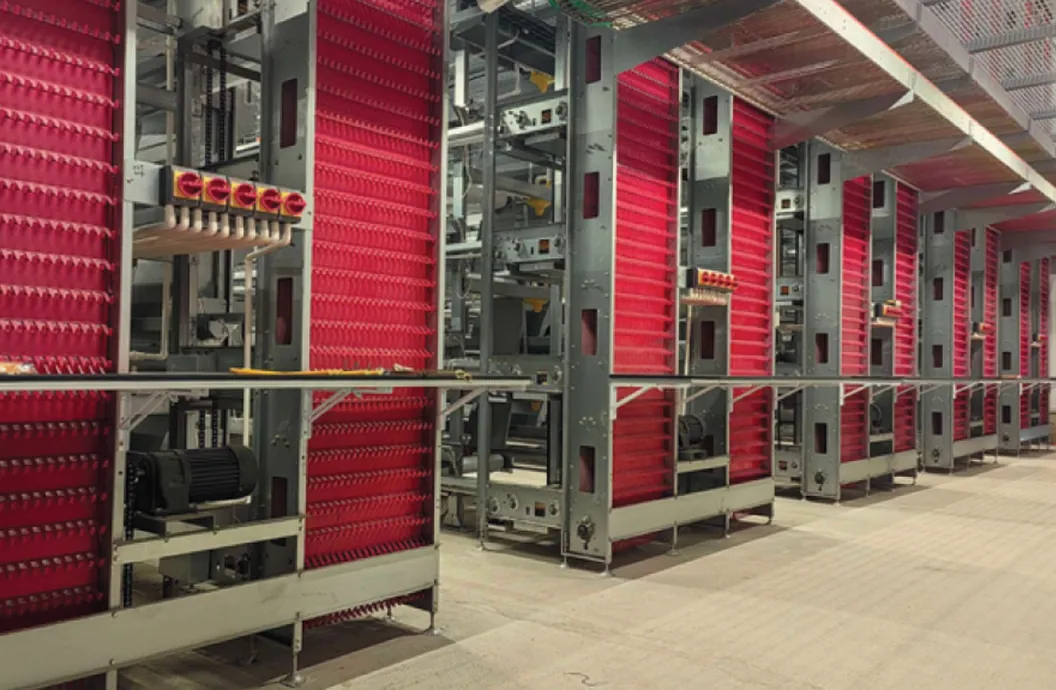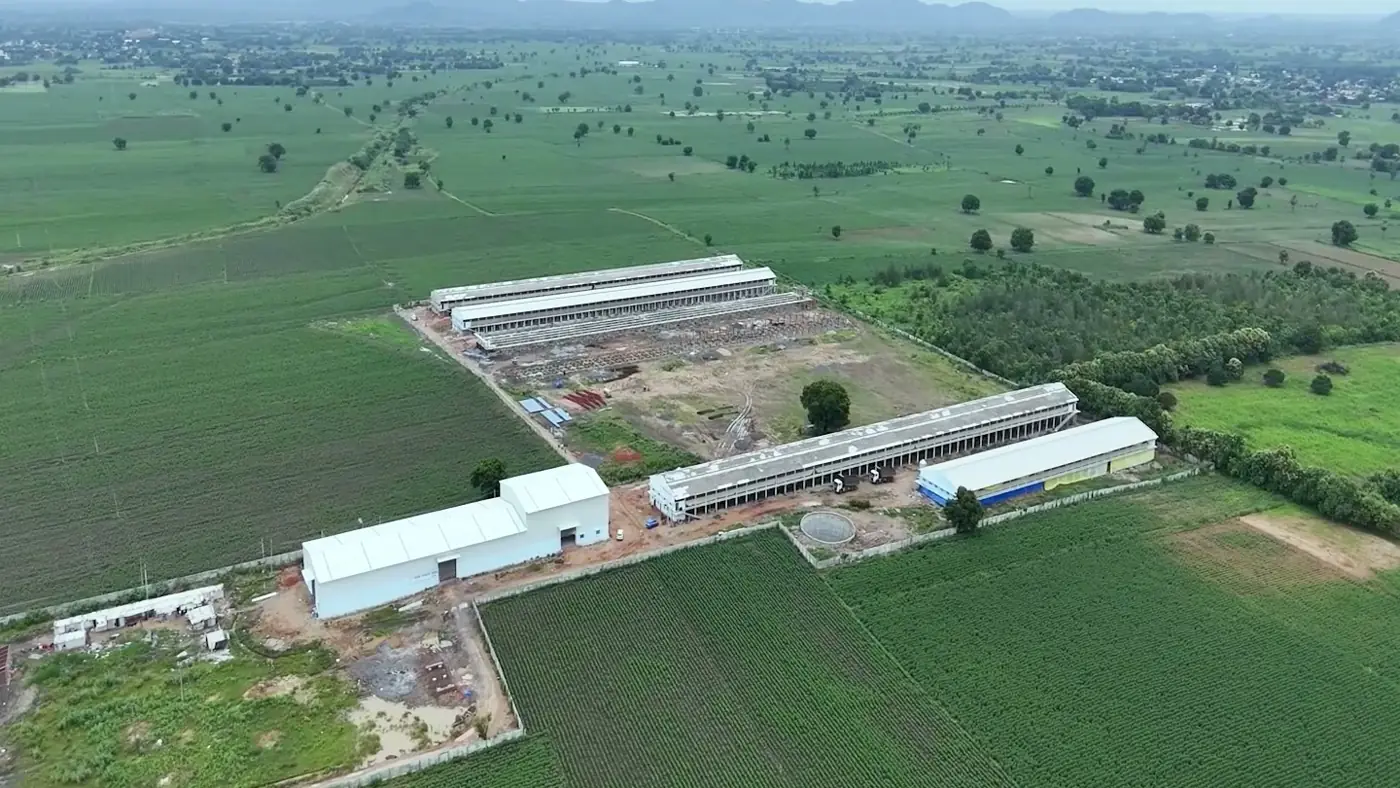


In this guide 21 sections
- Why eggs, and why now
- Choose your business model first
- Breeds and strains used in India
- The flock cycle from day one to depletion
- Cage, deep litter or cage-free
- The 2023 egg laying hen rules and your space norms
- Site selection and farm layout
- Open house or environment-controlled house
- Choosing California, Comfort+ or Automax
- Sizing a 10,000-bird layer house
- Equipment by stage
- Lighting programme basics
- Feed and water
- Vaccination and biosecurity
- Egg handling, grading and storage
- Labour and daily routine
- Capex for a 10,000-bird cage layer farm
- Yearly economics: a worked example
- Finance and subsidies
- Common mistakes new layer farmers make
- Launch checklist
To start a layer poultry farm in India, choose a model (rear pullets or buy them), pick a house and cage system, give every hen at least 550 sq cm under the 2023 laying hen rules, register with your state animal husbandry department and arrange finance. NABARD’s 2023-24 unit cost is Rs 642 per caged bird.
This guide walks through every decision in the order you will face it, from the egg market to the day you sell your spent hens. It uses published government figures and breed guides wherever a number matters, and shows the arithmetic so you can redo it with your own local prices.
Why Eggs, and Why Now
India produced 149.11 billion eggs in 2024-25, up 4.44% on the previous year, according to the Basic Animal Husbandry Statistics 2025 released by the Department of Animal Husbandry and Dairying. Per capita availability rose from 62 eggs a year in 2014-15 to 106 eggs a year in 2024-25. Commercial farms supplied 125.98 billion of those eggs, or 84.49% of the total, with backyard flocks making up the rest.
Production is concentrated in the south and east. The same release puts Andhra Pradesh at 18.37% of national output, followed by Tamil Nadu (15.63%), Telangana (12.98%), West Bengal (10.72%) and Karnataka (6.67%). Together these five states produce 64.37% of India’s eggs.
That concentration matters when you plan a farm. If you build in a surplus state, you sell into a crowded market and your price follows the regional NECC suggested rate. If you build in a deficit state, you may earn a better farm-gate price but you pay more for maize and soya, and you may find fewer experienced farm hands, vaccinators and feed mills nearby.
The other reason layers attract investors is cash flow. A broiler flock pays once every six or seven weeks. A layer flock, once it is in lay, sells eggs every single day for more than a year from one batch of birds. The trade-off is a longer wait before the first rupee comes in (about five months from day-old chick to meaningful production) and a much larger working capital need, mostly feed.
Tip: Before you commit, spend a week tracking the NECC daily rate for your nearest zone and ask two or three local traders what they actually pay at the farm gate. NECC rates are suggestions, not mandatory prices, and the gap between the published rate and what traders pay can decide whether your farm makes money.
Choose Your Business Model First
“Layer farm” covers three quite different businesses. Your choice changes the land you need, the number of houses, your staff skills and how long your money is tied up before eggs start selling.
Model 1: Integrated Farm (Rear Your Own Pullets)
You buy day-old chicks from a hatchery, brood and grow them in a rearing house, move them to the laying house before they start to lay, and keep them until depletion. This is the most common model for commercial farms because you control the most important weeks of a hen’s life. The BV300 Nutrition and Management Guide 2023 makes the point bluntly: after the onset of lay it is much harder to correct a flock than during rearing.
The integrated model needs two kinds of housing: a rearing house with chick and grower cages, and one or more laying houses. It also needs brooding equipment, a stronger vaccination routine and staff who can weigh birds and judge uniformity. In return you get pullets whose history you know, and you can time placements so that one flock starts laying as another is depleted.
Model 2: Buy Ready-To-Lay Pullets
Some farmers skip rearing and buy grown pullets from a specialist rearer. You need only a laying house, and your money is tied up for weeks instead of months before eggs start. The risks are that you inherit someone else’s brooding, beak treatment and vaccination record, and that the stress of transport and a new house falls in the sensitive weeks before lay.
If you choose this model, insist on the vaccination record, the body weight and uniformity at dispatch, and a delivery date that lets the birds settle before production starts. The BV300 guide recommends completing any transfer before the onset of production, because the ovary and oviduct go through major development in the two to three weeks before the first egg.
Model 3: Contract or Integrator-Linked Farming
In some regions an integrator supplies chicks, feed and veterinary support and pays the farmer for eggs or for growing birds. This lowers your working capital but also your margin and your control. Note that the law does not let you hand off welfare responsibility: under Rule 6(2) of the Prevention of Cruelty to Animals (Egg Laying Hens) Rules, 2023, in contract farming both the farm owner and the contractor are responsible for compliance.
| Model | Houses needed | Time to first eggs | Main risk | Best for |
|---|---|---|---|---|
| Integrated (own rearing) | Rearing house plus laying house(s) | About 20 weeks from chick placement | Brooding and rearing mistakes | Commercial farms planning repeat flocks |
| Buy ready-to-lay pullets | Laying house only | A few weeks after delivery | Unknown rearing history, transfer stress | First-time farmers, small land |
| Contract or integrator-linked | As the integrator specifies | Set by the contract | Low margin, shared compliance liability | Farmers with limited capital |
Breeds and Strains Used in India
Commercial egg farms in India use hybrid strains, not local or dual-purpose breeds. Two families dominate the conversation with farmers, and both publish detailed performance standards you can plan against.
BV300 (White Eggs)
The BV300 is developed by Venkateshwara Research and Breeding Farm, part of the VH Group, which describes it in its 2023 guide as developed for Indian agro-climatic conditions and farming practices. The guide’s performance goals under good management are worth knowing because the economics later in this guide use them:
- Livability of 96 to 98% from 0 to 18 weeks and 93% from 19 to 80 weeks.
- Feed intake of 5.6 kg per bird from 0 to 18 weeks and 46.5 kg from 19 to 80 weeks.
- 50% rate of lay at 20 weeks and 90% at 22 weeks, with a peak of 98%.
- 340 hen-housed eggs to 72 weeks and 386 to 80 weeks.
- Feed per egg of 121 g over 19 to 80 weeks.
Hy-Line W-80 and Hy-Line Brown
Hy-Line International strains are sold in India as day-old pullet chicks through Srinivasa Farms, which markets them as Srinivasa Hy-Line, offering the white W-80 and the Hy-Line Brown. The Hy-Line W-80 Performance Standards Guide (April 2026) gives a rearing period to 17 weeks with 96.8% livability and 5.41 kg of feed, 50% production at 142 days from hatch, and 251.9 to 262.2 hen-housed eggs to 60 weeks.
How to Choose a Strain
Do not pick a strain from a brochure headline. Ask each hatchery for three things: the performance guide for Indian conditions, references from farms in your district that have completed a full cycle, and their chick delivery reliability through summer. Egg colour is a market decision, not a production one. Ask your traders and institutional buyers what they pay for white and for brown eggs, and confirm demand before you order chicks.
Whatever you choose, plan with the breeder’s own guide. Lighting, feed phases and body weight targets differ between strains, and the guide is the yardstick your vet and feed supplier will use.
The Flock Cycle from Day One to Depletion
A layer flock lives through distinct stages: brooding, growing, pre-lay, lay and depletion. The timeline below pulls together what the BV300 guide, the Hy-Line W-80 guide and the TNAU Agritech vaccination schedule for commercial layers say should happen at each point. Use it as a planning calendar, then replace the details with your hatchery’s and vet’s own schedule.
| Age | Stage | What happens | Source |
|---|---|---|---|
| 2 weeks before placement | House preparation | Clean and disinfect the house and all equipment; preheat the brooding area for at least 24 hours before chicks arrive | BV300 guide |
| Day 0 | Arrival | Marek’s disease vaccine (usually at the hatchery); water first, feed about three hours later; 24 hours of light for days 0 to 3 | TNAU; BV300 guide |
| Week 1 | Brooding | House temperature 33 to 35 C; Newcastle disease (F or B1 strain) at 5 days; infectious bronchitis live vaccine at 5 to 7 days; 22 to 23 hours of light from day 4 | BV300 guide; TNAU |
| Days 7 to 10 | Brooding | Beak treatment by a trained operator with a precision trimmer; second Marek’s dose where your vet prescribes it | BV300 guide; TNAU |
| Weeks 2 to 7 | Chick | 20 hours of light with a 4-hour dark period; IBD (Gumboro) live at 12 to 14 days and booster at 22 to 24 days; Newcastle LaSota at 27 days; IB live at 28 to 30 days; hit target body weight by week 6 | BV300 guide; TNAU |
| Weeks 8 to 10 | Grower | Open houses: natural daylength from week 8; Newcastle LaSota at 52 days and R2B injection at 64 days | BV300 guide; TNAU |
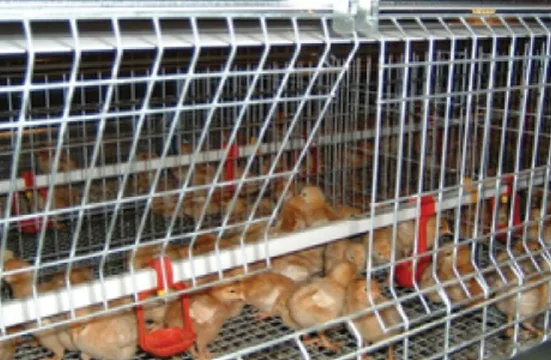
| Weeks 9 to 15 | Grower and developer | Cage space of about 60 sq in and feeder space of about 10 cm per bird; IB live at 80 days; check uniformity | BV300 guide; TNAU |
| Week 14 | Transfer (Vijay Raj rearing cages) | Vijay Raj rearing and chick cum grower cages are specified from day one to week 14, when pullets move to the layer cage | Vijay Raj product data |
| Weeks 15 to 17 | Pre-lay | Pre-lay feed, not before 15 weeks and not after the first egg; Newcastle LaSota and IB killed vaccine at about 112 days (16 weeks); finish any transfer before lay | Hy-Line W-80 guide; TNAU; BV300 guide |
| Weeks 17 to 18 | Light stimulation | Start stimulation at about 1,200 g body weight or 10% production, whichever comes first; add 1 hour, then 30 minutes a week up to 16 hours | BV300 guide |
| Week 20 | Onset of lay | 50% rate of lay | BV300 guide |
| Weeks 22 to 32 | Rise to peak | 90% lay by week 22 and a peak of 98% around weeks 29 to 32; egg weight about 50 g at 22 weeks and 55 g at 26 weeks | BV300 guide |
| Week 40 | Lay | Newcastle LaSota and IB killed boosters at about 280 days | TNAU |
| Week 72 | Late lay | About 88% hen-day production; 340 hen-housed eggs to date; cumulative depletion about 4.8% | BV300 guide |
| Week 80 | Late lay | About 85% hen-day production; 386 hen-housed eggs to date; cumulative depletion about 6% | BV300 guide |
| Depletion | Sale and clean-out | Sell spent hens, preferably to a licensed slaughter house or registered trader; clean, disinfect and rest the house for at least two weeks | PCA (Egg Laying Hens) Rules 2023, Rule 13; BV300 guide |
Two things stand out from this table. First, almost every major event happens before the first egg. Rearing is where you build the hen, and a farm that saves money on brooding usually pays for it later in lower peak and poor persistency. Second, when to deplete is a commercial decision, not a biological one. Modern strains can lay well past 80 weeks; you keep them while the value of the eggs covers feed and overheads, and you sell once it no longer does.
Cage, Deep Litter or Cage-Free
This is one of the biggest decisions you will make, because it fixes the size and type of your house for the life of the farm. Here is a practical summary. For the full engineering comparison of cage types, read our guide to poultry cage systems and how to choose one.
Cages
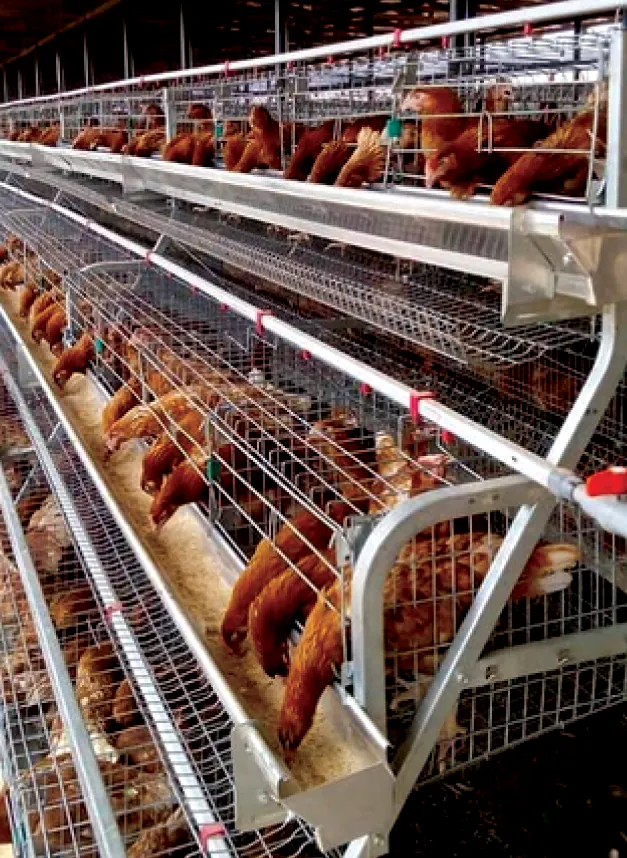
Cage housing is the norm for commercial layers in India. Eggs roll out of the cage away from the hens, so they stay cleaner; birds are separated from their droppings, which helps disease control; and one worker can look after far more birds. The BV300 guide notes that its layers can be raised successfully either on the floor or in cages, but a cage house holds more birds on the same land and makes feeding, drinking and egg collection easy to mechanise.
The law now sets a minimum for cages, which it calls “conventional colony enclosures” and defines to include battery cages and California cages. See the next section for what that means for your box sizes.
Deep Litter
On deep litter, hens run loose on a bedding of rice husk or similar material in an open house. The capital cost of equipment is lower, but you need much more floor area, eggs are laid in nests or on the floor and need hand collection, and the birds are in contact with their droppings. Deep litter is still used for small farms and for rearing in some areas, but few new commercial egg farms are designed around it.
Cage-Free
Cage-free systems (barns and aviaries with nests, perches and litter) are growing abroad and some large buyers ask for them. India does not have a separate legal standard for cage-free eggs at present, so the premium depends on the buyer you sign with. If you are considering cage-free, get a written offtake agreement first, because the house, equipment and labour cost per egg are all higher.
| Point | Cages | Deep litter | Cage-free (barn or aviary) |
|---|---|---|---|
| Birds per sq ft of house | Highest, rising with tiers | Lowest | Medium, depends on tiers |
| Egg cleanliness | Best: eggs roll away from birds | More floor and dirty eggs | Depends on nest management |
| Labour per 1,000 birds | Lowest, especially when automated | Highest | High |
| Disease contact with droppings | Low | High | Medium to high |
| Equipment cost | Higher | Lower | Higher |
| Legal space rule | 550 sq cm per bird minimum (2023 Rules) | Not covered by Rule 8, which addresses colony enclosures | No separate Indian standard yet |
The 2023 Egg Laying Hen Rules and Your Space Norms
The Ministry of Fisheries, Animal Husbandry and Dairying notified the Prevention of Cruelty to Animals (Egg Laying Hens) Rules, 2023 as G.S.R. 139(E) on 27 February 2023, under the Prevention of Cruelty to Animals Act, 1960. They came into force on the date of publication. If you are building a new cage farm, they apply to you from day one. Here is what they require, rule by rule.
Who the Rules Cover
- Rule 4: the rules apply to farms where egg laying hens are housed in colony enclosures.
- Rule 3: “conventional colony enclosures” means the same thing as what the industry called battery cages or California cages, whatever name they go by.
- Rule 3: the “Registering Authority” is the Animal Husbandry Department of the state or union territory where the farm is located.
Space Allowance (Rule 8)
All new farms, and any replacement of old cages, must meet two conditions. The floor space per bird must not be less than 550 square centimetres. And each enclosure should preferably hold a minimum of six to eight birds, so that hens have room to lie down, stand up, flap their wings, turn around and reach feed and water.
Most Indian cage suppliers quote box sizes in inches, so here is the conversion you need. 550 sq cm is 85.25 sq in, or about 0.59 sq ft per hen.
- Multiply the box front by the box depth, in inches, to get the box floor area in sq in.
- Divide that area by 85.25. Round down. The result is the maximum number of hens the box can legally hold.
- Check the result against the “preferably six to eight birds” guidance. A box that can hold only three or four birds at 550 sq cm meets the space rule but not the preferred group size.
For example, a box 24 in wide and 24 in deep has 576 sq in of floor. 576 divided by 85.25 is 6.76, so it can hold six hens. A box 20 in by 18 in has 360 sq in and can hold four.
Tip: Put “minimum 550 sq cm floor space per bird as per Rule 8 of the PCA (Egg Laying Hens) Rules, 2023” in writing in your equipment enquiry and in the purchase order. Box sizes for Vijay Raj California and Comfort+ systems are customised to each project, so ask for the box size and birds per box to be shown on the layout drawing and check it with the three steps above.
Registration (Rule 5)
- Farms above a size set by your state’s Registering Authority must register with the state Animal Husbandry Department.
- The application must include the farm layout, the biosecurity arrangement prescribed by the Department of Animal Husbandry and Dairying, and other information required under the rules.
- The registration certificate is valid for five years. Apply to renew it within three months of expiry.
- Farms operating before the rules began had three months to register.
- Display the certificate in a conspicuous place at the farm.
Records, Feed and Veterinary Care (Rules 9 to 11)
- Records: keep the total floor area available to hens, the space allowance, the maximum number of birds in each house, the number of birds present, daily mortality and the number culled. These must be available for inspection.
- Prohibited: feeding hens the remains of dead chicks, using antimicrobial growth promoters, and withdrawing feed to induce a moult. Antimicrobials may be used only to treat disease, under a veterinarian’s supervision.
- Veterinary care: deploy adequate manpower including a registered veterinarian, and display the vet’s emergency contact details at the farm.
Inspection, Penalties and Deadlines (Rules 7, 13 to 18)
- The state Animal Husbandry Department, the Animal Welfare Board, the State Board or the District SPCA may authorise officials to inspect farms. Inspectors must follow biosecurity protocols and may not visit more than one farm within 72 hours.
- Spent hens should be sold preferably to licensed slaughter houses or registered traders.
- Registration can be cancelled after a show cause notice with 30 days to reply. You can appeal within one month.
- Violations are punishable with a fine under the 1960 Act. For a company, the person in charge is deemed guilty.
- States had to notify their administrative provisions by 31 July 2023. Existing farms must adopt the new welfare norms by 1 January 2029.
The practical message for a new farm is simple: size every cage box to 550 sq cm per hen or more, keep the records from the first day, and budget for a registered vet. It is far cheaper to build a compliant house than to rebuild one before 2029.
Site Selection and Farm Layout
A good site saves money every day for twenty years. A poor one costs you in disease, transport and water every day for the same period.
Distance and Isolation
The NABARD Unit Cost 2023-24 booklet (Jharkhand Regional Office) sets a condition for bank-financed poultry farms: new farms may be one kilometre away from existing farms or poultry complexes. The BV300 guide adds a checklist for site and layout:
- A considerable distance from other poultry operations and villages.
- Good road access, ample high-quality water, good air movement and reliable electricity.
- Rearing facilities isolated from laying facilities, run all in, all out.
- As few age groups on the laying site as possible.
- A secure perimeter fence with a single entry point for people and vehicles, and the residential area kept separate.
- A vehicle wash and changing room at the main gate.
- At least 100 ft between sheds.
Shed Orientation and Design for Open Houses
For open-sided houses the BV300 guide recommends an east-west orientation to reduce direct sun, a 4 to 5 ft roof overhang, a 2 ft rat-proof platform on all sides, chain link mesh on both sides, an open ridge for hot air to escape and sparrow-proofing at the eaves and ridge. Build so the house can be cleaned and disinfected thoroughly between flocks.
Plan for Growth
Most farms that succeed add houses later. Leave room on the plot for the second and third house, a feed store, an egg room, a manure yard and a dead bird pit or incinerator away from the sheds. The Vijay Raj poultry house calculator has a plot mode that applies a boundary setback and a gap between sheds, so you can see how many houses fit on your land before you buy it.
Open House or Environment-Controlled House
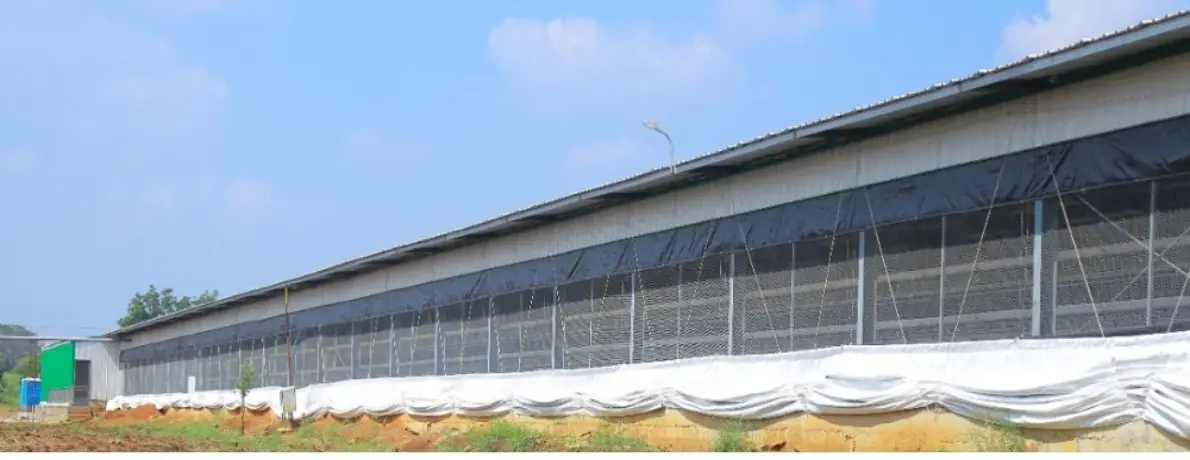
An open house has curtain sides and relies on natural ventilation, helped by fans and foggers in hot weather. An environment-controlled (EC) house is closed and insulated, with tunnel ventilation fans at one end and evaporative cooling pads at the other, so you control temperature and air speed regardless of the weather outside.
| Point | Open house | EC house |
|---|---|---|
| Building cost | Lower | Higher: insulation, fans, pads, controls |
| Power dependence | Low | High: needs a reliable generator backup |
| Birds per house | Limited by natural airflow; Vijay Raj’s brochure puts the open house limit for layers at about 33,000 birds | Much larger flocks, taller cage stacks |
| Summer performance | Falls in heat waves | Stable, if the ventilation is designed right |
| Lighting control | Natural daylength plus artificial light | Full control of light hours and intensity |
| Typical cage system | California or Comfort+ stepped cages, 2 or 3 tiers | Automax H-frame battery cages, 4 to 12 tiers |
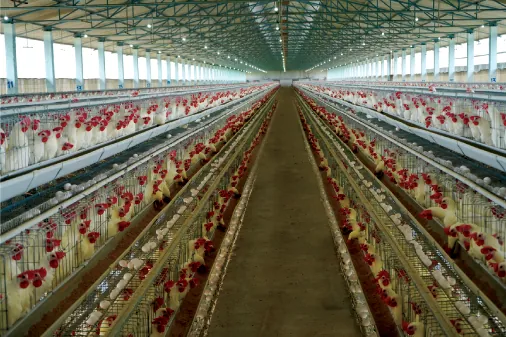
For a 10,000-bird first farm in most of peninsular India, a well-oriented open house with stepped cages is the usual starting point. EC houses make sense when land is expensive, when you plan a large flock in one building, or when summer heat regularly pulls your production down. If you are not sure, model both in the calculator and compare the land and building each needs.
Both house types can be built as a pre-engineered steel shed. Vijay Raj supplies open and closed PEB poultry houses in several frame types, from clear span frames up to about 30 m wide to multi-span frames for very wide buildings. Our guide to PEB poultry shed frame types and spans explains the options.
Choosing California, Comfort+ or Automax
Vijay Raj makes three layer cage families, each with matching pullet cages. The facts below come from Vijay Raj’s own product data. Use them to shortlist, then ask for a layout for your site.
California Cages
California cages are Vijay Raj’s most economical layer system, designed for open houses in tropical and subtropical regions. The stepped structure leaves open space above each tier for ventilation, and the system needs no automatic manure remover. Frames are tubular galvanised steel, and cage wire is 275 GSM galvanised or Bezinal wire.
- 2 or 3 tiers, with box sizes customised to each project.
- Feed by manual or automatic trolley with feed regulation.
- Egg collection manual, or automatic on request.
- Manure removal and drying options, from semi-automatic up to fully automatic.
- Matching California rearing cages and chick cum grower cages for day one to week 14.
Comfort+ Cages
Comfort+ cages are built for hot and humid open houses. Vijay Raj introduced the Comfort cage in 2001, and Comfort+ keeps its stepped design on a rigid tubular GI frame with 275 GSM galvanised or Bezinal wire. Box specifications are set for each project, the egg roll angle is engineered for zero breakage, and the troughs double as a step to reach the top tier.
- 2 or 3 tiers.
- Free air circulation through the house and between tiers keeps ammonia very low.
- Manual or automatic egg collection and feed distribution; can be fully automated.
- Matching Comfort+ rearing cages for day one to week 14, with a drinking line that lifts as birds grow.
Automax H-Frame Battery Cages
Automax is Vijay Raj’s vertical H-frame system for high-density, automated egg production, recommended for EC houses. It stacks from 4 to 12 tiers, with 10 and 12 tiers built as two stacked decks. The frame is a profile in specially graded, corrosion-resistant alloy steel.
- Wide ventilation gap between tiers to keep manure dry and ammonia low.
- Egg roll slope calculated for zero breakage, with automatic egg belts.
- Automatic feeding, drinking, egg and manure handling.
- Overall height from the Vijay Raj drawing: 279 cm at 4 tiers, 393 cm at 6 tiers, 507 cm at 8 tiers (single deck) and 828 cm at 12 tiers (two decks).
- Matching Automax pullet rearing battery for day old to week 14, in 3 to 8 tiers, with front gratings adjustable from the battery head and belt cleaning.
| Question | California | Comfort+ | Automax |
|---|---|---|---|
| House type | Open-sided | Open-sided | EC house recommended |
| Climate fit | Tropical and subtropical | Hot and humid | Any, with EC ventilation |
| Tiers | 2 or 3 | 2 or 3 | 4 to 12 |
| Frame | Tubular GI | Tubular GI | Graded alloy steel profile |
| Manure | Falls below, no automatic remover needed; removal and drying options | Removal and drying options | Manure belts per tier |
| Automation | Manual up to fully automatic | Manual up to fully automatic | Fully automatic |
| Product pages | California layer cage | Comfort+ layer cage | Automax layer cage |
A simple rule of thumb: if you are building an open house and want the lowest cost per bird, start with California. If your site is very hot and humid, look closely at Comfort+. If land is scarce, the flock is large, or you want the least labour per bird, plan an EC house with Automax.
Sizing a 10,000-Bird Layer House
Here is how to turn a flock size into a house size, using the layout figures in the Vijay Raj poultry house calculator and the 550 sq cm legal minimum. Several calculator figures are planning guidelines that Vijay Raj is still confirming, so treat the results as a first sketch, not a drawing.
The Method
- Birds per metre of cage row. For each tier, on each side of the row, one metre of cage gives 100 cm times the box depth in floor area. Divide by 550 to get hens per metre. Multiply by the number of tiers and by 2 (both sides of the row).
- Total row length. Divide your flock size by the hens per metre of row.
- Rows and house length. Split the row length into as many rows as fit your plot width. Add the front service area (4 m in the calculator, for egg collection, feed hoppers and controls) and the rear area (2 m, for manure exit and fans).
- House width. Add the row widths plus a walkway between rows and at each side wall (1 m in the calculator; it warns below 0.9 m).
- Clear height. Take the cage stack height and add 1.2 m of clear space above the top tier.
Worked Example a: Stepped Cages, Open House
Comfort+ layer boxes in the Vijay Raj brochure are 15 in (38.1 cm) deep. One metre of one tier on one side therefore gives 3,810 sq cm, or 6.93 hens at 550 sq cm each. With 3 tiers on both sides, one metre of row holds about 41.6 hens.
- Row length for 10,000 hens: 10,000 divided by 41.6 is about 241 m.
- Layout: 3 rows of about 81 m each.
- House width: 3 rows at 2 m plus 4 walkways at 1 m gives 10 m (about 33 ft).
- House length: 81 m plus 4 m front plus 2 m rear gives 87 m (about 285 ft).
- Floor area: about 870 sq m, or 9,365 sq ft, which is roughly 0.94 sq ft per hen.
- Stack height: the calculator uses 90 cm plus 45 cm per tier, so 225 cm for 3 tiers. Add 1.2 m clearance and you need about 3.45 m clear under the roof at the cage line.
Worked Example B: Automax, EC House
The calculator’s planning guideline for an Automax battery box is 24 in (61 cm) deep. One metre of one tier on one side gives about 6,096 sq cm, or 11.08 hens. With 6 tiers on both sides, one metre of row holds about 133 hens.
- Row length for 10,000 hens: about 75 m.
- Layout: 2 rows of 38 m each.
- House width: 2 rows at 1.6 m plus 3 walkways at 1 m gives about 6.2 m.
- House length: 38 m plus 4 m front plus 2 m rear gives 44 m.
- Floor area: about 273 sq m, or 2,936 sq ft, roughly 0.29 sq ft per hen.
- Height: 393 cm for 6 tiers (Vijay Raj drawing) plus 1.2 m gives about 5.1 m clear.
The comparison shows why tall battery cages exist: example B needs about a third of the floor area of example A for the same flock. You pay for that in a stronger, taller, closed building, full automation and dependable power.
Ventilation Check
For summer tunnel ventilation the calculator uses 5 CFM per layer as a planning figure, and Vijay Raj rates its 57 in cone fan at about 55,000 CFM. The fan count is birds times CFM per bird, divided by the fan’s airflow. For 10,000 hens that is 50,000 CFM of total airflow before any design margin; the calculator then sizes the cooling pad area from the total airflow and the air speed through the pads. Your designer will adjust these for your climate.
Tip: When you use the poultry house calculator, check the birds-per-box setting it applies against 550 sq cm per bird (85.25 sq in) before you rely on the flock size it gives. Adjust the box or the birds per box until it passes.
Equipment by Stage
Here is what a caged layer farm needs, stage by stage. For a full checklist across all poultry types, see the poultry farming equipment list.
Brooding and Rearing (Day One to Week 14 to 18)
- Chick and grower cages. The BV300 guide recommends at least 40 sq in per bird in cages from 0 to 8 weeks and 60 sq in from 9 to 15 weeks, with feeder space of 5 to 6 cm and then 10 cm per bird. Choose from Vijay Raj’s Comfort+, California or Automax rearing systems.
- Heat. Chicks cannot regulate their body temperature well until about two weeks old. The Vijay Raj electric brooder warms 1,000 day-old chicks over about 200 sq ft at 2 kW with an automatic cut-off; infrared gas brooders are an alternative where gas is cheaper than power.
- Chick drinkers. Low-pressure chick nipples (Vijay Raj VRND-C1 and VRND-C2) suit day-old chicks, and the drinking line in Vijay Raj rearing cages lifts as birds grow.
- Beak treatment. A precision trimmer such as the Vijay Raj de-beaker, used by a trained operator at 7 to 10 days.
- Vaccination tools. Eye-drop bottles, syringes and a vaccinator, plus a cold chain at 2 to 8 C for vaccines, as the BV300 guide advises.
Laying House
- Layer cages. California, Comfort+ or Automax, sized to 550 sq cm per hen or more.
- Feeding. A manual or automatic feed trolley running along each row. The calculator’s bill of quantities puts one trough run per tier per side, and one trolley with its control panel per row.
- Drinking. Nipple drinking lines with layer nipples: VRND-L1 (single lock, 180 degree) or VRND-L2 (twin lock, 360 degree). The calculator allows one nipple per cage box, one drinking line and pressure regulator per tier per side, and one water filter set per house. Hy-Line’s guide recommends one nipple per 12 birds in conventional and colony cages. Our guide to choosing poultry nipple drinkers covers flow rates and leak prevention.
- Egg collection. Manual collection from the egg roll-out, or an automatic egg collection system with one belt per tier per side and one collection unit per row.
- Manure handling. In stepped cages, manure falls below the rows and is removed between or during flocks. In Automax houses, manure belts run under every tier with one drive per row and a cross conveyor per house.
- Lighting. Timers or time switches and enough lamps for even light at bird level. The BV300 guide asks for 10 to 20 lux in growing and laying houses.
- Cooling and ventilation. Fans and foggers or sprinklers in open houses; exhaust fans with evaporative pads in EC houses. See our guide to cooling a poultry house.
Egg Room and Farm Yard
- Egg trays. Rigid, washable trays such as Vijay Raj plastic egg trays for collection, grading and dispatch.
- Feed store or silos, a water tank and borewell, a generator, a dead bird pit or incinerator and a manure yard away from the sheds.
- Bird transport crates for shifting pullets and selling spent hens.
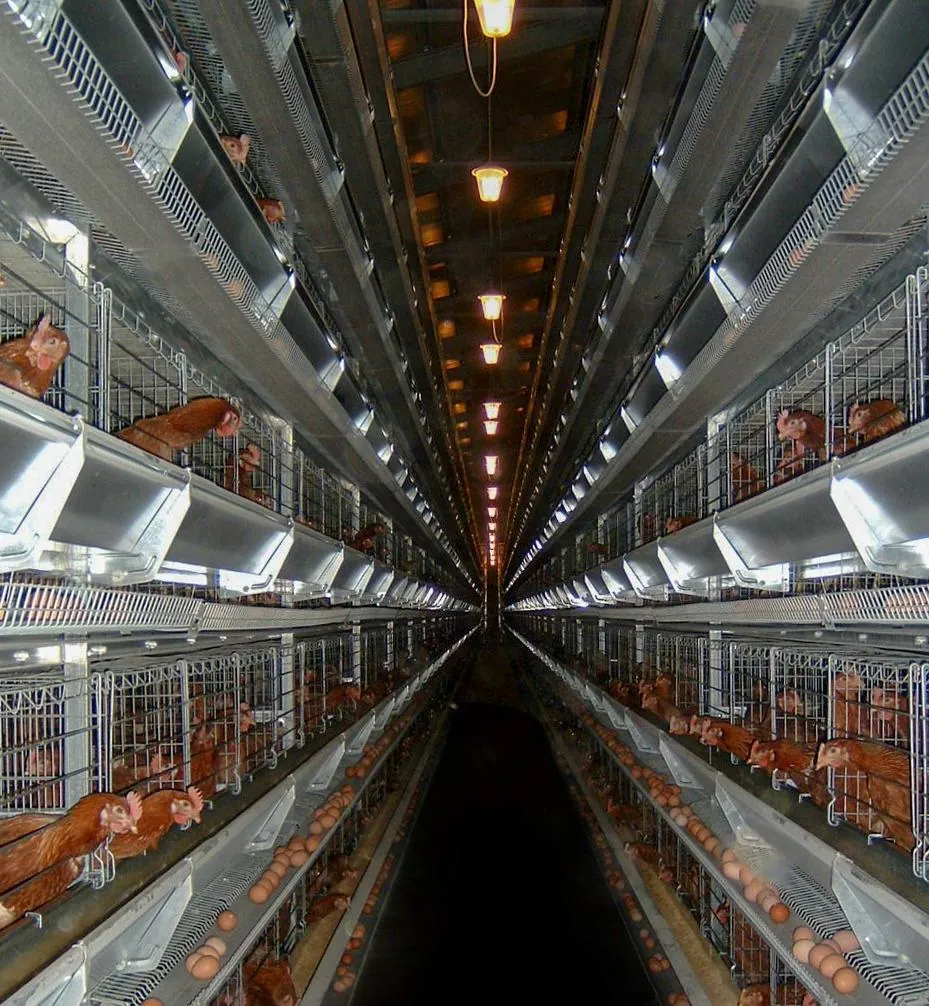
If you would rather hand over the whole package, from house structure to egg collection, a turnkey layer farm puts planning, supply and installation with one partner. Our guide to what a turnkey poultry farm project includes lists what to expect in the scope.
Lighting Programme Basics
Light controls when a pullet comes into lay and how long a hen keeps laying. The BV300 guide gives two rules that apply to every strain:
- Do not increase the hours of light during rearing.
- Do not decrease the hours of light during lay.
The one exception is a short midnight light, covered below.
Rearing (Open House, BV300 Guide)
| Age | Hours of light |
|---|---|
| Days 0 to 3 | 24 hours |
| Days 4 to 7 | 22 to 23 hours |
| Weeks 2 to 7 | 20 hours, with a 4-hour dark period (the guide suggests 7:30 pm to 11:30 pm) |
| Week 8 to stimulation | Natural daylength, no artificial light |
Stimulation and Lay
Start light stimulation when birds reach about 1,200 g or 10% production, whichever comes first. Add 1 hour in the first week (you can split it into two steps a few days apart), then 30 minutes a week until you reach 16 hours in total. Split the artificial light between morning and evening: the guide’s example switches lights on at 4 am until sunrise, and again from sunset to 8 pm.
The Hy-Line W-80 guide uses the same logic with its own targets: stimulate at ideal body weight and 85% uniformity (1,180 g for early egg numbers, 1,230 g for larger eggs) and increase light gradually up to 25 weeks. If you rear a Hy-Line flock, follow the Hy-Line programme.
Midnight Light
The BV300 guide allows up to two hours of light around midnight to lift feed intake in hot weather, with at least three hours of dark before and after, and feed and water available during that time. Withdraw it gradually, by 15 minutes a week, when you no longer need it.
Feed and Water
Feed is where a layer farm makes or loses its money. The BV300 guide puts feed at 79% of production cost during the laying period, and Poultry Federation of India joint secretary Ricky Thaper, writing in Rural Voice on 12 September 2026, puts feed at 65 to 70% of total cost.
Feed Phases
Layers eat a sequence of diets, changed by body weight and age rather than calendar alone. The BV300 guide uses chick, grower, developer and pre-lay feeds in rearing, then four laying phases. Hy-Line advises not feeding pre-lay earlier than 15 weeks, or later than the first egg, because pre-lay contains too little calcium for egg production.
How Much Feed
- Rearing: about 5.6 kg per bird to 18 weeks (BV300) or 5.41 kg to 17 weeks (Hy-Line W-80).
- Lay: about 110 to 114 g per bird per day once in full production (BV300), or 104.8 to 108.4 g on average from 19 to 100 weeks (Hy-Line W-80).
- Per egg: BV300’s cumulative feed per egg is 119 g at 72 weeks and 121 g at 80 weeks.
For a 10,000-hen house at 110 to 114 g per bird per day, plan for 1.1 to 1.14 tonnes of layer feed every day. Size your feed store and your working capital for at least a few weeks of that.
What Feed Costs Now
Feed prices have been volatile in 2026. The Rural Voice article reports layer feed at about Rs 24,000 per tonne in April 2026 rising to Rs 30,000 to Rs 32,000 per tonne by August 2026, driven by maize (Rs 21,000 to about Rs 26,500 to 27,000 per tonne) and de-oiled rice bran (Rs 14,000 to Rs 22,000 per tonne). A swing of this size moves your cost per egg by more than a rupee, as the economics section below shows.
The BV300 guide includes a ready reckoner for feed cost per egg. The formula behind it is simple:
Feed cost per egg = feed per bird per day (kg) x feed price (Rs per kg) / hen-day production
For example, 0.110 kg x Rs 31 / 0.95 = about Rs 3.59 per egg.
Water
According to the BV300 guide, birds normally drink 1.8 to 2 times as much water as feed, and more during heat stress. At 110 g of feed a day, that is roughly 200 to 220 ml of water per hen, or 2,000 to 2,200 litres a day for 10,000 hens before summer increases. The guide also recommends water meters, because a fall in water intake is often the first sign of illness.
Test your borewell before you build. The BV300 guide’s drinking water targets include a pH of 6.5 to 7.5, total dissolved solids below 1,000 ppm, total hardness of 60 to 180 ppm, zero total coliforms and nitrates below 25 mg per litre. Hard or salty water clogs nipple drinkers and hurts shell quality, and treating it is far cheaper before the pipes go in.
Vaccination and Biosecurity
The timeline table above shows a typical schedule from the TNAU Agritech portal. It covers Marek’s disease, Newcastle disease (Ranikhet), infectious bursal disease (Gumboro) and infectious bronchitis. Your vet will add or change vaccines based on what is circulating in your district, and the BV300 guide recommends having the schedule reviewed by a poultry disease laboratory or an expert veterinarian.
Vaccination Practice That Makes Vaccines Work
From the BV300 guide:
- Keep vaccines at 2 to 8 C, never freeze inactivated vaccines, and keep them out of direct sunlight.
- Vaccinate only healthy, unstressed flocks, and vaccinate early in the morning in summer.
- Do not use water sanitisers on the day of water vaccination, and calculate the water so birds drink the vaccine within two hours.
- Record the batch number, manufacturing and expiry dates of every vaccine used.
- Run regular blood tests in rearing and lay to confirm the flock actually has immunity.
NABARD’s unit cost conditions for bank finance also expect a regular vaccination schedule prescribed by a vet, a health check by a competent veterinarian preferably at least once a month, periodic de-beaking and deworming, and chicks from a reputed hatchery with prophylactic vaccinations.
Biosecurity Basics
- Restrict entry to essential staff, log every visitor, and bar anyone who has been on another poultry farm in the last 48 hours (BV300 guide).
- Run each house all in, all out, and keep rearing and laying sites apart.
- After cleaning and terminal disinfection, rest the house for at least two weeks before the next flock.
- Keep manure dry (around 30% moisture) and remove it at least weekly from under stepped cages, or two to three times a week from manure belts, to break the fly cycle.
- Dispose of dead birds in a pit or incinerator away from the sheds, never in the feed room.
- Control rodents and wild birds with chain link mesh, sparrow-proofing and bait stations.
Leaking nipples wet the manure, which breeds flies and raises ammonia. Walk every drinking line once a week and fix leaks the same day. It is one of the cheapest ways to protect bird health and egg quality.
Egg Handling, Grading and Storage
An egg’s value is set in the few hours after it is laid. Cracks, dirt and heat all cut its price.
Collection
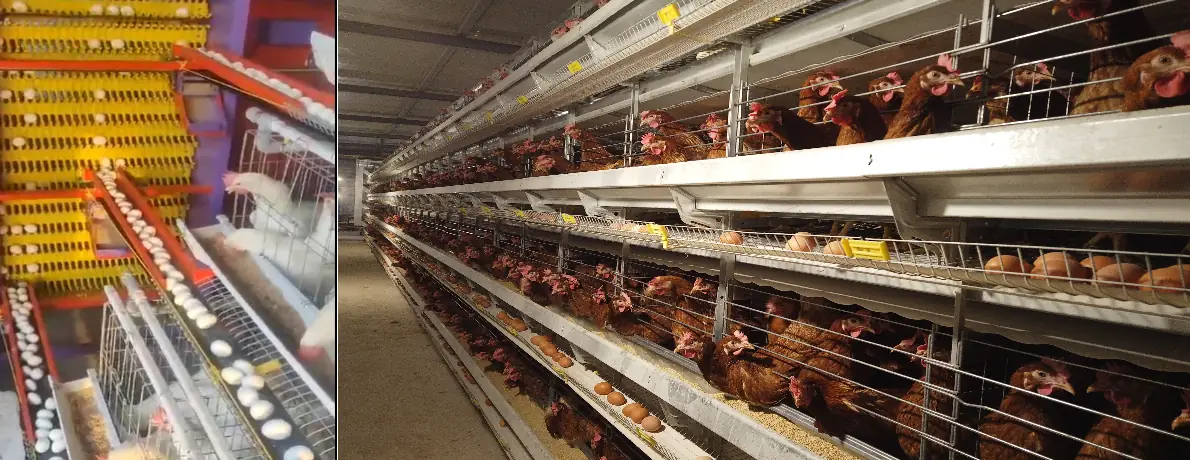
In a cage house, eggs roll forward out of the cage onto the egg tray or belt. Vijay Raj engineers the egg roll angle on its California, Comfort+ and Automax cages for zero breakage. Collect at fixed times at least twice a day, and more often in hot weather, so eggs spend less time in the warm house.
An automatic egg collection belt, like the Vijay Raj egg collection system for California houses, reduces handling and the cracks that come with it. On manual farms, use clean, rigid trays and never stack loose eggs.
Grading
Grade eggs by weight and by visible quality: clean, sound shells go to the main market, and dirty or cracked eggs are separated. India has AGMARK grading rules for table eggs under the Agricultural Produce (Grading and Marking) Act, which some institutional buyers ask for. Egg size rises through the cycle: in the BV300 standard, average egg weight moves from about 50 g at 22 weeks to 55 g at 26 weeks and about 59 g at 72 weeks. Plan your grading equipment and buyer mix around that shift.
Storage
Store eggs in a shaded, well-ventilated egg room away from the sheds, the manure yard and anything with a strong smell. Heat is the main enemy, so move eggs out quickly and keep the room as cool as your budget allows. Stack trays so air can move between them, and sell on a first in, first out basis.
Labour and Daily Routine
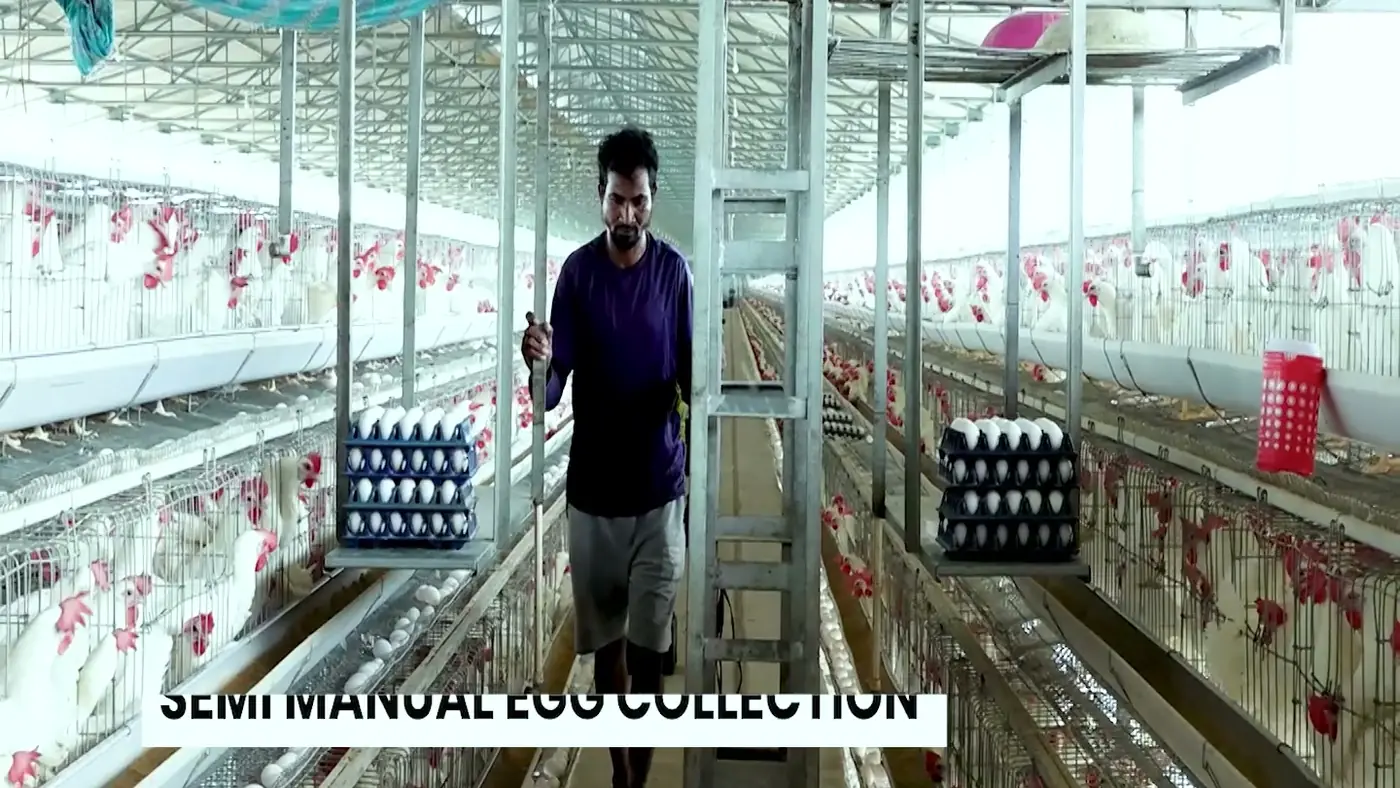
Labour needs depend heavily on automation. A fully manual stepped-cage house needs people to fill troughs, collect and tray eggs, and clean manure; an automated house needs fewer hands but more skilled ones who can run and maintain motors, trolleys and belts.
For budgeting, the NABARD 2023-24 unit cost uses Rs 12,000 per month for labour in its 5,000-bird cage layer model. Price your own labour by listing the daily tasks and the time each takes: feeding runs per row, egg collection rounds, water and nipple checks, mortality removal and records, manure work, and cleaning. Then add a supervisor and a vet visit. Remember that the 2023 rules require a registered veterinarian to be part of your manpower.
A typical day on a layer farm looks like this:
- Early morning: check lights, water pressure and feed levels; remove and record dead birds.
- Morning: first feed run and first egg collection; tray, grade and move eggs to the egg room.
- Midday: walk the house for sick birds, leaking nipples and cage problems; check fans or foggers in hot weather.
- Afternoon: second feed run and egg collection; record feed, water, eggs and mortality.
- Evening: check lighting timers, generator and security.
Capex for a 10,000-Bird Cage Layer Farm
The most useful public benchmark for capital cost is the NABARD Unit Cost 2023-24 booklet from the Jharkhand Regional Office. It gives a detailed cost break-up for a 5,000-bird commercial layer unit on a cage system (which NABARD labels 1+1+3), with a unit cost of Rs 32.1 lakh. The same booklet lists 1,000-bird and 2,000-bird units at Rs 6.42 lakh and Rs 12.84 lakh, which works out to the same Rs 642 per bird at every size.
The table below takes each NABARD line item and doubles it for 10,000 birds. Doubling is a simplification: some items (fencing, borewell, electrical) will not scale exactly, and every rate is a 2023-24 figure for one state. The right-hand column tells you what to check before you rely on each line.
| Item (NABARD basis) | 5,000 birds (NABARD 2023-24) | 10,000 birds (scaled x2) | 2026 check |
|---|---|---|---|
| Civil structure at 1 sq ft per bird, Rs 275 per sq ft | Rs 13,75,000 | Rs 27,50,000 | Get a current quote for your shed design; the sizing example above gives about 0.94 sq ft per hen for stepped cages |
| Feed store (100 sq ft per 5,000 birds) | Rs 27,500 | Rs 55,000 | Size for several weeks of feed at 1.1 tonnes a day |
| Fencing | Rs 12,000 | Rs 24,000 | Depends on your plot perimeter |
| Electrical installation at 3% of civil cost | Rs 41,250 | Rs 82,500 | Add a generator and lighting timers |
| Borewell, tank and pipes | Rs 90,000 | Rs 1,80,000 | Depends on water depth and quality |
| Cage and layer equipment at Rs 170 per bird | Rs 8,50,000 | Rs 17,00,000 | Varies widely with system, tiers and automation; get a quotation for your layout |
| Chicks (5% extra for mortality) at Rs 35 | Rs 1,83,750 | Rs 3,67,500 | Ask your hatchery for the current layer chick price |
| Feed at Rs 30 per kg, 3.2 kg per bird | Rs 4,80,000 | Rs 9,60,000 | Covers early rearing only; full rearing to 18 weeks needs about 5.6 kg per bird |
| Insurance at 6% of bird cost | Rs 11,025 | Rs 22,050 | Ask your insurer |
| Vaccines and medicine at Rs 25 per bird | Rs 1,25,000 | Rs 2,50,000 | Set by your vet’s schedule |
| Labour at Rs 12,000 per month to first batch | Rs 15,000 | Rs 30,000 | Local wage rates |
| Total | Rs 32,10,525 | Rs 64,21,050 | About Rs 64 lakh on 2023-24 rates |
Two cautions. First, the NABARD model includes only 3.2 kg of feed per bird, far short of the 5.6 kg a BV300 pullet eats to 18 weeks, so it understates the working capital you need before eggs start. Second, the equipment line of Rs 170 per bird reflects a basic system. Automatic feed trolleys, egg belts, manure systems, EC fans and pads, and taller stacks all add to it, and they also reduce your labour and losses. Treat NABARD’s figure as the floor your bank will recognise, not as a quotation.
NABARD’s booklet gives a repayment period of 5 years for these poultry units and a gestation period of 6 months to 1 year. Your bank will set the actual terms.
Yearly Economics: A Worked Example
Capital cost gets a farm built. Running cost per egg decides whether it survives. This worked example shows the arithmetic for one laying cycle of 10,000 hens housed at the start of lay, kept to 72 weeks, using published performance standards and 2026 market prices. Change any input and redo the sums for your own farm.
Inputs and Where They Come from
- Eggs: 340 hen-housed eggs per hen to 72 weeks (BV300 guide), so 34 lakh eggs for 10,000 hens.
- Laying feed: cumulative 119 g per egg at 72 weeks (BV300 guide), so about 404.6 tonnes.
- Feed price: Rs 24 per kg (April 2026) and Rs 31 per kg (midpoint of the August 2026 range), from the Rural Voice article.
- Overheads: the BV300 guide estimates overheads at about one-fourth of feed cost per egg.
- Pullet cost: 10,500 chicks at Rs 35 and Rs 25 per bird for vaccines and medicine (NABARD 2023-24), plus 5.6 kg of rearing feed per bird (BV300) at the same feed price.
- Egg price: Rs 5.35 per egg, the NECC Hyderabad average for September 2026 (Rs 535 per 100 eggs); and Rs 6.50, the ex-farm price cited in the Rural Voice article.
Cost per Egg
| Cost line (10,000 hens, to 72 weeks) | Feed at Rs 24 per kg | Feed at Rs 31 per kg |
|---|---|---|
| Laying feed (404.6 tonnes) | Rs 97.1 lakh | Rs 125.4 lakh |
| Overheads (one-fourth of feed) | Rs 24.3 lakh | Rs 31.4 lakh |
| Pullets: chicks Rs 3.7 lakh, vaccines Rs 2.5 lakh, rearing feed | Rs 19.6 lakh | Rs 23.5 lakh |
| Total cost of the cycle | Rs 141.0 lakh | Rs 180.3 lakh |
| Feed cost per egg | Rs 2.86 | Rs 3.69 |
| Total cost per egg (break-even egg price) | Rs 4.15 | Rs 5.30 |
We show pullet cost as a separate line so you can see it. If the overhead figure you use already includes pullet depreciation, drop that line to avoid counting it twice.
Margin for the Cycle
| Scenario | Egg revenue (34 lakh eggs) | Total cost | Margin before depreciation and interest |
|---|---|---|---|
| Feed Rs 24, eggs Rs 5.35 | Rs 181.9 lakh | Rs 141.0 lakh | Rs 40.9 lakh |
| Feed Rs 31, eggs Rs 5.35 | Rs 181.9 lakh | Rs 180.3 lakh | Rs 1.6 lakh |
| Feed Rs 24, eggs Rs 6.50 | Rs 221.0 lakh | Rs 141.0 lakh | Rs 80.0 lakh |
| Feed Rs 31, eggs Rs 6.50 | Rs 221.0 lakh | Rs 180.3 lakh | Rs 40.7 lakh |
The margin excludes sales of spent hens and manure, which add income, and excludes loan interest and depreciation on the house and equipment, which you must pay from it. At 72 weeks the BV300 standard has about 4.8% cumulative depletion, so roughly 9,520 hens are left to sell. Multiply that by your local spent hen rate to add that income.
Turning a Cycle into a Year
A laying house is occupied from about week 19 to week 72, which is 54 weeks, plus at least two weeks of cleaning and rest. That is roughly 56 weeks per cycle, so one year is about 52 / 56, or 0.93, of a cycle. With a separate rearing house, the next flock is ready to move in as soon as the laying house is clean.
What the Numbers Tell You
- Feed price is the swing factor. A Rs 7 per kg rise in feed took Rs 1.15 off the margin on every egg in this example. Buying maize and soya well, or locking in a feed contract, matters more than almost any other decision.
- Egg price varies by region and season. In the same September 2026 NECC sheet, Hyderabad averaged Rs 535 per 100 eggs while Kolkata averaged Rs 637.50. Your location decides your price.
- Every egg per hen counts. Ten more eggs per hen across 10,000 hens is 1 lakh eggs, worth Rs 5.35 lakh at the Hyderabad rate. Good rearing, lighting and cooling pay for themselves in this line.
- Plan for thin months. At high feed and low egg prices the farm barely breaks even. Your working capital and loan structure must carry you through those months.
Tip: Rebuild this example in a spreadsheet with your own chick quote, feed quote, local egg rate and labour cost before you go to the bank. Banks look for exactly these assumptions, and a farmer who can explain his cost per egg gets a better hearing.
Finance and Subsidies
Most layer farms are financed with a mix of your own margin money, a bank term loan for the house and equipment, and working capital for chicks and feed until eggs start. NABARD’s unit costs are what many banks use to check a project’s cost, so it helps to present your project in the same line items as the table above.
Central and state schemes change often, and eligibility depends on your category, state and the size and type of project. We cover the current schemes, how subsidies are paid and what banks ask for in our guide to poultry farm subsidy and loans in India. Check it, and your district animal husbandry office, before you finalise your project report.
For the bank, prepare:
- A project report with capex, the flock plan, the per-egg cost and a cash flow for at least the loan period.
- Land documents and any local building permissions.
- Equipment and building quotations with layout drawings showing birds per box and space per bird.
- Your hatchery tie-up for chick supply and your marketing arrangement for eggs. NABARD’s conditions ask banks to confirm both.
- Your plan for registration under the 2023 egg laying hen rules.
Common Mistakes New Layer Farmers Make
- Buying cages before checking the law. A box that holds too many hens for 550 sq cm per bird is not compliant for a new farm. Check birds per box on the drawing.
- Underfunding working capital. Feed for rearing and the first weeks of lay costs lakhs before the first egg is sold. The NABARD model covers only part of it.
- Saving money on brooding. Cold, crowded or thirsty chicks never catch up. The first 14 to 18 weeks set the ceiling for the whole cycle.
- Ignoring body weight and uniformity. Weigh a sample every week in rearing. Light stimulation and feed changes follow body weight, not the calendar.
- Increasing light in rearing or cutting it in lay. Both upset the flock’s timing and cost eggs.
- Not testing water. Hard or contaminated water blocks nipples, spreads disease and hurts shells.
- Weak biosecurity. Letting traders, visitors and vehicles move freely between farms brings disease in.
- No market plan. Build buyer relationships before the first egg, and know your NECC zone and local trader rates.
- Undersizing the house for growth. Leave room on the plot for the next houses, the egg room and the manure yard.
- Skipping records. The 2023 rules require them, your bank will ask for them, and you cannot manage what you do not measure.
Launch Checklist
Work through this list in order. Each block depends on the one before it.
Plan
- Business model chosen: integrated, ready-to-lay pullets or contract.
- Strain chosen, with the breeder’s management guide in hand and a hatchery or pullet supplier confirmed.
- Egg buyers identified and local price history checked against NECC rates.
- Site checked for distance from other farms, water quality and quantity, power and road access.
Design
- House type (open or EC) and cage system (California, Comfort+ or Automax) chosen.
- Cage boxes checked at 550 sq cm per hen or more (85.25 sq in).
- House length, width and height worked out, and the plot layout drawn with room for future houses.
- Rearing house or rearing arrangement planned.
Fund and Register
- Project report with capex, per-egg cost and cash flow prepared.
- Bank loan and any subsidy application filed.
- Farm registration with the state Animal Husbandry Department planned under Rule 5.
- Registered veterinarian engaged and emergency contact ready to display.
Build and Equip
- House built, oriented and sealed against rodents and wild birds.
- Cages, feed trolleys, nipple lines, egg collection, lighting and cooling installed and tested.
- Borewell, tank, filters, generator, feed store, egg room, dead bird pit and manure yard ready.
Before the Chicks Arrive
- House and equipment cleaned and disinfected at least two weeks before placement.
- Brooding area preheated for 24 hours; water lines flushed and filled.
- Vaccination schedule agreed with your vet; vaccines and cold chain ready.
- Record sheets ready for floor area, birds housed, daily mortality, culls, feed, water and eggs.
If you want help turning your flock plan into a house layout and an equipment list, try the poultry house calculator first, then talk to a Vijay Raj engineer about a layout for your site. You can also see layer farm projects Vijay Raj has built.
Frequently Asked Questions
How much does it cost to start a 10,000-bird layer poultry farm in India?
NABARD's Unit Cost 2023-24 booklet (Jharkhand Regional Office) puts a 5,000-bird cage layer unit at Rs 32.1 lakh, or Rs 642 per bird. Scaled to 10,000 birds that is about Rs 64 lakh on 2023-24 rates. It covers only part of the rearing feed and a basic cage system, so get current quotations for your shed, cages, chicks and feed before you apply for a loan.
How much space does a laying hen need in a cage in India?
Rule 8 of the Prevention of Cruelty to Animals (Egg Laying Hens) Rules, 2023 says floor space per bird must not be less than 550 sq cm for all new farms and cage replacements, with preferably six to eight birds per enclosure. That is 85.25 sq in per hen. Multiply box front by depth in inches, divide by 85.25 and round down to get the maximum hens per box.
At what age do layer hens start laying eggs?
Modern commercial strains start laying at around 18 to 20 weeks. The BV300 Nutrition and Management Guide 2023 gives 50% rate of lay at 20 weeks and 90% at 22 weeks, with a peak of 98%. The Hy-Line W-80 guide gives 50% production at 142 days from hatch. Timing depends on body weight, lighting and management during rearing.
How many eggs does a layer hen lay in one cycle?
Under good management the BV300 standard is 340 hen-housed eggs to 72 weeks and 386 to 80 weeks. The Hy-Line W-80 standard is 251.9 to 262.2 hen-housed eggs to 60 weeks. Real flocks often fall short of these standards, so plan your economics with a margin and track production weekly against the breeder's table.
Do I need a licence or registration to start a layer farm?
Under Rule 5 of the 2023 egg laying hen rules, farms above a size set by your state must register with the state Animal Husbandry Department. The application includes the farm layout and biosecurity plan. The certificate is valid for five years and must be displayed at the farm. Check local building, pollution and panchayat permissions separately with your district offices.
What is the cost of producing one egg in India?
It depends mostly on feed price. Using BV300 feed per egg, a feed price of Rs 24 to Rs 31 per kg reported for 2026, overheads at one-fourth of feed cost and pullet costs, a 10,000-hen cycle to 72 weeks works out to about Rs 4.15 to Rs 5.30 per egg. Redo the sum with your own feed and chick quotes.
Which cage system is best for a layer farm in India?
For open-sided houses in hot climates, stepped California or Comfort+ cages in 2 or 3 tiers are the usual choice and cost the least per bird. For large flocks or scarce land, tall H-frame battery cages such as Automax (4 to 12 tiers) in an environment-controlled house hold far more birds per square metre, with full automation.
How long does a layer farm take to become profitable?
The first eggs come about 20 weeks after chick placement, and the flock reaches peak around weeks 29 to 32. Profit then depends on the gap between your egg price and your cost per egg, which swings with feed prices. NABARD's unit cost booklet uses a 5-year repayment period for layer units, which gives a sense of the payback banks expect.
Sources
- Ministry of Fisheries, Animal Husbandry and Dairying: Prevention of Cruelty to Animals (Egg Laying Hens) Rules, 2023, G.S.R. 139(E) (2023)
- PIB / Department of Animal Husbandry and Dairying: Release of Basic Animal Husbandry Statistics 2025 (2025)
- NABARD Jharkhand Regional Office: Unit Cost 2023-24 (2023)
- VH Group: BV300 Nutrition and Management Guide (2023)
- Hy-Line International: W-80 Commercial Layers Performance Standards Guide, Conventional Systems (2026)
- Srinivasa Farms: Layer breeders, Srinivasa Hy-Line W-80 and Hy-Line Brown (2026)
- TNAU Agritech Portal: Poultry disease control and management, vaccination schedules
- National Egg Co-ordination Committee: Daily egg prices suggested by NECC, September 2026 (2026)
- Rural Voice: Poultry feed costs rise 25 percent, put India's poultry and egg sector under pressure, Ricky Thaper (2026)